Review
. 2018 Dec 7:13:275-290.
doi: 10.1016/j.omtn.2018.09.008. Epub 2018 Sep 13.

Potential Role of miRNAs as Theranostic Biomarkers of Epilepsy

Affiliations
Review

Potential Role of miRNAs as Theranostic Biomarkers of Epilepsy

Claudia Cava et al. Mol Ther Nucleic Acids. .

Abstract

Epilepsy includes a group of disorders of the brain characterized by an enduring predisposition to generate epileptic seizures. Although familial epilepsy has a genetic component and heritability, the etiology of the majority of non-familial epilepsies has no known associated genetic mutations. In epilepsy, recent epigenetic profiles have highlighted a possible role of microRNAs in its pathophysiology. In particular, molecular profiling identifies a significant number of microRNAs (miRNAs) altered in epileptic hippocampus of both animal models and human tissues. In this review, analyzing molecular profiles of different animal models of epilepsy, we identified a group of 20 miRNAs commonly altered in different epilepsy-animal models. As emerging evidences highlighted the poor overlap between signatures of animal model tissues and human samples, we focused our analysis on miRNAs, circulating in human biofluids, with a principal role in epilepsy hallmarks, and we identified a group of 8 diagnostic circulating miRNAs. We discussed the functional role of these 8 miRNAs in the epilepsy hallmarks. A few of them have also been proposed as therapeutic molecules for epilepsy treatment, revealing a great potential for miRNAs as theranostic molecules in epilepsy.

Keywords: biomarker; diagnosis; epilepsy; miRNA; microRNA; theranostic molecules.


Figures

None
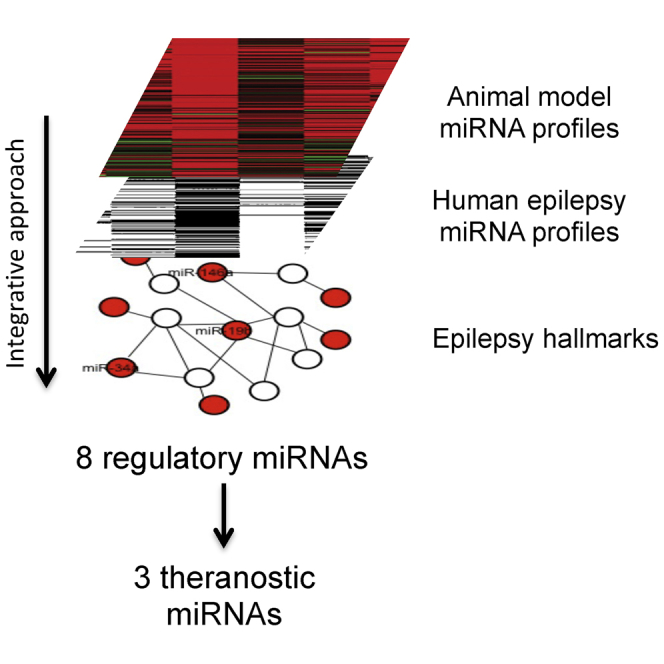
Graphical abstract
Figure 1
Figure 1
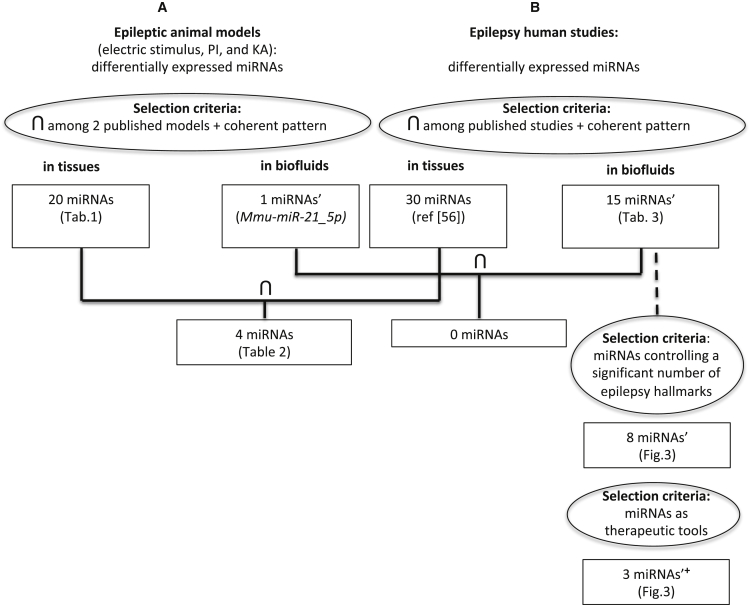
Flowchart Flowchart representing the logic flux of the analysis for the identification of animal-derived (A) and human (B) miRNAs with a main role in epilepsy. The selection criteria in the (A) and (B) approaches are indicated in the ovals. The horseshoe symbol indicates selecting miRNAs in common among. Coherent pattern means selecting an miRNA only if the miRNA has constantly been found with an upregulated or downregulated pattern. Circulating miRNAs previously found with therapeutic effect are indicated (’+) and the other circulating miRNAs are also indicated (’).
Figure 2
Figure 2
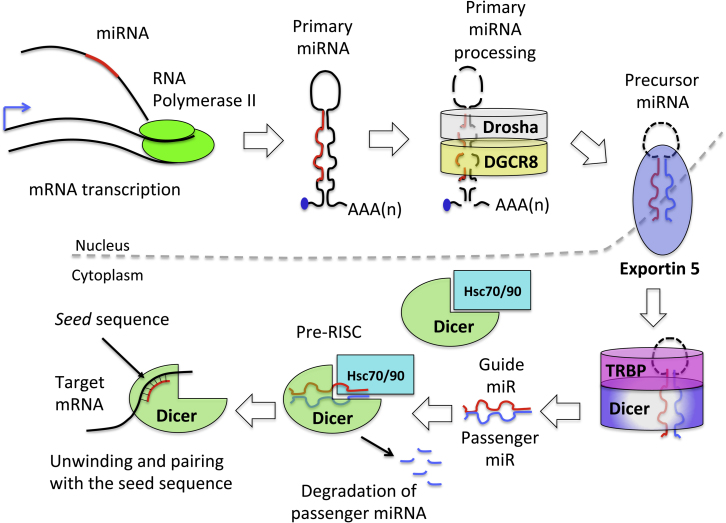
miRNA Biogenesis The life of an miRNA begins in the nucleus, where RNA polymerase II (Pol II) transcribes the whole RNA along with miRNA. The long primary miRNA (pri-miRNA) (approximately 1 kb) with its hairpin structure is processed by the Drosha-DCGR8 complex. The microprocessor complex, formed by Drosha and its cofactor DCGR8, lead to the maturation of the pri-miR into precursor miRNA (pre-miRNA). The RNase activity of Drosha removes the stem loop structure, releasing a small hairpin RNA of approximately 65 bp. Several other proteins collaborate with the microprocessor to guide the correct maturation of the pri-miRNA (p53, SMAD1-3, p68, and TDP43). After Drosha processing, pre-miRNAs are exported into the cytoplasm by the transport complex formed by Exportin 5 and RAN-GTP. Once the complex is translocated into the cytoplasm, GTP is hydrolyzed to GDP, leading to complex disassembly. In the cytoplasm, another RNase guides the maturation of pre-miRNA into the duplex form,.i.e., Dicer. Dicer interacts with the double-strand hairpin structure of the cytosolic pre-miRNA and, in collaboration with TAR RNA-binding protein, cleaves the RNA duplex; further, the mature miRNA is loaded directly into the RNA-induced silencing complex (RISC), whereas the passenger miRNA is usually degraded. The RISC complex needs the help of two heat shock cognate proteins (HSC70 and 90) that, using ATP, mediate the opening of the Argonaute (AGO) protein to receive the miRNA duplex. The RISC receives the duplex, unwinds it, and degrades the passenger miRNA. The pairing between the RISC-mature miRNA and the seed sequence on the target mRNA determines mRNA degradation or mRNA repression.
Figure 3
Figure 3
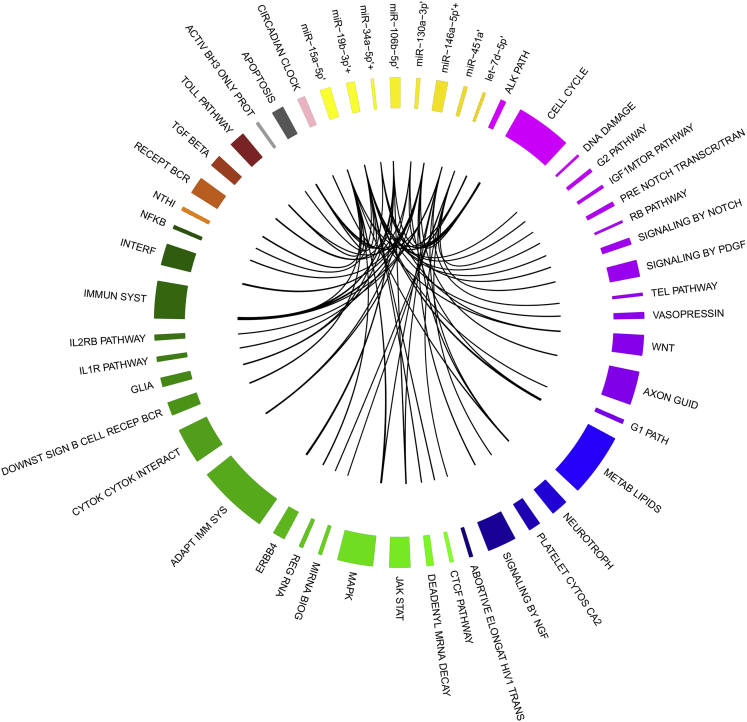
Circulating miRNAs with a Main Role in Epilepsy Hallmarks Circos plot showing the relationships among eight circulating miRNAs in epilepsy (yellow gradation, ’) and their target pathways. The pathways are grouped into six main sets: purple gradation, cell cycle control; blue gradation, tissue remodeling ion channel modification and neuronal plasticity; green gradation, transcription regulation and gene expression; brown gradation, inflammation pathway; black gradation, apoptosis; and pink, stemness. The width of each pathway slice is proportional to the number of genes of each pathway, and that of each miRNA slice is proportional to the number of gene targets of those miRNAs of all pathways. The circos plot was constructed using R-package circlize. The miRNAs that have been proposed as therapeutic molecules are indicated with a plus sign.

References

    1. Megiddo I., Colson A., Chisholm D., Dua T., Nandi A., Laxminarayan R. Health and economic benefits of public financing of epilepsy treatment in India: An agent-based simulation model. Epilepsia. 2016;57:464–474. - PMC - PubMed
    1. Browne T., Holmes G.L. Fourth Edition. Lippincott Williams & Wilkins; Philadelphia, PA: 2008. Handbook of Epilepsy.
    1. Fisher R.S., Acevedo C., Arzimanoglou A., Bogacz A., Cross J.H., Elger C.E., Engel J., Jr., Forsgren L., French J.A., Glynn M. ILAE official report: a practical clinical definition of epilepsy. Epilepsia. 2014;55:475–482. - PubMed
    1. Fisher R.S., Cross J.H., French J.A., Higurashi N., Hirsch E., Jansen F.E., Lagae L., Moshé S.L., Peltola J., Roulet Perez E. Operational classification of seizure types by the International League Against Epilepsy: Position Paper of the ILAE Commission for Classification and Terminology. Epilepsia. 2017;58:522–530. - PubMed
    1. Scheffer I.E., Berkovic S., Capovilla G., Connolly M.B., French J., Guilhoto L., Hirsch E., Jain S., Mathern G.W., Moshé S.L. ILAE classification of the epilepsies: Position paper of the ILAE Commission for Classification and Terminology. Epilepsia. 2017;58:512–521. - PMC - PubMed