


Arsenic, one carbon metabolism and diabetes-related outcomes in the Strong Heart Family Study
- PMID: 30321848
- PMCID: PMC6221918
- DOI: 10.1016/j.envint.2018.09.048
Arsenic, one carbon metabolism and diabetes-related outcomes in the Strong Heart Family Study
Abstract
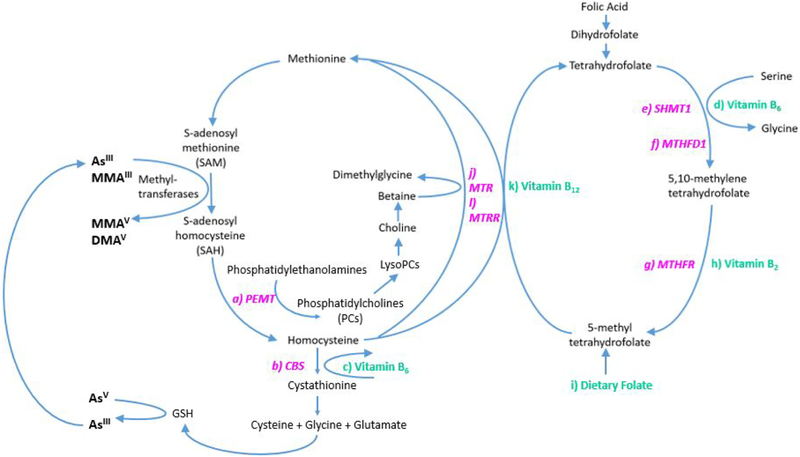
Background: Inorganic arsenic exposure and inter-individual differences in its metabolism have been associated with cardiometabolic risk. A more efficient arsenic metabolism profile (lower MMA%, higher DMA%) has been associated with reduced risk for arsenic-related health outcomes; however, this profile has also been associated with increased risk for diabetes-related outcomes. The mechanism behind these contrasting associations is equivocal; we hypothesized one carbon metabolism (OCM) may play a role.
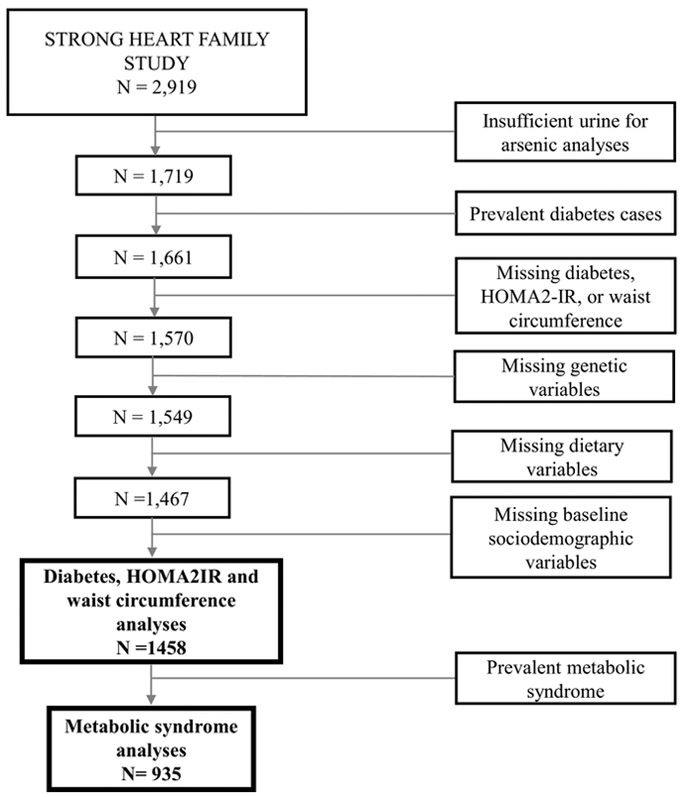
Methods: We evaluated the association between OCM-related variables (nutrient intake and genetic variants) and both arsenic metabolism biomarkers (iAs%, MMA% and DMA%) and diabetes-related outcomes (metabolic syndrome, diabetes, HOMA2-IR and waist circumference) in 935 participants free of prevalent diabetes and metabolic syndrome from the Strong Heart Family Study, a family-based prospective cohort comprised of American Indian tribal members aged 14+ years.
Results: Of the 935 participants free of both diabetes and metabolic syndrome at baseline, 279 (29.8%) developed metabolic syndrome over a median of 5.3 years of follow-up and of the 1458 participants free of diabetes at baseline, 167 (11.3%) developed diabetes over follow-up. OCM nutrients were not associated with arsenic metabolism, however, higher vitamin B6 was associated with diabetes-related outcomes (higher HOMA2-IR and increased risk for diabetes and metabolic syndrome). A polymorphism in an OCM-related gene, methionine synthase (MTR), was associated with both higher MMA% (β = 2.57, 95% CI: 0.22, 4.92) and lower HOMA2-IR (GMR = 0.79, 95% CI = 0.66, 0.93 per 5 years of follow-up). Adjustment for OCM variables did not affect previously reported associations between arsenic metabolism and diabetes-related outcomes; however, the association between the MTR variant and diabetes-related outcomes were attenuated after adjustment for arsenic metabolism.
Conclusions: Our findings suggest MMA% may be a partial mediator in the association between OCM and diabetes-related outcomes. Additional mediation analyses with longer follow-up period are needed to confirm this finding. Further research is needed to determine whether excess B vitamin intake is associated with increased risk for diabetes-related outcomes.
Keywords: American Indians; Arsenic; Arsenic metabolism; Diabetes; Metabolic syndrome; One carbon metabolism.
Copyright © 2018 Elsevier Ltd. All rights reserved.
Figures
References
-
- Ralph Carmel DWJ, ed. Homocysteine in Health and Disease. 2001, Cambridge University Press.
-
- Voutilainen S, et al. , Low dietary folate intake is associated with an excess incidence of acute coronary events: The Kuopio Ischemic Heart Disease Risk Factor Study. Circulation, 2001. 103(22): p. 2674–80. - PubMed
-
- Verhaar MC, Stroes E, and Rabelink TJ, Folates and cardiovascular disease. Arterioscler Thromb Vasc Biol, 2002. 22(1): p. 6–13. - PubMed
-
- Robinson K, et al. , Low circulating folate and vitamin B6 concentrations: risk factors for stroke, peripheral vascular disease, and coronary artery disease. European COMAC Group. Circulation, 1998. 97(5): p. 437–43. - PubMed
-
- Peng Y, Dong B, and Wang Z, Serum folate concentrations and all-cause, cardiovascular disease and cancer mortality: A cohort study based on 1999-2010 National Health and Nutrition Examination Survey (NHANES). Int J Cardiol, 2016. 219: p. 136–42. - PubMed
Publication types
MeSH terms
Substances
Grants and funding
- U01 HL041642/HL/NHLBI NIH HHS/United States
- U01 HL041654/HL/NHLBI NIH HHS/United States
- R01 ES025216/ES/NIEHS NIH HHS/United States
- R01 HL090863/HL/NHLBI NIH HHS/United States
- U01 HL041652/HL/NHLBI NIH HHS/United States
- P42 ES010349/ES/NIEHS NIH HHS/United States
- F31 ES027796/ES/NIEHS NIH HHS/United States
- R01 HL109315/HL/NHLBI NIH HHS/United States
- R01 HL109319/HL/NHLBI NIH HHS/United States
- R01 HL109284/HL/NHLBI NIH HHS/United States
- U01 HL065521/HL/NHLBI NIH HHS/United States
- T32 ES007141/ES/NIEHS NIH HHS/United States
- R01 HL109301/HL/NHLBI NIH HHS/United States
- R01 HL109282/HL/NHLBI NIH HHS/United States
- U01 HL065520/HL/NHLBI NIH HHS/United States
- R01 ES021367/ES/NIEHS NIH HHS/United States
- P30 ES009089/ES/NIEHS NIH HHS/United States
LinkOut - more resources
Full Text Sources
Medical
Research Materials
