Review
. 2018 Oct 12;7(10):166.
doi: 10.3390/cells7100166.

The Dual Role of TAM Receptors in Autoimmune Diseases and Cancer: An Overview

Affiliations
Review

The Dual Role of TAM Receptors in Autoimmune Diseases and Cancer: An Overview

Martha Wium et al. Cells. .

Abstract

Receptor tyrosine kinases (RTKs) regulate cellular processes by converting signals from the extracellular environment to the cytoplasm and nucleus. Tyro3, Axl, and Mer (TAM) receptors form an RTK family that plays an intricate role in tissue maintenance, phagocytosis, and inflammation as well as cell proliferation, survival, migration, and development. Defects in TAM signaling are associated with numerous autoimmune diseases and different types of cancers. Here, we review the structure of TAM receptors, their ligands, and their biological functions. We discuss the role of TAM receptors and soluble circulating TAM receptors in the autoimmune diseases systemic lupus erythematosus (SLE) and multiple sclerosis (MS). Lastly, we discuss the effect of TAM receptor deregulation in cancer and explore the therapeutic potential of TAM receptors in the treatment of diseases.

Keywords: Axl; Mer; TAM receptors; Tyro3; autoimmune disease; cancer.


Conflict of interest statement

The authors declare no conflict of interest.

Figures
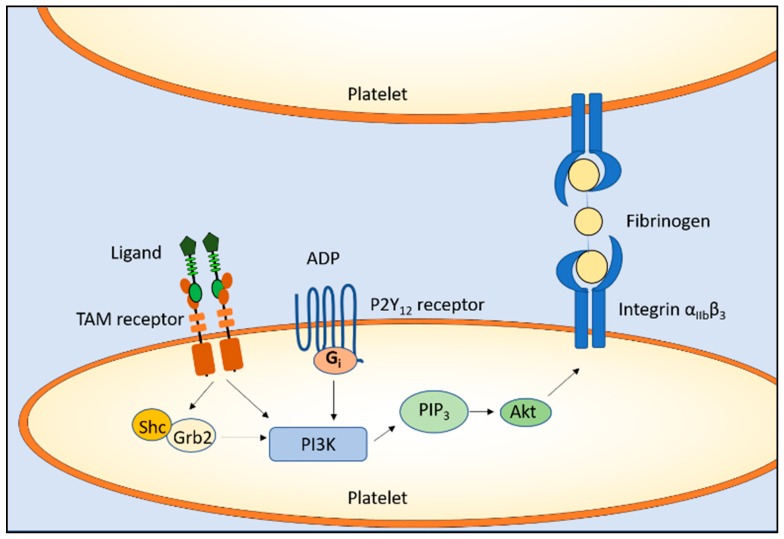
Figure 1
Figure 1
Function of Tyro3, Axl, and Mer (TAM) receptors in hemostasis. In platelets, the activation of TAM receptors and the adenosine diphosphate (ADP) receptor (P2Y12) leads to the phosphorylation of phosphoinositide 3 kinase (PI3K) and Akt, resulting in persistent activation of the fibrinogen receptor integrin αIIbβ3 and leading to thrombogenesis and platelet stabilization.
Figure 2
Figure 2
Activation of TAM receptors in dendritic cells down regulate inflammation. Activation of the type I interferon receptor (IFNAR) leads to cytokine amplification, a subsequent increase in inflammation, and the upregulation of Axl transcription. The association of the TAM/ligand complex with IFNAR leads to the transcription of SOCS1 and SOCS3. SOCS1 and SOCS3 inhibit the TLR3, TLR4, and TLR9 pathways as well as cytokine receptors to resolve inflammation. TLR: toll-like receptor; JAK: Janus kinases; STAT: signal transducer and activator of transcription protein; SOCS: suppressor of cytokine signaling.
Figure 3
Figure 3
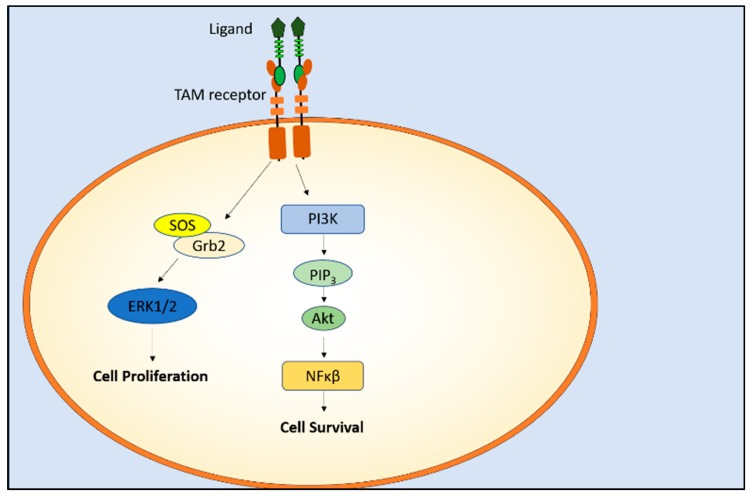
TAM receptor activation results in cell proliferation and survival that are essential for normal neural development. Activation of the PI3K/Akt/NF-κB pathway leads to cell survival, while the activation of SOS/ growth factor receptor-bound protein (Grb2) / extracellular-signal-regulated kinase (ERK) pathway leads to cell proliferation. NF-κB: nuclear factor κ-light-chain-enhancer of activated B cells.

References

    1. Linger R.M., Keating A.K., Earp H.S., Graham D.K. Tam receptor tyrosine kinases: Biologic functions, signaling, and potential therapeutic targeting in human cancer. Adv. Cancer Res. 2008;100:35–83. - PMC - PubMed
    1. Lu Q., Gore M., Zhang Q., Camenisch T., Boast S., Casagranda F., Lai C., Skinner M.K., Klein R., Matsushima G.K., et al. Tyro-3 family receptors are essential regulators of mammalian spermatogenesis. Nature. 1999;398:723–728. doi: 10.1038/19554. - DOI - PubMed
    1. Xu L., Hu F., Zhu H., Liu X., Shi L., Li Y., Zhong H., Su Y. Soluble tam receptor tyrosine kinases in rheumatoid arthritis: Correlation with disease activity and bone destruction. Clin. Exp. Immunol. 2018;192:95–103. doi: 10.1111/cei.13082. - DOI - PMC - PubMed
    1. Weinger J.G., Omari K.M., Marsden K., Raine C.S., Shafit-Zagardo B. Up-regulation of soluble axl and mer receptor tyrosine kinases negatively correlates with gas6 in established multiple sclerosis lesions. Am. J. Pathol. 2009;175:283–293. doi: 10.2353/ajpath.2009.080807. - DOI - PMC - PubMed
    1. Zhu H., Sun X., Zhu L., Hu F., Shi L., Li Z., Su Y. The expression and clinical significance of different forms of mer receptor tyrosine kinase in systemic lupus erythematosus. J. Immunol. Res. 2014;2014:431896. doi: 10.1155/2014/431896. - DOI - PMC - PubMed