


Assessment of quality of primary care with facility surveys: a descriptive analysis in ten low-income and middle-income countries
- PMID: 30322648
- PMCID: PMC6187280
- DOI: 10.1016/S2214-109X(18)30440-6
Assessment of quality of primary care with facility surveys: a descriptive analysis in ten low-income and middle-income countries
Abstract
Background: Primary care has the potential to address a large proportion of people's health needs, promote equity, and contain costs, but only if it provides high-quality health services that people want to use. 40 years after the Declaration of Alma-Ata, little is known about the quality of primary care in low-income and middle-income countries. We assessed whether existing facility surveys capture relevant aspects of primary care performance and summarised the quality of primary care in ten low-income and middle-income countries.
Methods: We used Service Provision Assessment surveys, the most comprehensive nationally representative surveys of health systems, to select indicators corresponding to three of the process quality domains (competent systems, evidence-based care, and user experience) identified by the Lancet Global Health Commission on High Quality Health Systems in the Sustainable Development Goals Era. We calculated composite and domain quality scores for first-level primary care facilities across and within ten countries with available facility assessment data (Ethiopia, Haiti, Kenya, Malawi, Namibia, Nepal, Rwanda, Senegal, Tanzania, and Uganda).
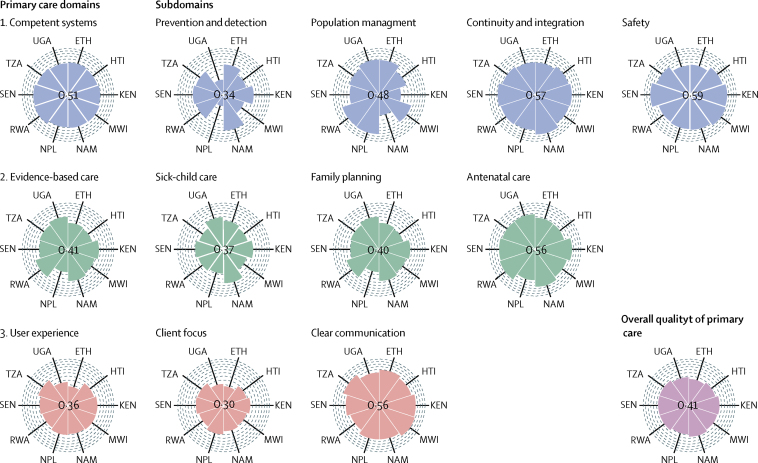
Findings: Data were available for 7049 facilities and 63 869 care visits. There were gaps in measurement of important outcomes such as user experience, health outcomes, and confidence, and processes such as timely action, choice of provider, affordability, ease of use, dignity, privacy, non-discrimination, autonomy, and confidentiality. No information about care competence was available outside maternal and child health. Overall, scores for primary care quality were low (mean 0·41 on a scale of 0 to 1). At a domain level, scores were lowest for user experience, followed by evidence-based care, and then competent systems. At the subdomain level, scores for patient focus, prevention and detection, technical quality of sick-child care, and population-health management were lower than those for other subdomains.
Interpretation: Facility surveys do not capture key elements of primary care quality. The available measures suggest major gaps in primary care quality. If not addressed, these gaps will limit the contribution of primary care to reaching the ambitious Sustainable Development Goals.
Funding: Bill & Melinda Gates Foundation.
Copyright © 2018 The Author(s). Published by Elsevier Ltd. This is an Open Access article under the CC BY 4.0 license. Published by Elsevier Ltd.. All rights reserved.
Figures
References
-
- Kruk ME, Porignon D, Rockrs PC, Van Lerberghe W. The contribution of primary care to health and health systems in low- and middle-income countries: a critical review of major primary care initiatives. Soc Sci Med. 2010;70:904–911. - PubMed
-
- Mackintosh M, Channon A, Karan A, Selvaraj S, Cavagnero E, Zhao H. What is the private sector? Understanding private provision in the health systems of low-income and middle-income countries. Lancet. 2016;388:596–605. - PubMed
Publication types
MeSH terms
LinkOut - more resources
Full Text Sources
Research Materials
