. 2018 Dec 21;63(1):e01585-18.
doi: 10.1128/AAC.01585-18. Print 2019 Jan.

A Novel Actin Binding Drug with In Vivo Efficacy

Affiliations

A Novel Actin Binding Drug with In Vivo Efficacy

Akshaya Ravichandran et al. Antimicrob Agents Chemother. .

Abstract

Occidiofungin is produced by the soil bacterium Burkolderia contaminans MS14 and is structurally similar or identical to the burkholdines, xylocandins, and cepacidines. This study identified the primary cellular target of occidiofungin, which was determined to be actin. The modification of occidiofungin with a functional alkyne group enabled affinity purification assays and localization studies in yeast. Occidiofungin has a subtle effect on actin dynamics that triggers apoptotic cell death. We demonstrate the highly specific localization of occidiofungin to cellular regions rich in actin in yeast and the binding of occidiofungin to purified actin in vitro Furthermore, a disruption of actin-mediated cellular processes, such as endocytosis, nuclear segregation, and hyphal formation, was observed. All of these processes require the formation of stable actin cables, which are disrupted following the addition of a subinhibitory concentration of occidiofungin. We were also able to demonstrate the effectiveness of occidiofungin in treating a vulvovaginal yeast infection in a murine model. The results of this study are important for the development of an efficacious novel class of actin binding drugs that may fill the existing gap in treatment options for fungal infections or different types of cancer.

Keywords: actin binding proteins; anticancer therapy; antifungal therapy; candidiasis; occidiofungin.


Figures

FIG 1
FIG 1
Covalent structure of occidiofungin A-D and alkyne-OF.
FIG 2
FIG 2
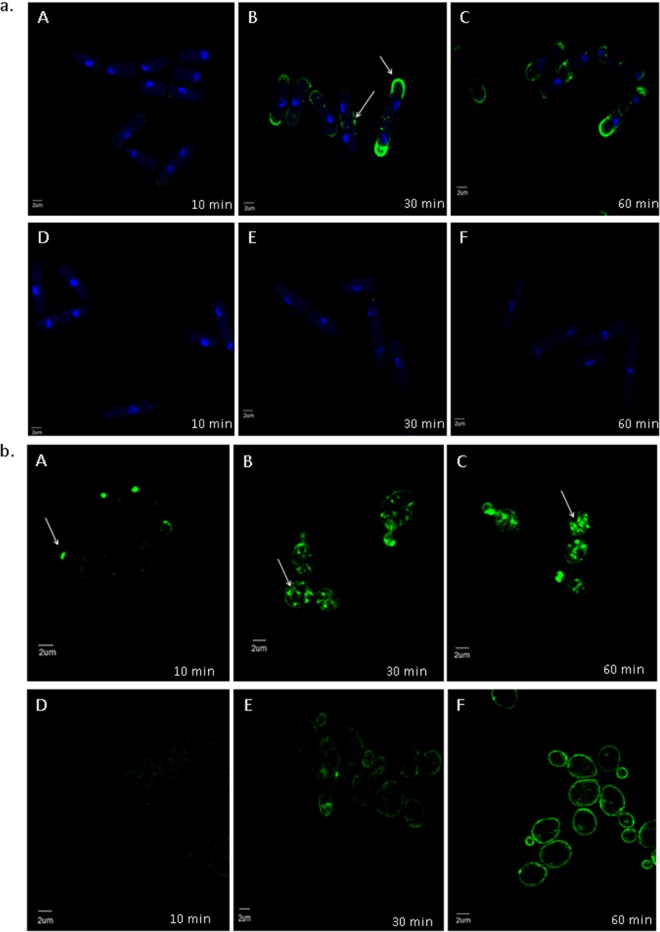
Competition assay of native occidiofungin and alkyne-OF. Time course analyses of alkyne-OF distribution (A to C) and the distribution of alkyne-OF with the competition of native occidiofungin (D to F) in Schizosaccharomyces pombe (a) and Saccharomyces cerevisiae (b). Arrows indicate specific localization patterns of alkyne-OF observed in each cell at 10, 30, and 60 min. When pretreated with native occidiofungin, alkyne-OF does not bind or is restricted to the cellular envelope in Schizosaccharomyces pombe and Saccharomyces cerevisiae, respectively.
FIG 3
FIG 3
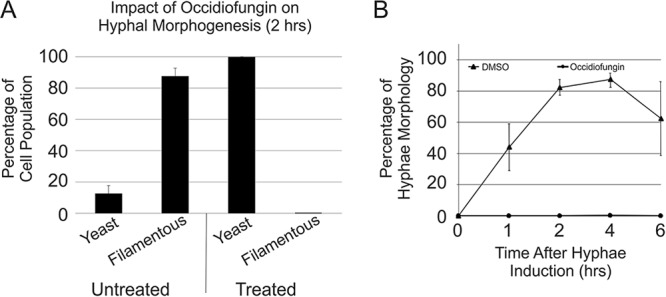
Candida albicans morphology under hypha-inducing conditions. (A) The percentages of cells with a morphology scored as “yeast” or “filamentous” at 2 h. The data are the averages with the standard deviations from >200 cells per sample (n = 3) for each treatment condition. (B) The percentages of the cell population that had a hyphal morphology following exposure to DMSO and occidiofungin after 0, 1, 2, 4, and 6 h at 37°C in Spider medium. The data are the averages with the standard deviations from >200 cells per sample (n = 2 or 3) for each time point and treatment condition.
FIG 4
FIG 4
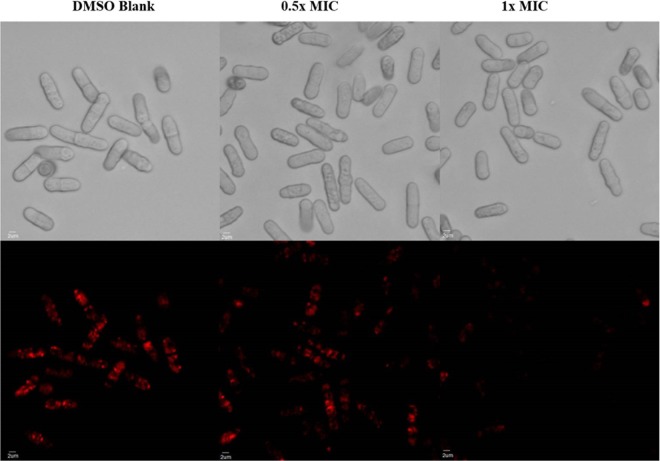
Effect of the native occidiofungin on endocytosis in fission yeast. Differential inference contrast (DIC; top) and fluorescence (bottom) images of cells stained with FM-464 following treatment with the sample blank, 0.5× MIC of occidiofungin, and 1× MIC occidiofungin. FM-464 dye uptake by endocytosis was decreased in a dose-dependent fashion in cells exposed to occidiofungin.
FIG 5
FIG 5
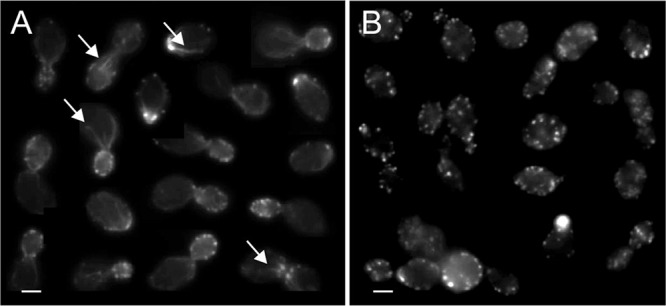
Effects of occidiofungin exposure on the integrity of actin cables in S. cerevisiae cells. Images of cells processed for actin visualization using phalloidin-TRITC from a culture exposed to solvent blank control (DMSO), where actin patches and cables (arrows) are easily identifiable (A), and a culture treated with occidiofungin (0.5× MIC; for 30 min), showing a loss of actin cables and the accumulation of actin aggregates (B). Scale bars, 2 µm.
FIG 6
FIG 6
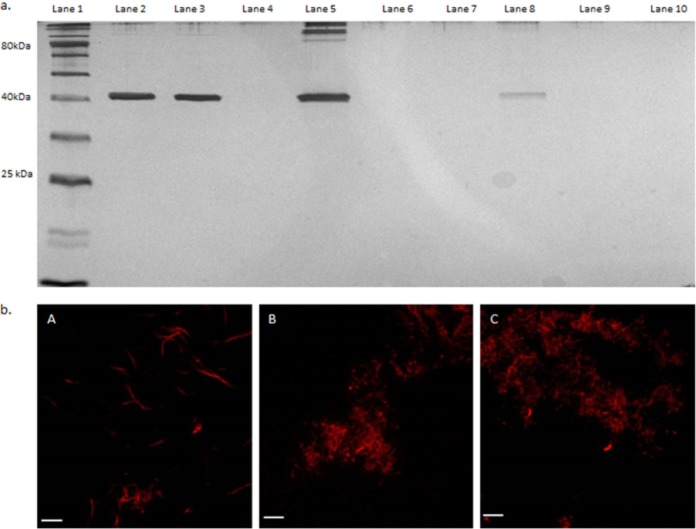
In vitro interaction of occidiofungin with F- and G-actin. (a) Affinity pulldown of actin using alkyne-OF. Lane 1, ladder; lane 2, 100 ng pure F-actin; lane 3, 100 ng pure G-actin; lane 4, empty; lane 5, F-actin treated with alkyne-OF; lane 6, F-actin treated with native occidiofungin; lane 7, F-actin treated with DMSO; lane 8, G-actin treated with alkyne-OF; lane 9, G-actin treated with native occidiofungin; lane 10, G-actin treated with DMSO. (b) Fluorescence microscopy of the effect of occidiofungin treatment on actin filaments visualized by fluorescently labeled phalloidin. (A) Actin filaments treated with solvent blank (DMSO). (B) Actin/native occidiofungin (24 μg actin:4 μg native occidiofungin). (C) Actin/native occidiofungin (24 μg actin:8 μg native occidiofungin). Scale bar, 5 µm.
FIG 7
FIG 7
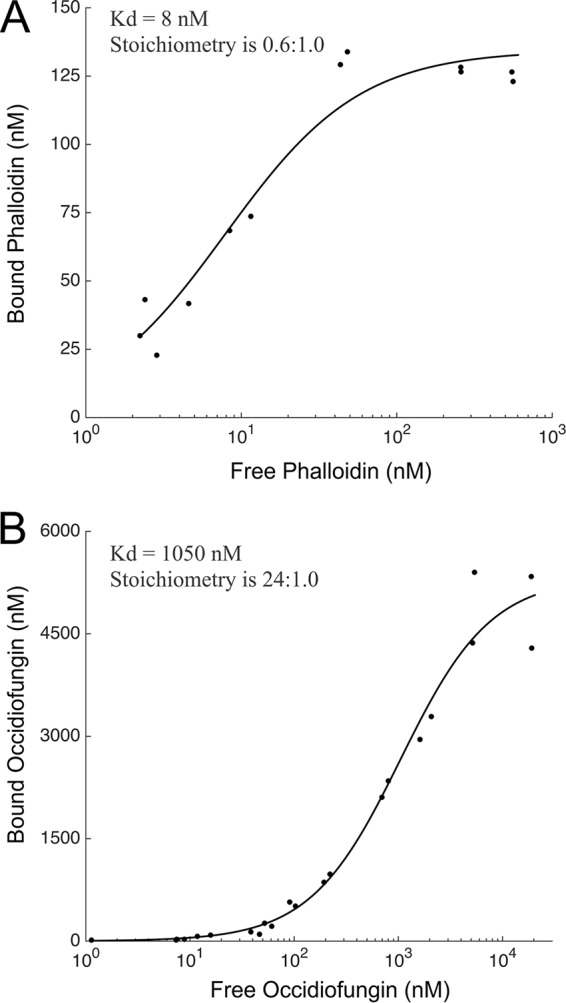
Cosedimentation assay demonstrating the binding of occidiofungin to actin. (A) Binding curve of phalloidin to actin (Kd = 8 nM; the stoichiometry [ligand: protein] is 0.6:1.0). (B) Binding curve of occidiofungin to actin (Kd = 1 μM; the stoichiometry [ligand: protein] is 24:1). The graph is plotted between the amount of free occidiofungin obtained in the supernatant of the cosedimentation assay and the amount of bound occidiofungin obtained from the actin pellet. The data were fit to a standard Langmuir binding isotherm of the form: [X]bound = [X]×S/(Kd + [X]), where S is the maximal X bound, Kd is the dissociation constant, and X is the concentration of free ligand.
FIG 8
FIG 8
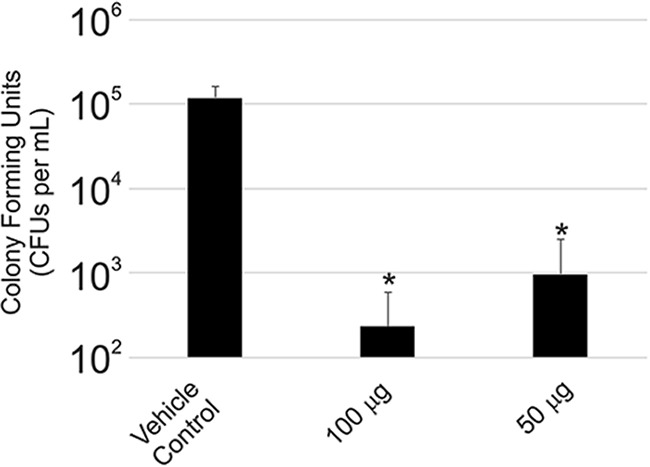
Efficacy of occidiofungin in treating murine vulvovaginal candidiasis. CFUs per ml of Candida albicans in the control group of mice compared to that for the groups treated intravaginally with different concentrations of occidiofungin in 0.3% noble agar. Error bars represent standard deviations.

References

    1. Centers for Disease Control and Prevention. 2017. Candida auris clinical update - September 2017. Centers for Disease Control and Prevention, Atlanta, GA.
    1. Berkow EL, Lockhart SR. 2017. Fluconazole resistance in Candida species: a current perspective. Infect Drug Resist 10:237–245. doi:10.2147/IDR.S118892. - DOI - PMC - PubMed
    1. Whaley SG, Berkow EL, Rybak JM, Nishimoto AT, Barker KS, Rogers PD. 2017. Azole antifungal resistance in Candida albicans and emerging non-albicans Candida species. Front Microbiol 7:2173. doi:10.3389/fmicb.2016.02173. - DOI - PMC - PubMed
    1. Perlin DS. 2015. Echinocandin resistance in Candida. Clin Infect Dis 61:S612–S617. doi:10.1093/cid/civ791. - DOI - PMC - PubMed
    1. Cuenca-Estrella M, Rodriguez D, Almirante B, Morgan J, Planes AM, Almela M, Mensa J, Sanchez F, Ayats J, Gimenez M, Salvado M, Warnock DW, Pahissa A, Rodriguez-Tudela JL, Barcelona Candidemia Project Study Group. 2005. In vitro susceptibilities of bloodstream isolates of Candida species to six antifungal agents: results from a population-based active surveillance programme, Barcelona, Spain, 2002–2003. J Antimicrob Chemother 55:194–199. doi:10.1093/jac/dkh548. - DOI - PubMed

LinkOut - more resources