. 2018 Sep 28:9:2206.
doi: 10.3389/fimmu.2018.02206. eCollection 2018.

AIRR Community Standardized Representations for Annotated Immune Repertoires

Affiliations

AIRR Community Standardized Representations for Annotated Immune Repertoires

Jason Anthony Vander Heiden et al. Front Immunol. .

Abstract

Increased interest in the immune system's involvement in pathophysiological phenomena coupled with decreased DNA sequencing costs have led to an explosion of antibody and T cell receptor sequencing data collectively termed "adaptive immune receptor repertoire sequencing" (AIRR-seq or Rep-Seq). The AIRR Community has been actively working to standardize protocols, metadata, formats, APIs, and other guidelines to promote open and reproducible studies of the immune repertoire. In this paper, we describe the work of the AIRR Community's Data Representation Working Group to develop standardized data representations for storing and sharing annotated antibody and T cell receptor data. Our file format emphasizes ease-of-use, accessibility, scalability to large data sets, and a commitment to open and transparent science. It is composed of a tab-delimited format with a specific schema. Several popular repertoire analysis tools and data repositories already utilize this AIRR-seq data format. We hope that others will follow suit in the interest of promoting interoperable standards.

Keywords: AIRR-seq; B cell; Rep-Seq; T cell; antibody; immunoglobulin; immunology; repertoire.


Figures
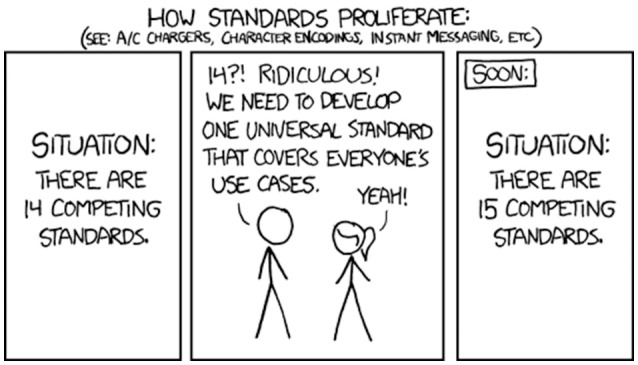
Figure 1
Figure 1
Standards proliferation. The DRWG has been actively engaging as many community members as possible to drive adoption of our new standard. https://xkcd.com/927/.
Figure 2
Figure 2
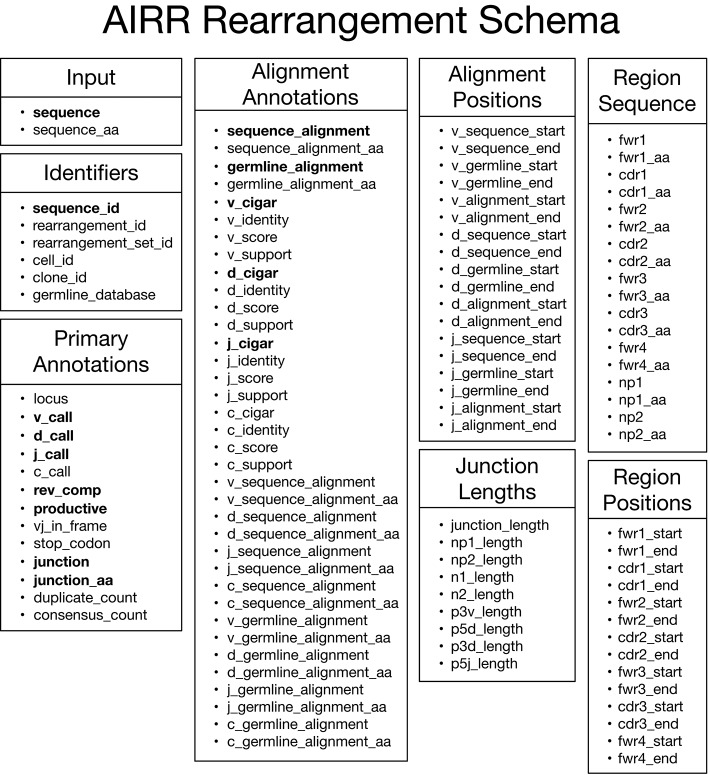
AIRR Rearrangement schema v1.2.0. Overview of the schema for representing annotated rearrangements. Fields in bold are required columns in the TSV. All fields, including those that are required columns in the TSV header, can be set to null by assigning an empty string as the value.
Figure 3
Figure 3
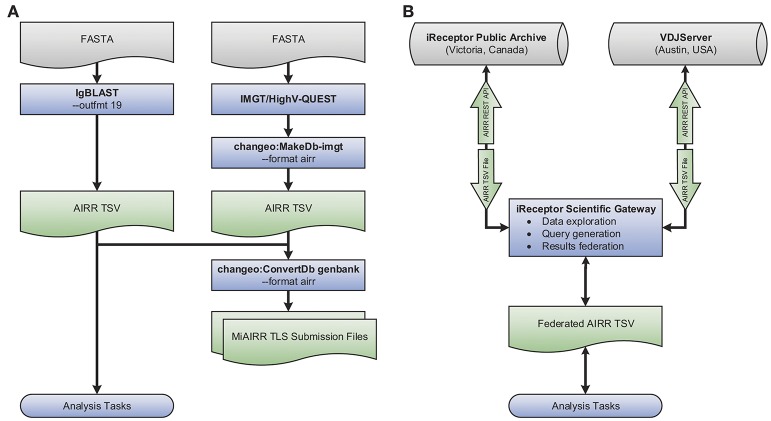
Interoperability example. Shown is a set of flowcharts depicting examples of the interoperability facilitated by the AIRR Rearrangement schema. (A) Starting with repertoire sequencing data in the FASTA format, either IgBLAST or IMGT/HighV-QUEST in combination with Change-O's conversion tool may be used. Once data conforms to the AIRR Rearrangement schema, Change-O can be used to generated MiAIRR-compliant GenBank/TLS submissions. AIRR-seq data from separate tools and pipelines can easily be combined for aggregate analysis. (B) Data may be exported from or imported to the iReceptor or VDJServer repositories using the TSV format. Data is returned from queries to the separate repositories using the TSV format and can be integrated into a single collection for downstream analysis.

References

    1. Breden F, Luning Prak ET, Peters B, Rubelt F, Schramm CA, Busse CE, et al. . Reproducibility and reuse of adaptive immune receptor repertoire data. Front Immunol. (2017) 8:1418. 10.3389/fimmu.2017.01418 - DOI - PMC - PubMed
    1. Rubelt F, Busse CE, Bukhari SAC, Bürckert J-P, Mariotti-Ferrandiz E, Cowell LG, et al. . Adaptive immune receptor repertoire community recommendations for sharing immune-repertoire sequencing data. Nat Immunol. (2017) 18:1274–8. 10.1038/ni.3873 - DOI - PMC - PubMed
    1. Bukhari SAC, O'Connor M, Martínez-Romero M, Egyedi A, Debra Willrett D, Graybeal J, et al. . The CAIRR pipeline for submitting standards-compliant B and T cell receptor repertoire sequencing studies to the National Center for Biotechnology Information Repositories. Front Immunol. (2018) 9:1877. 10.3389/fimmu.2018.01877 - DOI - PMC - PubMed
    1. Boyd SD, Crowe JE, Jr. Deep sequencing and human antibody repertoire analysis. Curr Opin Immunol. (2016) 40:103–9. 10.1016/j.coi.2016.03.008 - DOI - PMC - PubMed
    1. Yaari G, Kleinstein SH. Practical guidelines for B-cell receptor repertoire sequencing analysis. Genome Med. (2015) 7:121. 10.1186/s13073-015-0243-2 - DOI - PMC - PubMed

Publication types

LinkOut - more resources