. 2018 Sep 28:9:434.
doi: 10.3389/fgene.2018.00434. eCollection 2018.

Common and Rare Genetic Risk Factors Converge in Protein Interaction Networks Underlying Schizophrenia

Affiliations

Common and Rare Genetic Risk Factors Converge in Protein Interaction Networks Underlying Schizophrenia

Xiao Chang et al. Front Genet. .

Abstract

Hundreds of genomic loci have been identified with the recent advances of schizophrenia in genome-wide association studies (GWAS) and sequencing studies. However, the functional interactions among those genes remain largely unknown. We developed a network-based approach to integrate multiple genetic risk factors, which lead to the discovery of new susceptibility genes and causal sub-networks, or pathways in schizophrenia. We identified significantly and consistently over-represented pathways in the largest schizophrenia GWA studies, which are highly relevant to synaptic plasticity, neural development and signaling transduction, such as long-term potentiation, neurotrophin signaling pathway, and the ERBB signaling pathway. We also demonstrated that genes targeted by common SNPs are more likely to interact with genes harboring de novo mutations (DNMs) in the protein-protein interaction (PPI) network, suggesting a mutual interplay of both common and rare variants in schizophrenia. We further developed an edge-based search algorithm to identify the top-ranked gene modules associated with schizophrenia risk. Our results suggest that the N-methyl-D-aspartate receptor (NMDAR) interactome may play a leading role in the pathology of schizophrenia, as it is highly targeted by multiple types of genetic risk factors.

Keywords: GWAS; PPI Network; copy number variation (CNV); gene modules; schizophrenia.


Figures
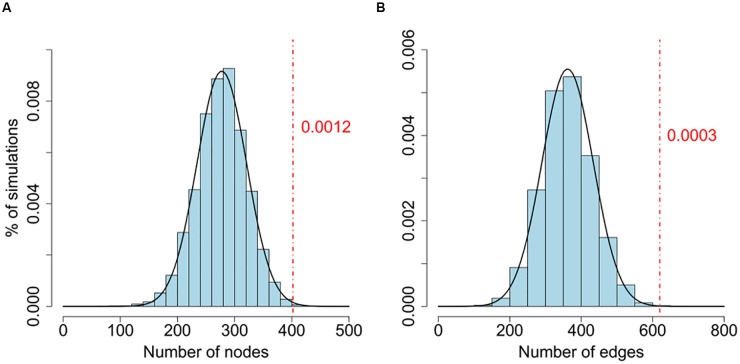
FIGURE 1
FIGURE 1
(A,B) Comparison of the number of nodes between the real network and random networks. Connectedness of the LCC based on gene-wise significant genes (Pgene < 0.01) from PGC2 study. The background distributions are generated by the number of nodes and edges of LCCs from 10,000 random simulations. P values are estimated by the proportion of LCCs from 10,000 random networks with more nodes or edges than the real network. Both node and edge numbers of the real data are significantly larger than random simulations (Pnode = 0.0012; Pedge = 0.0003).
FIGURE 2
FIGURE 2
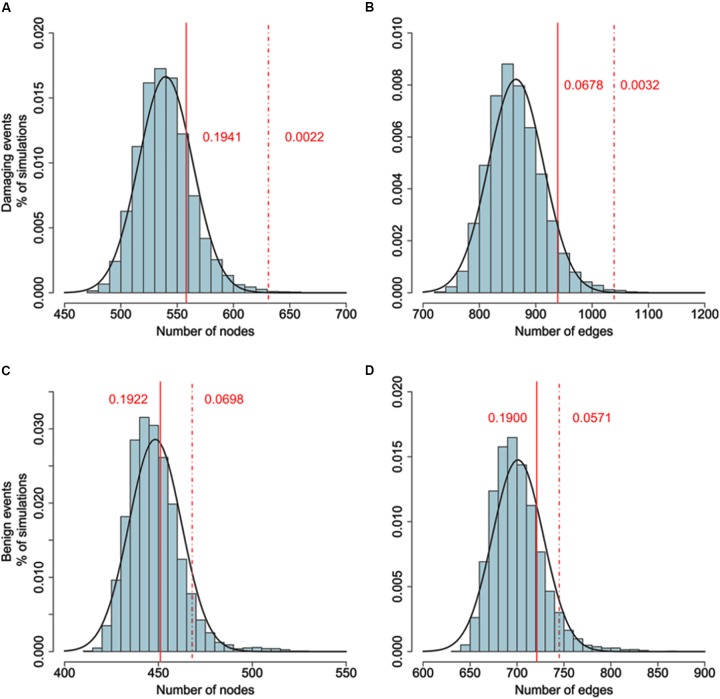
(A,B) Comparison of the number of nodes between the real network (damaging events) and random networks. (C,D) Comparison of the number of nodes between the real network (benign events) and random networks. Connectedness of the LCC based on gene-level significant genes (Pgene < 0.01) from PGC2 study and genes harboring DNMs. Original size of LCC based on gene-wise significant genes constituting 402 nodes and 620 edges. 635 genes harboring DNMs are added to generate the new LCC. The background distribution is generated by 10,000 LCCs based on adding 635 random selected genes. P values are estimated by the proportion of LCCs from random networks with more nodes or edges than the real network. As a control, we use the LCC generated by adding top 635 gene-level significant genes from Crohn’s disease as control. Dash line denotes the size of LCC generated by adding DNMs. Solid line denotes the size of LCC generated by adding CD top genes. Adding DNMs significantly increased the size of LCCs (DNMs: Pnode = 0.0022, Pedge = 0.0032; CD: Pnode = 0.1941, Pedge = 0.0678), while adding top CD genes did not. For comparison, we also added the synonymous and non-frameshift substitutions to generate the new LCC. The size of new LCC is not significantly larger than random simulations (Benign substitutions: Pnode = 0.698, Pedge = 0.0571; CD: Pnode = 0.1922, Pedge = 0.1900).
FIGURE 3
FIGURE 3
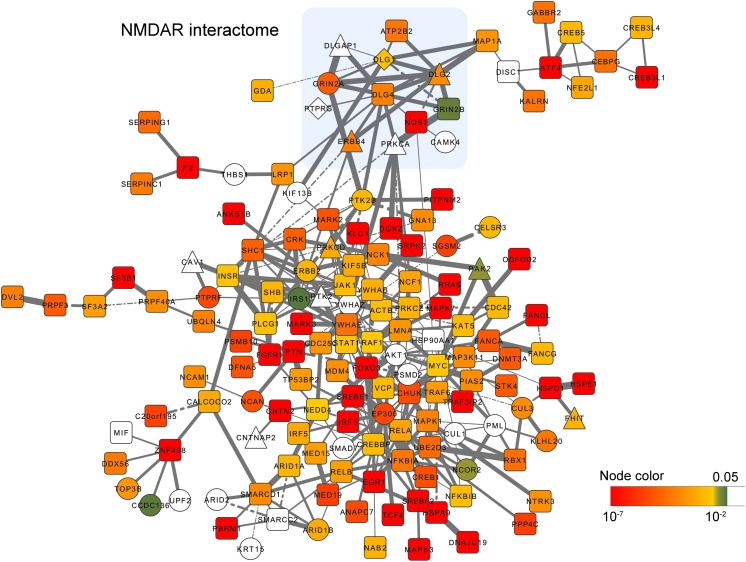
PPI network visualization of the most significant gene module derived from the network analysis. Gene-level P values (<0.05) are colored from green to red. Genes harboring DNMs and CNVs are shown as circles, and triangles respectively. Genes harboring both DNMs and CNVs are diamond shaped. Edges width reflects the gene co-expression correlation between two connected nodes. Solid and dash line denote positive, and negative correlations respectively.

References

    1. Altar C. A., Jurata L. W., Charles V., Lemire A., Liu P., Bukhman Y., et al. (2005). Deficient hippocampal neuron expression of proteasome, ubiquitin, and mitochondrial genes in multiple schizophrenia cohorts. Biol. Psychiatry 58 85–96. 10.1016/j.biopsych.2005.03.031 - DOI - PubMed
    1. Aston C., Jiang L., Sokolov B. P. (2004). Microarray analysis of postmortem temporal cortex from patients with schizophrenia. J. Neurosci. Res. 77 858–866. 10.1002/jnr.20208 - DOI - PubMed
    1. Barabasi A. L., Gulbahce N., Loscalzo J. (2011). Network medicine: a network-based approach to human disease. Nat. Rev. Genet. 12 56–68. 10.1038/nrg2918 - DOI - PMC - PubMed
    1. Bergen S. E., O’dushlaine C. T., Ripke S., Lee P. H., Ruderfer D. M., Akterin S., et al. (2012). Genome-wide association study in a Swedish population yields support for greater CNV and MHC involvement in schizophrenia compared with bipolar disorder. Mol. Psychiatry 17 880–886. 10.1038/mp.2012.73 - DOI - PMC - PubMed
    1. Bilecki W., Przewlocki R. (2000). Effect of opioids on Ca2 + /cAMP responsive element binding protein. Acta Neurobiol. Exp. 60 557–567. - PubMed