. 2018 Oct 15;9(10):495.
doi: 10.3390/genes9100495.

The Global Hepatitis B Virus Genotype Distribution Approximated from Available Genotyping Data

Affiliations

The Global Hepatitis B Virus Genotype Distribution Approximated from Available Genotyping Data

Stoyan Velkov et al. Genes (Basel). .

Abstract

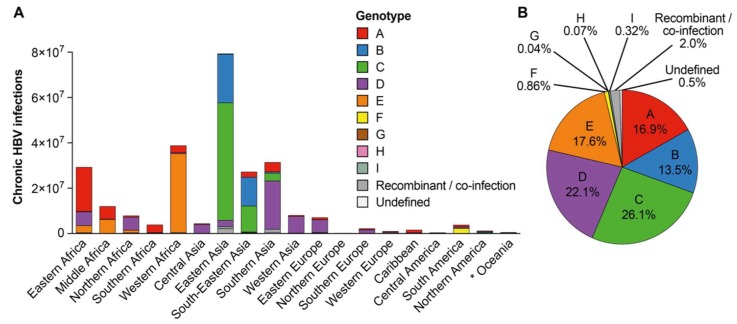
Hepatitis B virus (HBV) is divided into nine genotypes, A to I. Currently, it remains unclear how the individual genotypes contribute to the estimated 250 million chronic HBV infections. We performed a literature search on HBV genotyping data throughout the world. Over 900 publications were assessed and data were extracted from 213 records covering 125 countries. Using previously published HBV prevalence, and population data, we approximated the number of infections with each HBV genotype per country and the genotype distribution among global chronic HBV infections. We estimated that 96% of chronic HBV infections worldwide are caused by five of the nine genotypes: genotype C is most common (26%), followed by genotype D (22%), E (18%), A (17%) and B (14%). Genotypes F to I together cause less than 2% of global chronic HBV infections. Our work provides an up-to-date analysis of global HBV genotyping data and an initial approach to estimate how genotypes contribute to the global burden of chronic HBV infection. Results highlight the need to provide HBV cell culture and animal models that cover at least genotypes A to E and represent the vast majority of global HBV infections to test novel treatment strategies.

Keywords: Hepatitis B virus; chronic hepatitis B; genotype; molecular epidemiology; sequencing.


Conflict of interest statement

The authors declare no conflicts of interest.

Figures
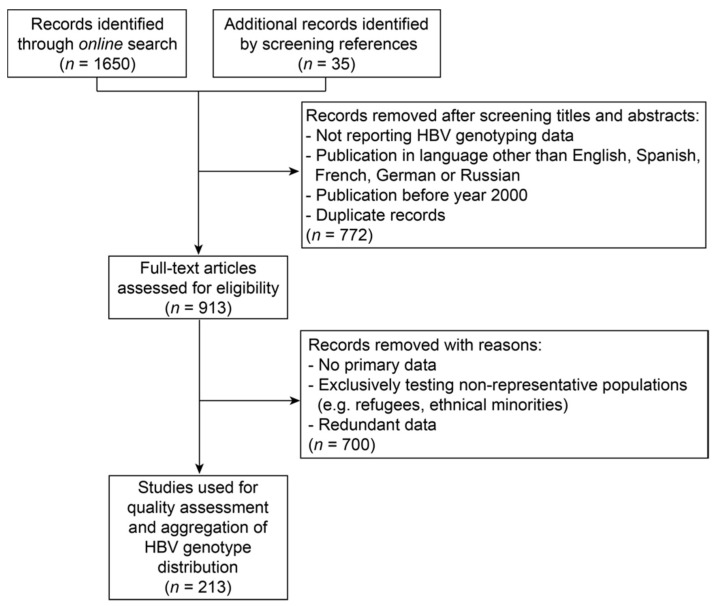
Figure 1
Figure 1
Flow chart on selection of records describing primary hepatitis B virus (HBV) genotyping data.
Figure 2
Figure 2
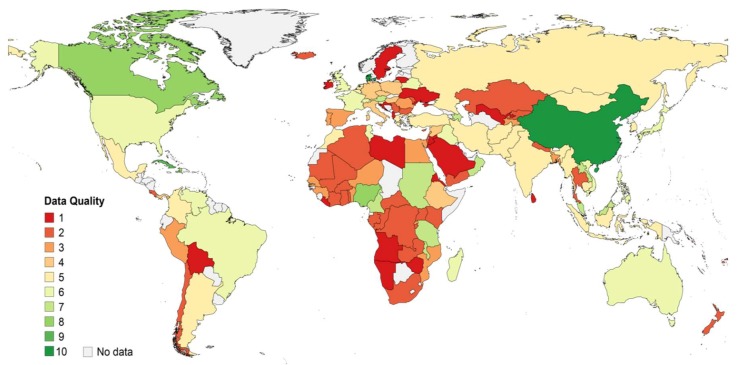
Quality of acquired HBV genotyping data per country. One (red) indicates the lowest and ten (green) represents the highest data quality. The scoring system was based on the sampling region, study population, sampling year, genotyping method, year of analysis, and number of analyzed samples.
Figure 3
Figure 3
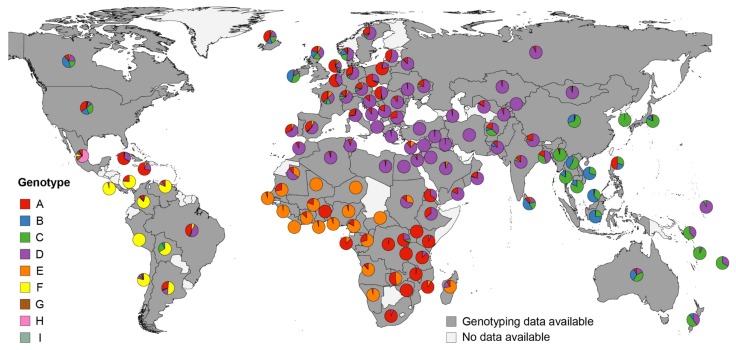
Distribution of HBV genotypes by country. Pie charts indicate proportional HBV genotype distributions in the respective countries. Genotype distributions within samples with successful genotyping are presented, excluding inter-genotype recombinant viruses, co-infections with more than one HBV genotype or undefined infections. Underlying literature sources and number of sequenced isolates are given in Table S1 (Supplementary Materials).
Figure 4
Figure 4
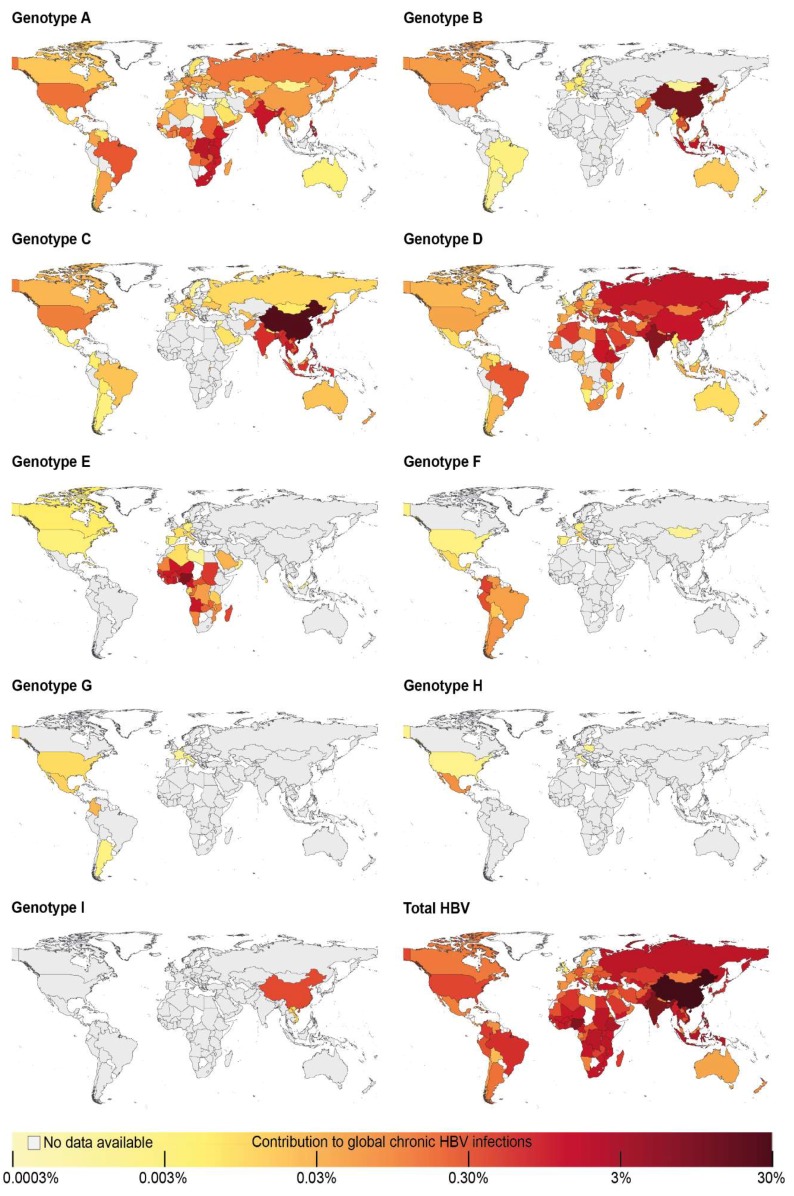
Contribution of genotypes to global chronic HBV infections. The number of infections with each genotype in a respective country is illustrated as percentage of global chronic HBV infections.
Figure 5
Figure 5
Approximation of the contribution of HBV genotypes to global burden of chronic HBV infection. (A) Estimation of the number of chronic infections with each genotype per world region. *: Oceania includes pooled data of Australia/New Zealand, Melanesia, Micronesia, and Polynesia. (B) Approximation of the genotype distribution within global chronic HBV infections. Values <2% are given with two decimals to prevent distortion of genotype distribution. Recombinant/co-infection: infection with an inter-genotype recombinant or with more than one HBV genotype; Undefined: genotype allocation not possible.

References

    1. Schweitzer A., Horn J., Mikolajczyk R.T., Krause G., Ott J.J. Estimations of worldwide prevalence of chronic hepatitis B virus infection: A systematic review of data published between 1965 and 2013. Lancet. 2015;386:1546–1555. doi: 10.1016/S0140-6736(15)61412-X. - DOI - PubMed
    1. Word Health Organisation . Global Hepatitis Report 2017. World Health Organisation; Geneva, Switzerland: 2017.
    1. Kramvis A. Genotypes and genetic variability of hepatitis B virus. Intervirology. 2014;57:141–150. doi: 10.1159/000360947. - DOI - PubMed
    1. Pourkarim M.R., Amini-Bavil-Olyaee S., Kurbanov F., Van Ranst M., Tacke F. Molecular identification of hepatitis B virus genotypes/subgenotypes: Revised classification hurdles and updated resolutions. World J. Gastroenterol. 2014;20:7152–7168. doi: 10.3748/wjg.v20.i23.7152. - DOI - PMC - PubMed
    1. Tran T.T., Trinh T.N., Abe K. New complex recombinant genotype of hepatitis B virus identified in Vietnam. J. Virol. 2008;82:5657–5663. - PMC - PubMed

LinkOut - more resources