Effects of Two Different Hip-Knee-Ankle-Foot Orthoses on Postural Stability in Subjects with Spinal Cord Injury: A Pilot Study
- PMID: 30326698
- PMCID: PMC6365790
- DOI: 10.31616/asj.2017.0283
Effects of Two Different Hip-Knee-Ankle-Foot Orthoses on Postural Stability in Subjects with Spinal Cord Injury: A Pilot Study
Abstract
Study design: Pilot study.
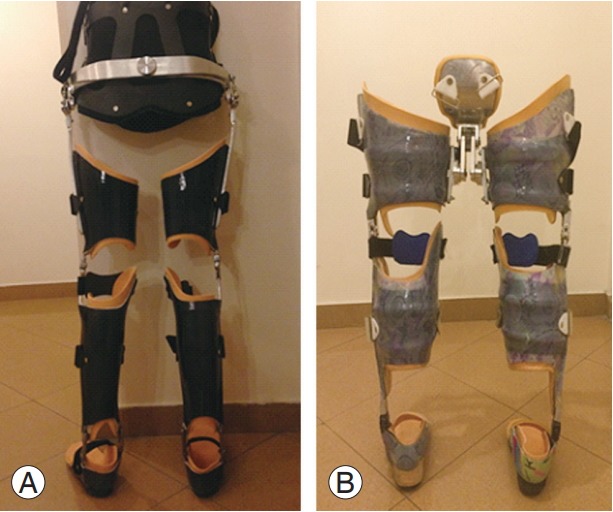
Purpose: Evaluation of two different hip-knee-ankle-foot orthoses (HKAFOs; medial linkage reciprocating gait orthosis [MLRGO] and isocentric reciprocating gait orthosis [IRGO]) using gait and postural stability analysis in four subjects with spinal cord injury (SCI).
Overview of literature: To the best of our knowledge, no study has evaluated postural stability in subjects with SCI when using MLRGO and IRGO.
Methods: The relative efficacy of each orthosis was evaluated with relevant gait parameters, and an assessment of postural stability and sway during usage was made. Each analysis was conducted following an appropriate period of training and acclimatization. The gait parameters employed in the study were walking speed, cadence, and endurance; these were recorded and analyzed using current, validated methods. Postural stability was assessed using a verified force plate measurement system, and a modified Falls Efficacy Scale (mFES) was used for the measurement of postural sway and the perceived fear of falling.
Results: Walking speed, cadence, and endurance increased with the use of both HKAFOs. When the two types of HKAFOs were compared, all the parameters showed a slight (but not significant) increase with the use of MLRGO compared with the use of IRGO. In contrast, there were slight but insignificant improvements in postural sway with the use of IRGO. However, although there were no significant differences between the two sets of mFES scores, there was a slightly reduced fear of falling with the use of MLRGO compared with the use of IRGO in the static standing position.
Conclusions: It is noteworthy that meaningful interpretations of results can only be drawn if a larger sample is employed. This pilot study showed no significant data; however, the results indicate that the use of MLRGO is superior to that of IRGO in terms of potential improvement in the mobility and confidence levels of subjects with SCI.
Keywords: Fear of falling; Isocentric reciprocating gait orthosis; Medial reciprocating gait linkage orthosis; Stability.
Conflict of interest statement
No potential conflict of interest relevant to this article was reported.
Figures
References
-
- Barbeau H, Ladouceur M, Norman KE, Pepin A, Leroux A. Walking after spinal cord injury: evaluation, treatment, and functional recovery. Arch Phys Med Rehabil. 1999;80:225–35. - PubMed
-
- Nene AV, Hermens HJ, Zilvold G. Paraplegic locomotion: a review. Spinal Cord. 1996;34:507–24. - PubMed
-
- Harvey LA, Davis GM, Smith MB, Engel S. Energy expenditure during gait using the walkabout and isocentric reciprocal gait orthoses in persons with paraplegia. Arch Phys Med Rehabil. 1998;79:945–9. - PubMed
-
- Harvey LA, Smith MB, Davis GM, Engel S. Functional outcomes attained by T9-12 paraplegic patients with the walkabout and the isocentric reciprocal gait orthoses. Arch Phys Med Rehabil. 1997;78:706–11. - PubMed
-
- Leung AK, Wong AF, Wong EC, Hutchins SW. The Physiological Cost Index of walking with an isocentric reciprocating gait orthosis among patients with T(12) - L(1) spinal cord injury. Prosthet Orthot Int. 2009;33:61–8. - PubMed
Grants and funding
LinkOut - more resources
Full Text Sources
Research Materials