Review
. 2018 Oct 16;15(1):70.
doi: 10.1186/s12977-018-0453-y.

The expanding array of HIV broadly neutralizing antibodies

Affiliations
Review

The expanding array of HIV broadly neutralizing antibodies

Laura E McCoy. Retrovirology. .

Abstract

A large array of broadly neutralizing antibodies (bnAbs) against HIV have been isolated and described, particularly in the last decade. This continually expanding array of bnAbs has crucially led to the identification of novel epitopes on the HIV envelope protein via which antibodies can block a broad range of HIV strains. Moreover, these studies have produced high-resolution understanding of these sites of vulnerability on the envelope protein. They have also clarified the mechanisms of action of bnAbs and provided detailed descriptions of B cell ontogenies from which they arise. However, it is still not possible to predict which HIV-infected individuals will go onto develop breath nor is it possible to induce neutralization breadth by immunization in humans. This review aims to discuss the major insights gained so far and also to evaluate the requirement to continue isolating and characterizing new bnAbs. While new epitopes may remain to be uncovered, a clearer probable benefit of further bnAb characterization is a greater understanding of key decision points in bnAb development within the anti-HIV immune response. This in turn may lead to new insights into how to trigger bnAbs by immunization and more clearly define the challenges to using bnAbs as therapeutic agents.

Keywords: Antibody; Epitope; HIV; Immunity; Infection; Neutralization.


Figures
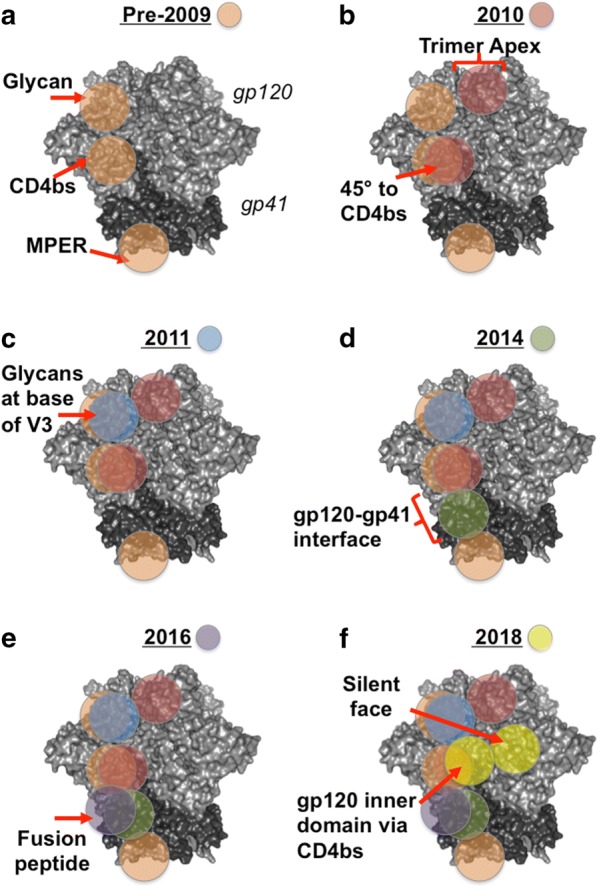
Fig. 1
Fig. 1
Continual advances in identifying bnAb epitopes on HIV Env following the identification of new bnAbs. Each panel represents a key advance in the identification of new epitopes/refinement of epitopes bound by bnAbs. The Env figure is adapted from the crystal structure of the BG505 SOSIP.664 trimer (PDB: 5cez), gp120 is coloured light grey, gp41 is coloured dark grey. Approximate epitope locations are indicated by red arrows/lines and circles are color-coded for each year as shown in the key given in each panel heading. Epitopes are highlighted only once per protomer. a Pre 2009 knowledge of CD4bs, glycan and MPER epitopes gained from studying predominantly by b12, 2G12, 2F5 and 4E10 respectively. b By 2010 the trimer apex epitope had been described following discovery of PG9/16 in 2009 and the importance of angle of approach to the CD4bs highlighted by the discovery of VRC01 in 2010. c The glycan patch epitope was redefined as supersite of vulnerability by the isolation of the PGT121 and 128 families of bnAbs in 2011. d From 2014 onwards the discovery of additional bnAbs, including PGT151, 35O22 and 8ANC195, revealed a new area of bnAbs which span the gp120–gp41 interface. e In 2016 subunit interface targeting antibodies were found that also bind the gp41 fusion peptide, VRC34 and ACS202. f 2018 saw the description of bnAbs binding the highly glycosylated “silent” face of gp120 and targeting CD4bs via novel contacts with the gp120 inner domain after bypassing the Phe43 cavity

References

    1. Weiss RA, Clapham PR, Cheingsong-Popov R, Dalgleish AG, Carne CA, Weller IV, Tedder RS. Neutralization of human T-lymphotropic virus type III by sera of AIDS and AIDS-risk patients. Nature. 1985;316(6023):69–72. doi: 10.1038/316069a0. - DOI - PubMed
    1. Weiss RA, Clapham PR, Weber JN, Dalgleish AG, Lasky LA, Berman PW. Variable and conserved neutralization antigens of human immunodeficiency virus. Nature. 1986;324(6097):572–575. doi: 10.1038/324572a0. - DOI - PubMed
    1. Robert-Guroff M, Brown M, Gallo RC. HTLV–III-neutralizing antibodies in patients with AIDS and AIDS-related complex. Nature. 1985;316(6023):72–74. doi: 10.1038/316072a0. - DOI - PubMed
    1. Burton DR, Pyati J, Koduri R, Sharp SJ, Thornton GB, Parren PW, Sawyer LS, Hendry RM, Dunlop N, Nara PL, et al. Efficient neutralization of primary isolates of HIV-1 by a recombinant human monoclonal antibody. Science. 1994;266(5187):1024–1027. doi: 10.1126/science.7973652. - DOI - PubMed
    1. Hessell AJ, Hangartner L, Hunter M, Havenith CE, Beurskens FJ, Bakker JM, Lanigan CM, Landucci G, Forthal DN, Parren PW, et al. Fc receptor but not complement binding is important in antibody protection against HIV. Nature. 2007;449(7158):101–104. doi: 10.1038/nature06106. - DOI - PubMed

Publication types

LinkOut - more resources
