. 2019 Jun;21(6):1345-1354.
doi: 10.1038/s41436-018-0337-5. Epub 2018 Oct 16.

Translating genotype data of 44,000 biobank participants into clinical pharmacogenetic recommendations: challenges and solutions

Affiliations

Translating genotype data of 44,000 biobank participants into clinical pharmacogenetic recommendations: challenges and solutions

Sulev Reisberg et al. Genet Med. 2019 Jun.

Abstract

Purpose: Biomedical databases combining electronic medical records and phenotypic and genomic data constitute a powerful resource for the personalization of treatment. To leverage the wealth of information provided, algorithms are required that systematically translate the contained information into treatment recommendations based on existing genotype-phenotype associations.

Methods: We developed and tested algorithms for translation of preexisting genotype data of over 44,000 participants of the Estonian biobank into pharmacogenetic recommendations. We compared the results obtained by genome sequencing, exome sequencing, and genotyping using microarrays, and evaluated the impact of pharmacogenetic reporting based on drug prescription statistics in the Nordic countries and Estonia.

Results: Our most striking result was that the performance of genotyping arrays is similar to that of genome sequencing, whereas exome sequencing is not suitable for pharmacogenetic predictions. Interestingly, 99.8% of all assessed individuals had a genotype associated with increased risks to at least one medication, and thereby the implementation of pharmacogenetic recommendations based on genotyping affects at least 50 daily drug doses per 1000 inhabitants.

Conclusion: We find that microarrays are a cost-effective solution for creating preemptive pharmacogenetic reports, and with slight modifications, existing databases can be applied for automated pharmacogenetic decision support for clinicians.

Keywords: biobank participants; genotyping array; pharmacogenetics; pharmacogenomics; preemptive pharmacogenetic testing.


Conflict of interest statement

V.M.L. is a cofounder and owner of HepaPredict AB. The other authors declare no conflicts of interest.

Figures
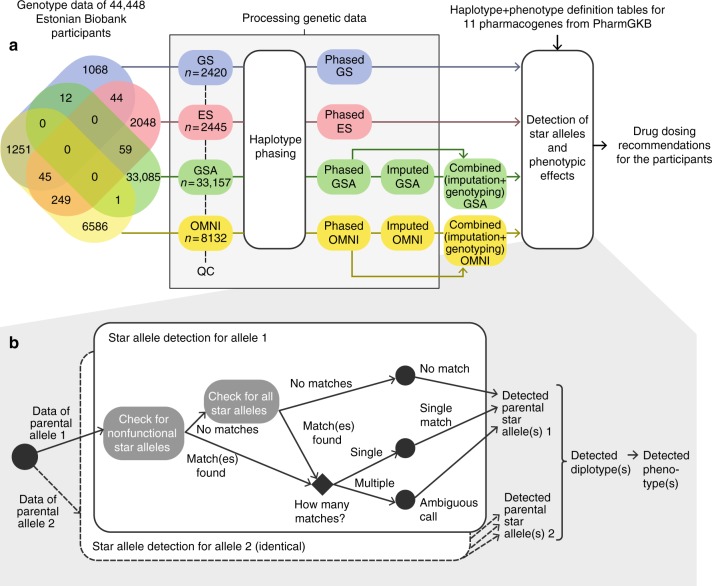
Fig. 1
Fig. 1
Pipeline for extracting pharmacogenetically relevant alleles from existing genotyping data. Panel (a) depicts the different data sets, their overlap (Venn diagram), and how the data were processed. Panel (b) zooms into the detection of star alleles according to specific definition tables. ES exome sequencing, GS genome sequencing, GSA Global Screening Array, OMNI HumanOmniExpress.
Fig. 2
Fig. 2
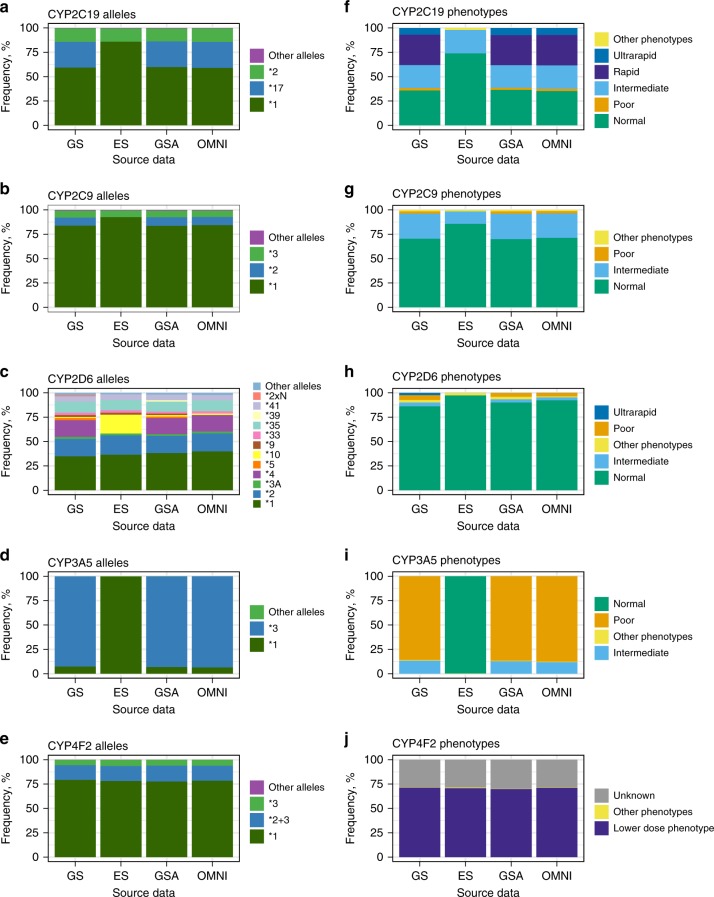
Frequencies of predicted alleles and phenotypes by CYP gene and method. The results for OMNI and GSA are based on imputed microarray genotype data. The decision to assign an allele a wild-type status (*1) is based upon a genotyping test that interrogates only the most common and already-proven sites of functional variation. In human DNA, it is always possible that a new, previously undiscovered (and therefore uninterrogated) site of variation may confer loss of function in an individual, and thus lead to the rare possibility of a nonfunctional allele being erroneously called as wild type. Alleles and phenotypes with frequencies below 2% are marked as “Other” for better visualization. ES exome sequencing, GS genome sequencing, GSA Global Screening Array, OMNI HumanOmniExpress.
Fig. 3
Fig. 3
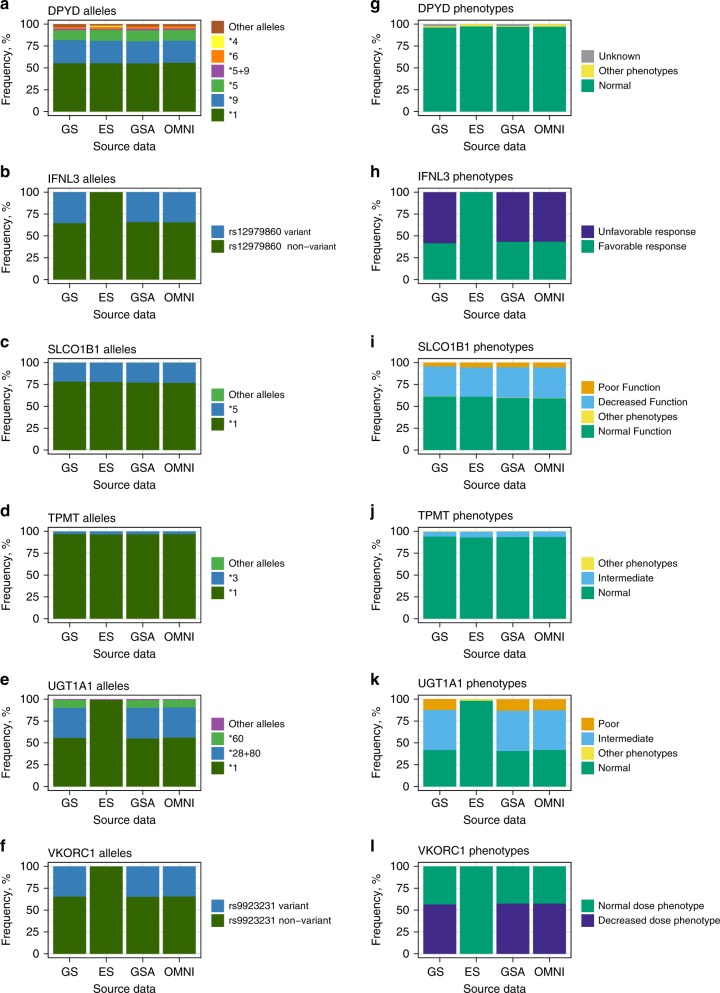
Frequencies of predicted alleles and phenotypes by gene and method for non-CYP genes. The results for OMNI and GSA are based on imputed microarray genotype data. The decision to assign an allele a wild-type status (*1) is based upon a genotyping test that interrogates only the most common and already-proven sites of functional variation. In human DNA, it is always possible that a new, previously undiscovered (and therefore uninterrogated) site of variation may confer loss of function in an individual, and thus lead to the rare possibility of a nonfunctional allele being erroneously called as wild type. Alleles and phenotypes with frequencies below 2% are marked as “Other” for better visualization. ES exome sequencing, GS genome sequencing, GSA Global Screening Array, OMNI HumanOmniExpress.

References

    1. Lauschke VM, Milani L, Ingelman-Sundberg M. Pharmacogenomic biomarkers for improved drug therapy—recent progress and future developments. AAPS J. 2018;20:4. doi: 10.1208/s12248-017-0161-x. - DOI - PubMed
    1. Lauschke VM, Ingelman-Sundberg M. Requirements for comprehensive pharmacogenetic genotyping platforms. Pharmacogenomics. 2016;17:917–924. doi: 10.2217/pgs-2016-0023. - DOI - PubMed
    1. Kozyra M, Ingelman-Sundberg M, Lauschke VM. Rare genetic variants in cellular transporters, metabolic enzymes and nuclear receptors can be important determinants of interindividual differences in drug response. Genet Med. 2017;19:20–29. doi: 10.1038/gim.2016.33. - DOI - PubMed
    1. Rasmussen-Torvik LJ, et al. Design and anticipated outcomes of the eMERGE-PGx Project: a multicenter pilot for preemptive pharmacogenomics in electronic health record systems. Clin Pharmacol Ther. 2014;96:482–489. doi: 10.1038/clpt.2014.137. - DOI - PMC - PubMed
    1. Dunnenberger HM, et al. Preemptive clinical pharmacogenetics implementation: current programs in five US medical centers. Annu Rev Pharmacol Toxicol. 2015;55:89–106. doi: 10.1146/annurev-pharmtox-010814-124835. - DOI - PMC - PubMed

Publication types

LinkOut - more resources