


Regional Differences in Palliative Care Utilization Among Geriatric Colorectal Cancer Patients Needing Emergent Surgery
- PMID: 30328071
- PMCID: PMC6751557
- DOI: 10.1007/s11605-018-3929-0
Regional Differences in Palliative Care Utilization Among Geriatric Colorectal Cancer Patients Needing Emergent Surgery
Abstract
Background: The benefits of palliative care (PC) in critical illness are validated across a range of diseases, yet it remains underutilized in surgical patients. This study analyzed patient and hospital factors predictive of PC utilization for elderly patients with colorectal cancer (CRC) requiring emergent surgery.
Methods: The National Inpatient Sample was queried for patients aged ≥ 65 years admitted emergently with CRC from 2009 to 2014. Patients undergoing colectomy, enterectomy, or ostomy formation were included and stratified according to documentation of PC consultation during admission. Chi-squared testing identified unadjusted group differences, and multivariable logistic regression identified predictors of PC.
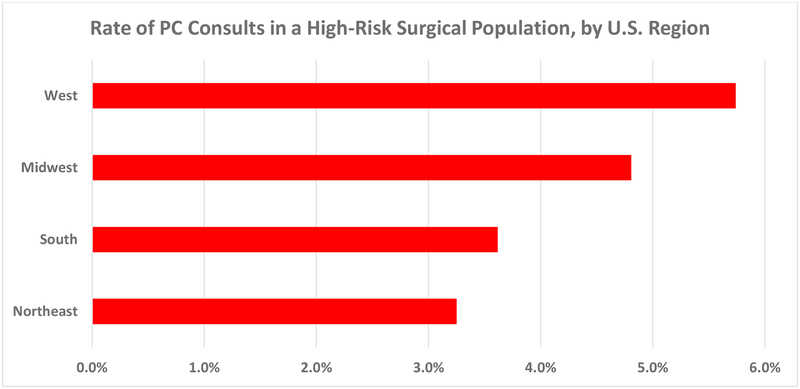
Results: Of 86,573 discharges meeting inclusion criteria, only 3598 (4.2%) had PC consultation. Colectomy (86.6%) and ostomy formation (30.4%) accounted for the operative majority. PC frequency increased over time (2.9% in 2009 to 6.2% in 2014, P < 0.001) and was nearly twice as likely to occur in the West compared with the Northeast (5.7 vs. 3.3%, P < 0.001) and in not-for-profit compared with proprietary hospitals (4.5 vs. 2.3%, P < 0.001). PC patients were more likely to have metastases (60.1 vs. 39.9%, P < 0.001) and die during admission (41.5 vs. 6.4%, P < 0.001). On multivariable logistic regression, PC predictors (P < 0.05) included region outside the Northeast, increasing age, more recent year, and metastatic disease.
Conclusions: In the USA, PC consultation for geriatric patients with surgically managed complicated CRC is low. Regional variation appears to play an important role. With mounting evidence that PC improves quality of life and outcomes, understanding the barriers associated with its provision to surgical patients is paramount.
Keywords: Colorectal neoplasms; Emergency treatment; Geriatrics; Palliative care.
Figures
References
-
- Institute of Medicine. Dying in America: Improving Quality and Honoring Individual Preferences Near the End of Life. Washington, DC: National Academies Press; 2015. - PubMed
-
- World Health Organization. Global atlas of palliative care at the end of life. 2014. http://www.who.int/nmh/Global_Atlas_of_Palliative_Care.pdf. Accessed April 20th, 2018.
-
- Temel JS, Greer JA, Muzikansky A, et al. Early palliative care for patients with metastatic non-small-cell lung cancer. N Engl J Med. 2010;363:733–742. - PubMed
-
- Dans M, Smith T, Back A, et al. NCCN Guidelines Insights: Palliative Care, Version 2.2017. J Natl Compr Canc Netw 2017;15:989–997 - PubMed
Publication types
MeSH terms
Grants and funding
LinkOut - more resources
Full Text Sources
Medical
