


CT-guided percutaneous core needle biopsy of pulmonary nodules smaller than 2 cm: technical aspects and factors influencing accuracy
- PMID: 30328929
- PMCID: PMC6326710
- DOI: 10.1590/S1806-37562017000000259
CT-guided percutaneous core needle biopsy of pulmonary nodules smaller than 2 cm: technical aspects and factors influencing accuracy
Abstract
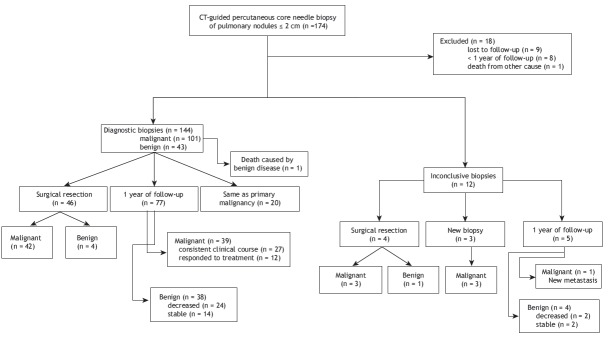
Objective: To evaluate the diagnostic accuracy of CT-guided percutaneous core needle biopsy (CT-CNB) of pulmonary nodules ≤ 2 cm, as well as to identify factors influencing the accuracy of the procedure and its morbidity.
Methods: This was a retrospective, single-center study of 170 consecutive patients undergoing CT-CNB of small pulmonary nodules (of ≤ 2 cm) between January of 2010 and August of 2015.
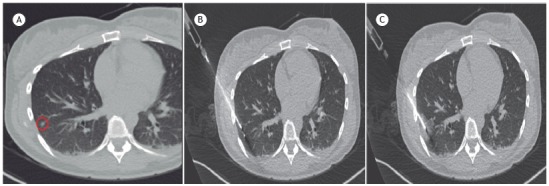
Results: A total of 156 CT-CNBs yielded a definitive diagnosis, the overall diagnostic accuracy being 92.3%. Larger lesions were associated with a higher overall accuracy (OR = 1.30; p = 0.007). Parenchymal hemorrhage occurring during the procedure led to lower accuracy rates (OR = 0.13; p = 0.022). Pneumothorax was the most common complication. A pleura-to-lesion distance > 3 cm was identified as a risk factor for pneumothorax (OR = 16.94), whereas performing a blood patch after biopsy was a protective factor for pneumothorax (OR = 0.18).
Conclusions: Small nodules (of < 2 cm) represent a technical challenge for diagnosis. CT-CNB is an excellent diagnostic tool, its accuracy being high.
Objetivo:: Avaliar a precisão diagnóstica da biópsia percutânea com agulha grossa, guiada por TC - doravante denominada BAG-TC - de nódulos pulmonares ≤ 2 cm, bem como identificar fatores que influenciam a precisão do procedimento e sua morbidade.
Métodos:: Estudo retrospectivo, realizado em um único centro, com 170 pacientes consecutivos submetidos a BAG-TC de nódulos pulmonares pequenos (≤ 2 cm) entre janeiro de 2010 e agosto de 2015.
Resultados:: Do total de biópsias, 156 resultaram em diagnóstico definitivo, com precisão diagnóstica global de 92,3%. Lesões maiores estiveram relacionadas com maior precisão global (OR = 1,30; p = 0,007). A presença de hemorragia parenquimatosa durante o procedimento resultou em menor precisão (OR = 0,13; p = 0,022). Pneumotórax foi a complicação mais comum. Uma distância > 3 cm entre a lesão e a pleura foi identificada como fator de risco de pneumotórax (OR = 16,94), ao passo que a realização de tampão sanguíneo após a biópsia foi um fator de proteção contra o pneumotórax (OR = 0,18).
Conclusões:: O diagnóstico de nódulos pequenos (< 2 cm) é um desafio do ponto de vista técnico. A BAG-TC é uma excelente ferramenta diagnóstica, cuja precisão é alta.
Figures
References
MeSH terms
LinkOut - more resources
Full Text Sources
Medical
Miscellaneous
