


Cell-Based Therapies for Cardiac Regeneration: A Comprehensive Review of Past and Ongoing Strategies
- PMID: 30332812
- PMCID: PMC6214096
- DOI: 10.3390/ijms19103194
Cell-Based Therapies for Cardiac Regeneration: A Comprehensive Review of Past and Ongoing Strategies
Abstract
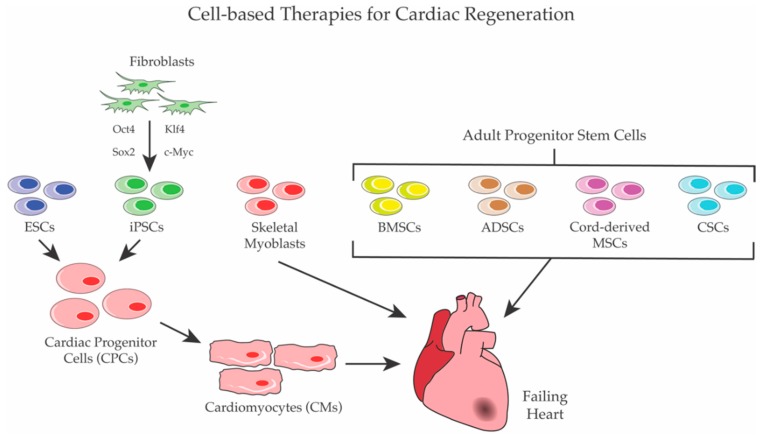
Despite considerable improvements in the treatment of cardiovascular diseases, heart failure (HF) still represents one of the leading causes of death worldwide. Poor prognosis is mostly due to the limited regenerative capacity of the adult human heart, which ultimately leads to left ventricular dysfunction. As a consequence, heart transplantation is virtually the only alternative for many patients. Therefore, novel regenerative approaches are extremely needed, and several attempts have been performed to improve HF patients' clinical conditions by promoting the replacement of the lost cardiomyocytes and by activating cardiac repair. In particular, cell-based therapies have been shown to possess a great potential for cardiac regeneration. Different cell types have been extensively tested in clinical trials, demonstrating consistent safety results. However, heterogeneous efficacy data have been reported, probably because precise end-points still need to be clearly defined. Moreover, the principal mechanism responsible for these beneficial effects seems to be the paracrine release of antiapoptotic and immunomodulatory molecules from the injected cells. This review covers past and state-of-the-art strategies in cell-based heart regeneration, highlighting the advantages, challenges, and limitations of each approach.
Keywords: cardiac clinical trials; cardiac regeneration; cell therapy; heart dysfunction; heart failure; stem cells; translational medicine.
Conflict of interest statement
The authors declare no conflict of interest.
Figures
References
-
- World Health Organization: Annual Report on Cardiovascular Diseases. [(accessed on 4 September 2018)];2017 Available online: http://www.webcitation.org/72fSeoOIs.
-
- Writing Group Member. Mozaffarian D., Benjamin E.J., Go A.S., Arnett D.K., Blaha M.J., Cushman M., Das S.R., de Ferranti S., Despres J.P., et al. Heart disease and stroke statistics-2016 update: A report from the american heart association. Circulation. 2016;133:e38–e360. doi: 10.1161/CIR.0000000000000350. - DOI - PubMed
-
- Conrad N., Judge A., Tran J., Mohseni H., Hedgecott D., Crespillo A.P., Allison M., Hemingway H., Cleland J.G., McMurray J.J.V., et al. Temporal trends and patterns in heart failure incidence: A population-based study of 4 million individuals. Lancet. 2018;391:572–580. doi: 10.1016/S0140-6736(17)32520-5. - DOI - PMC - PubMed
Publication types
MeSH terms
LinkOut - more resources
Full Text Sources
Research Materials
Miscellaneous
