


Safety, efficacy, and cost-effectiveness of intraoperative blood salvage in OPCABG with different amount of bleeding: a single-center, retrospective study
- PMID: 30333028
- PMCID: PMC6192097
- DOI: 10.1186/s13019-018-0794-6
Safety, efficacy, and cost-effectiveness of intraoperative blood salvage in OPCABG with different amount of bleeding: a single-center, retrospective study
Abstract
Background: We sought to evaluate the safety, efficacy, and cost-effectiveness of intraoperative blood salvage (IBS) in off-pump coronary artery bypass grafting (OPCABG) surgery with different amount of bleeding.
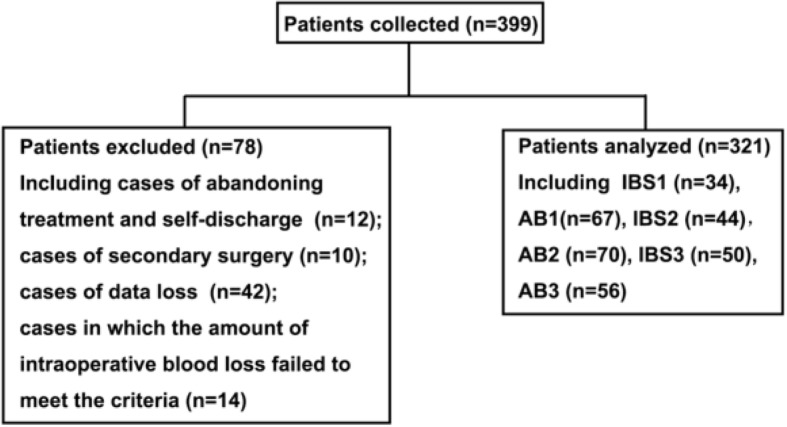
Methods: We retrospectively reviewed the medical records of 321 patients who underwent OPCABG between December 2012 and December 2016 at our hospital. Patients treated with IBS or allogeneic blood (AB) transfusions were divided into three groups depending on the amount of bleeding respectively: IBS1 or AB1 group (400-600 ml); IBS2 or AB2 group (600-1000 ml); IBS3 or AB3 group (1000-1500 ml). The intraoperative and postoperative conditions, blood transfusion volume, clinical and hematological outcomes, and total blood transfusion cost were examined.
Results: The amount of allogeneic red blood cell (RBC) transfusion in the IBSs groups were significantly lower than that in the ABs groups (P < 0.01). Furthermore, drainage volume 24 h post-surgery (P < 0.05) and white blood cell count (WBC) 2 day post-surgery (P < 0.01) in IBS3 group were significantly higher compared with the AB3 group. Additionally, when IBS cost was 230 USD per set, the total blood transfusion cost in the IBSs groups was significantly higher than that in the ABs groups (P < 0.01); however, when 199 or 184 USD, only the IBS1 group, rather than IBS2 or IBS3, showed significantly higher cost of the total blood transfusion compared with the AB1 group (P < 0.05).
Conclusions: When the amount of bleeding was 600-1000 ml, IBS can significantly reduce the demand for allogeneic blood, and has no direct adverse effects on coagulation function and recuperation, and is cost-effective in OPCABG.
Keywords: Autologous blood transfusion; Cost-effectiveness; OPCABG.
Conflict of interest statement
Ethics approval and consent to participate
The study was approved by the Ethics Committee of the First Affiliated Hospital of Anhui Medical University.
Consent for publication
Written informed consent was obtained from each patient.
Competing interests
The authors declare that they have no competing interests.
Publisher’s Note
Springer Nature remains neutral with regard to jurisdictional claims in published maps and institutional affiliations.
Figures
References
-
- Malhotra A, Garg P, Bishnoi AK, Sharma P, Wadhawa V, Shah K, et al. Dialyzer-based cell salvage system: a superior alternative to conventional cell salvage in off-pump coronary artery bypass grafting. Interact Cardiovasc Thorac Surg. 2017;24(4):489–497. - PubMed
Publication types
MeSH terms
LinkOut - more resources
Full Text Sources
