C-reactive Protein Can Predict Patients with Cirrhosis at a High Risk of Early Mortality after Acute Esophageal Variceal Bleeding
- PMID: 30333404
- PMCID: PMC6421136
- DOI: 10.2169/internalmedicine.1447-18
C-reactive Protein Can Predict Patients with Cirrhosis at a High Risk of Early Mortality after Acute Esophageal Variceal Bleeding
Abstract
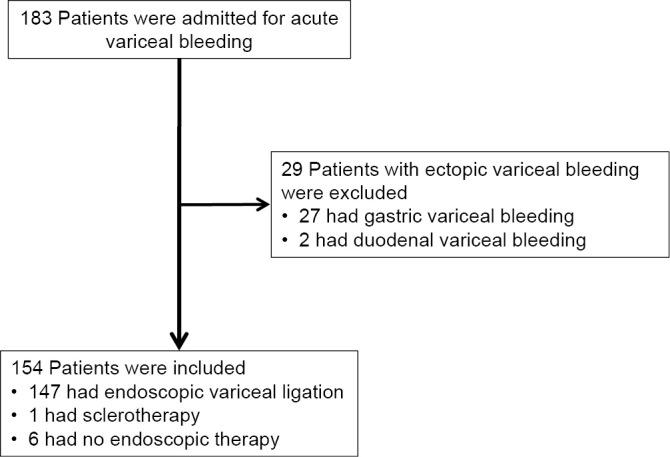
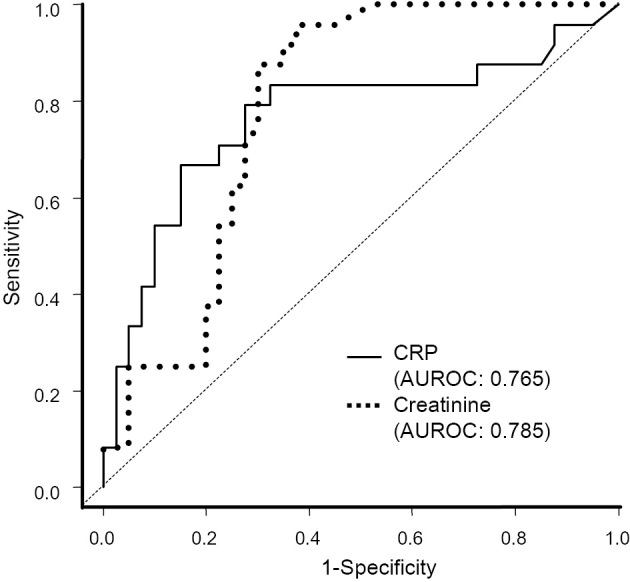
Objective The aim of this study was to identify patients with a high risk of early mortality after acute esophageal variceal bleeding by measuring the C-reactive protein (CRP) level. Methods We retrospectively evaluated 154 consecutive cirrhotic patients admitted with acute esophageal variceal bleeding. Differences between categorical variables were assessed by the chi-square test. Continuous variables were compared using the Mann-Whitney U-test. Multivariate logistic regression analyses consisting of clinical laboratory parameters were performed to identify risk factors associated with the 6-week mortality. The discriminative ability and the best cut-off value were assessed by a receiver-operating characteristic (ROC) curve analysis. Results Child-Pugh C patients showed a significantly higher 6-week mortality than Child-Pugh A or B patients (38% vs. 6%, p<0.0001). The 6-week mortality in Child-Pugh C patients was associated with the age (p<0.0001), etiology of cirrhosis (p=0.003), hepatocellular carcinoma (p=0.0003), portal vein thrombosis (p=0.005), baseline creatinine (p=0.0001), albumin (p=0.001), white blood cell count (p=0.038), baseline CRP [p=0.0004; area under the ROC (AUROC)=0.765; optimum cut-off value at 1.30 mg/dL] and bacterial infection (p=0.019). We determined that CRP ≥1.30 mg/dL was an independent predictor for 6-week mortality in Child-Pugh C patients [odds ratio (OR)=8.789; 95% confidence interval (CI): 2.080-47.496; p=0.003], along with a creatinine level of 0.71 mg/dL (OR=17.628; 95% CI: 2.349-384.426; p=0.004) (73% mortality if CRP ≥1.30 mg/dL vs. 19% if CRP<1.30 mg/dL, p<0.0001). Conclusion In Child-Pugh C patients with esophageal variceal bleeding, a baseline CRP ≥1.30 mg/dL can help identify patients with an increased risk of mortality.
Keywords: C-reactive protein; acute esophageal variceal bleeding; cirrhosis; early mortality.
Conflict of interest statement
Figures
References
-
- Sato M, Tateishi R, Yasunaga H, et al. Variceal hemorrhage: analysis of 9987 cases from a Japanese nationwide database. Hepatol Res 45: 288-293, 2015. - PubMed
-
- Jairath V, Rehal S, Logan R, et al. Acute variceal haemorrhage in the United Kingdom: patients characteristics, management and outcomes in a nationwide audit. Dis Liver Dis 46: 419-426, 2014. - PubMed
-
- Graham DY, Smith JL. The course of patients after variceal hemorrhage. Gastroenterology 80: 800-809, 1981. - PubMed
-
- Augustin S, Muntaner L, Altamirano JT, et al. Predicting early mortality after acute variceal hemorrhage based on classification and regression tree analysis. Clin Gastroenterol Hepatol 7: 1347-1354, 2009. - PubMed
-
- Augustin S, Altamirano J, Gonzalez A, et al. Effectiveness of combined pharmacologic and ligation therapy in high-risk patients with acute esophageal variceal bleeding. Am J Gastroenterol 106: 1787-1795, 2011. - PubMed
MeSH terms
Substances
LinkOut - more resources
Full Text Sources
Medical
Research Materials
Miscellaneous