Review
. 2019 Jan;76(2):301-328.
doi: 10.1007/s00018-018-2935-4. Epub 2018 Oct 17.

mRNA as novel technology for passive immunotherapy

Affiliations
Review

mRNA as novel technology for passive immunotherapy

Thomas Schlake et al. Cell Mol Life Sci. 2019 Jan.

Abstract

While active immunization elicits a lasting immune response by the body, passive immunotherapy transiently equips the body with exogenously generated immunological effectors in the form of either target-specific antibodies or lymphocytes functionalized with target-specific receptors. In either case, administration or expression of recombinant proteins plays a fundamental role. mRNA prepared by in vitro transcription (IVT) is increasingly appreciated as a drug substance for delivery of recombinant proteins. With its biological role as transient carrier of genetic information translated into protein in the cytoplasm, therapeutic application of mRNA combines several advantages. For example, compared to transfected DNA, mRNA harbors inherent safety features. It is not associated with the risk of inducing genomic changes and potential adverse effects are only temporary due to its transient nature. Compared to the administration of recombinant proteins produced in bioreactors, mRNA allows supplying proteins that are difficult to manufacture and offers extended pharmacokinetics for short-lived proteins. Based on great progress in understanding and manipulating mRNA properties, efficacy data in various models have now demonstrated that IVT mRNA constitutes a potent and flexible platform technology. Starting with an introduction into passive immunotherapy, this review summarizes the current status of IVT mRNA technology and its application to such immunological interventions.

Keywords: Adoptive cell transfer; Antibody; CAR T cell; Immune globulin; Passive immunization; Tolerability; mRNA design; mRNA technology.


Conflict of interest statement

The authors are employees of CureVac AG developing therapeutics based on sequence-engineered mRNA.

Figures
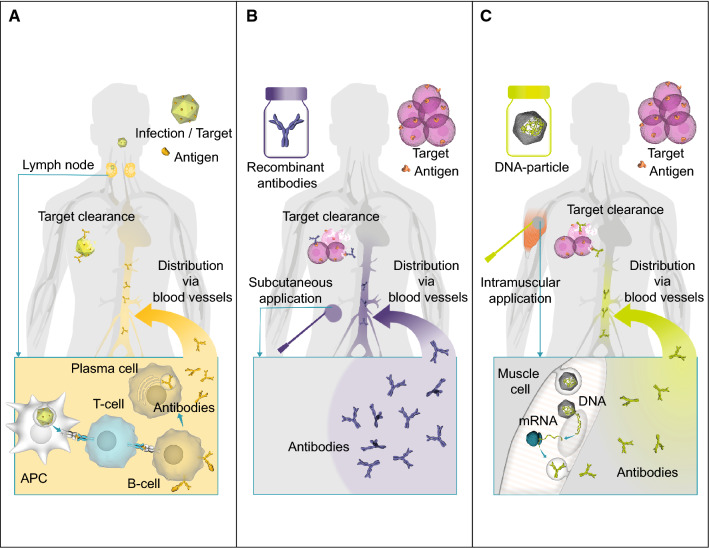
Fig. 1
Fig. 1
Schematic illustration comparing active immunization and passive antibody immunotherapies. a During active immunization triggered by natural infection or vaccination, antigenic patterns are presented by antigen-presenting cells in the lymph nodes. This leads to T cell mediated activation of antigen-specific B cells. As a consequence, B lymphocytes differentiate into plasma cells which produce and secrete antigen-specific antibodies that bind to cognate structures, finally leading to their clearance. b Instead of being produced by plasma B cells, antibodies can be manufactured recombinantly and administered for instance by subcutaneous injection for passive immunization. After injection, antibodies enter circulation by diffusion and act like endogenous antibodies. c For DNA-based passive immunization, DNA is often packaged in nanoparticles, e.g., virus capsids, which for instance can be injected intramuscularly. After uptake by muscle cells, DNA is released into the cytosol. For transcription into mRNA, the DNA has to enter the cell nucleus first. mRNA is then translated into antibodies which are secreted to bind their cognate targets
Fig. 2
Fig. 2
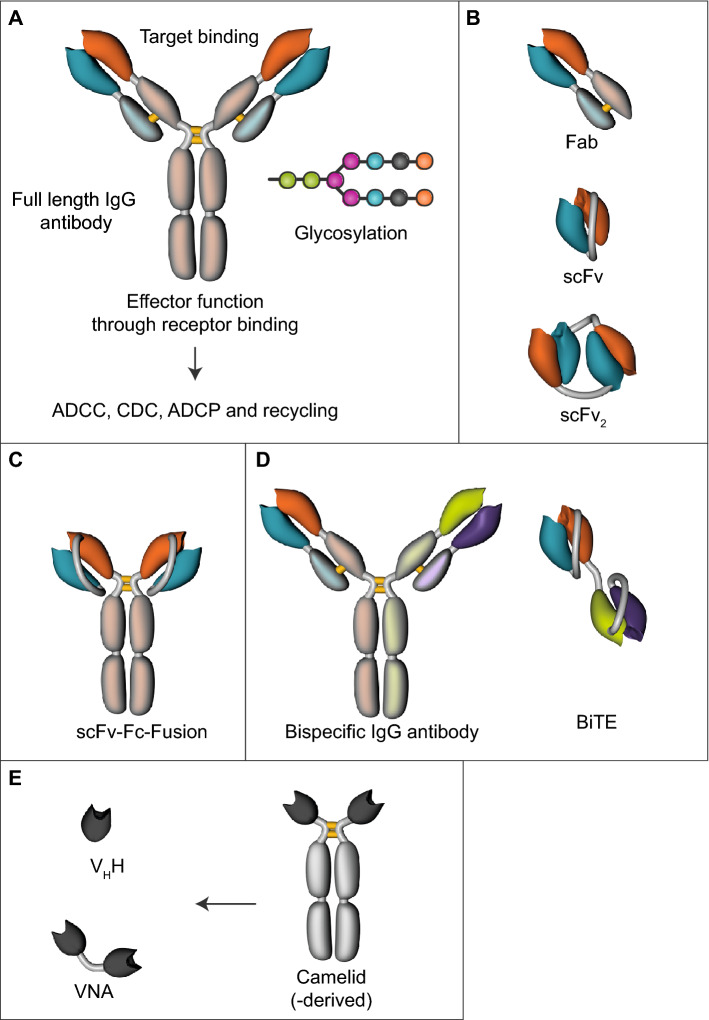
Schematic representation of antibody formats used for passive immunotherapies. a A full-size antibody consisting of two heavy and two light chains assembles via disulfide bonds (yellow connection). Both heavy and light chains contain constant (dim color) and variable (bright color) regions. Variable regions are involved in antigen binding. The heavy constant region contains the Fc region mediating effector functions and binding to the FcRn for antibody recycling and thus enhancing antibody serum half-life. Antibodies can be modified by glycosylation in the ER/Golgi posttranslationally. b Derivatives of full-size antibodies include Fab fragments and different types of scFvs. c To enhance the half-life or to introduce effector functions, scFv constructs can be fused to an Fc region. The resulting single-chain construct can assemble into a homo-dimer. d More complex antigen-binding properties can be introduced by the generation of bi-specific antibodies or covalently linked scFv domains with different binding affinities, such as bi-specific T-cell engagers (BiTE). e Camelids produce antibodies that lack light chains. Single domain VHH derived from such antibodies could be used for therapeutic purposes. More sophisticated approaches utilize fusions of two or more antigen-binding domains with identical or different antigen specificity termed VHH-based neutralizing agent (VNA)
Fig. 3
Fig. 3
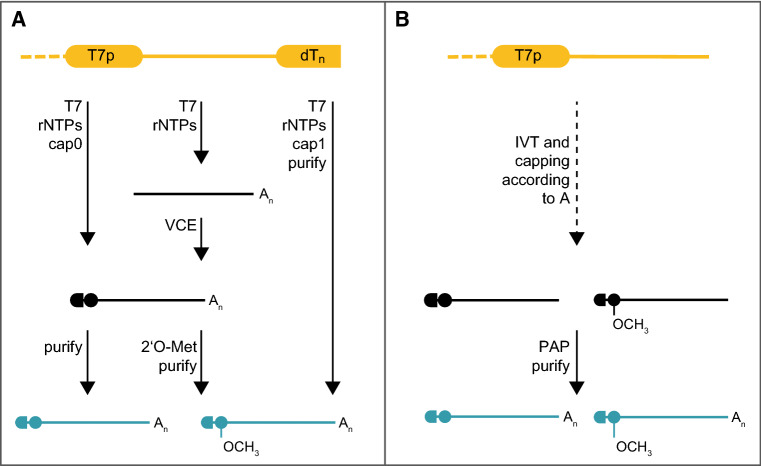
Flowchart for the manufacturing of IVT mRNA. a Starting with a DNA template (yellow) harboring all essential mRNA sequences including a poly(A) tail, different processes can be used to generate mRNA with either a cap0 or a cap1 structure (Fig. 4). T7p, T7 RNA polymerase promoter; dTn, poly(dT); T7, T7 RNA polymerase; rNTPs, ribonucleotides; cap0, cap1, cap analogs; VCE, Vaccinia virus capping enzyme; 2′O-Met, Vaccinia virus methyltransferase. b If a poly(A) tail is not encoded in the DNA template, it can be enzymatically added to the mRNA after IVT and capping by a poly(A) polymerase (PAP)
Fig. 4
Fig. 4
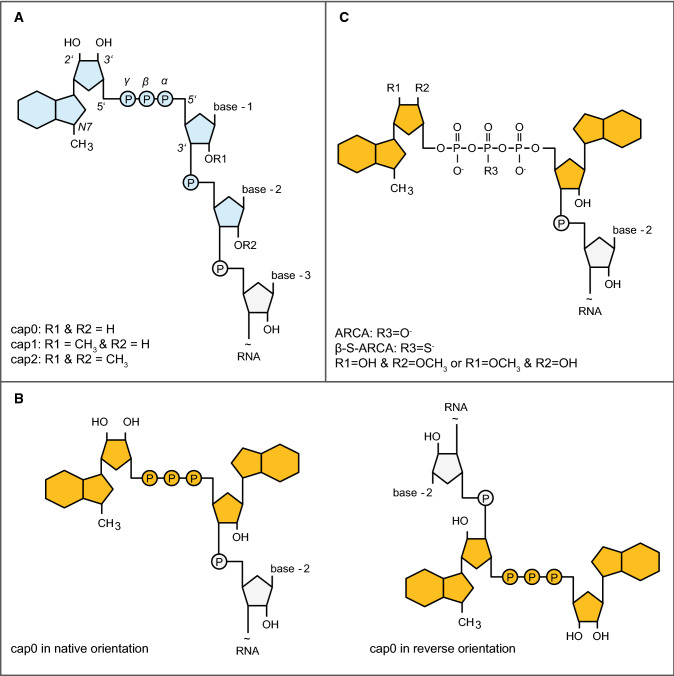
Schematic representation of different cap structures. a The typical 5′ cap of eukaryotic mRNAs. A guanosine is methylated at position 7 and linked to the first nucleotide of the mRNA by an unusual 5′ to 5′ triphosphate bridge. Depending on the degree of methylation of the first two bases of the mRNA, the full 5′ terminal structure is referred to as cap0, cap1 or cap2. The CleanCap™ analog, a trinucleotide introducing a cap1 structure during IVT, is indicated in blue. b A plain cap0 analog (orange) is incorporated in two orientations during IVT. c Inverse orientation can be avoided using anti-reverse cap analogs (ARCAs, highlighted in orange). Such analogs are characterized by the presence of a methoxy group at either C2′ or C3′ of m7G. To improve resistance to decapping, a phosphorothioate was positioned in the 5′–5′ bridge of ARCA (β-S-ARCA)
Fig. 5
Fig. 5
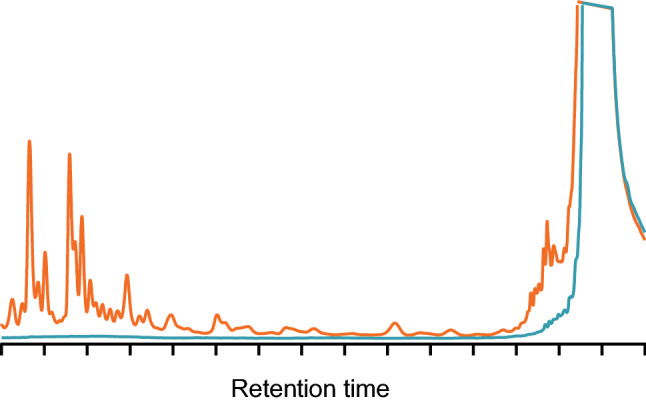
Prototypical analytical HPLC profiles demonstrating the effect of chromatographic purification of IVT mRNA. IVT mRNA preparations may be contaminated with smaller or larger by-products such as abortive transcripts or transcripts from traces of non-linearized DNA template. Analyzing a raw IVT mRNA preparation by HPLC, the various erroneous transcripts contained are apparent in the chromatogram (orange). After separating the various transcripts by size on a preparative HPLC column and isolating the mRNA of interest, reanalysis of the purified mRNA demonstrates complete removal of all contaminants (blue)
Fig. 6
Fig. 6
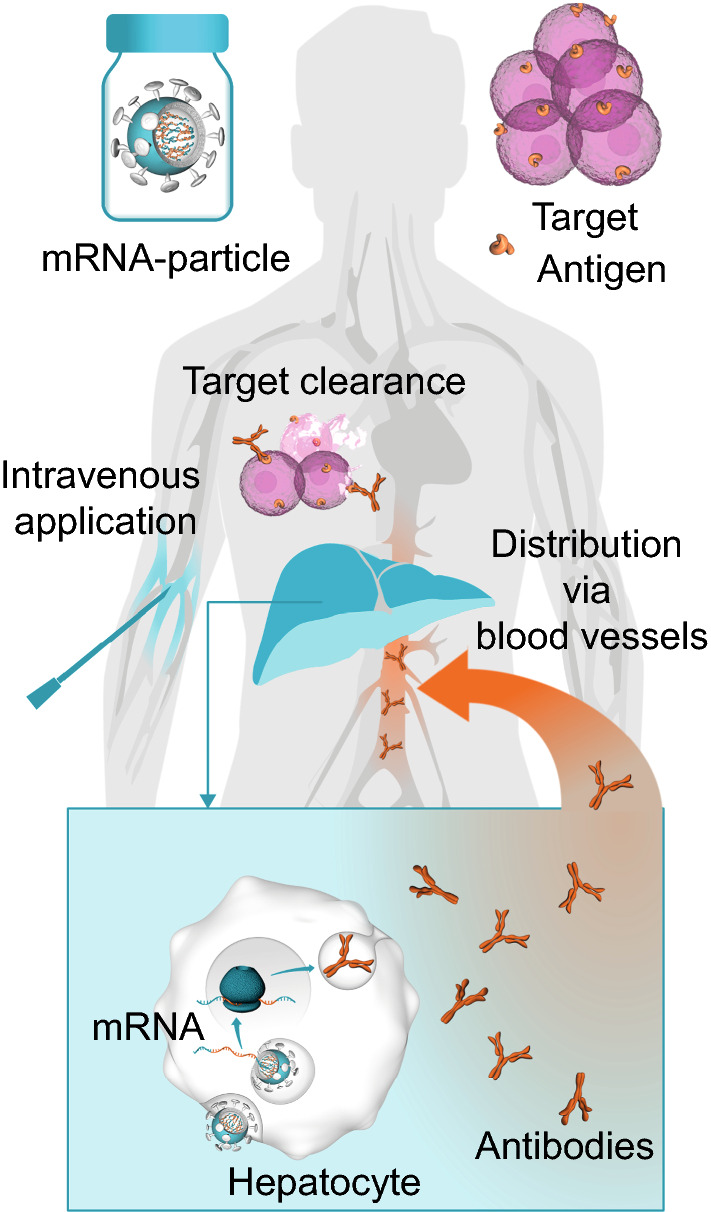
Schematic illustration of mRNA-mediated passive antibody immunotherapy. For in vivo administration, mRNA is usually formulated in nanoparticles which for instance can be administered by IV injection. For many formulations, liver is the main target organ. Upon uptake of nanoparticles by hepatocytes and release of the mRNA into the cytosol, it is translated into antibodies that are typically secreted into circulation and finally bind their cognate antigens

References

    1. Akira S, Uematsu S, Takeuchi O. Pathogen recognition and innate immunity. Cell. 2006;124(4):783–801. doi: 10.1016/j.cell.2006.02.015. - DOI - PubMed
    1. Rubartelli A, Lotze MT. Inside, outside, upside down: damage-associated molecular-pattern molecules (DAMPs) and redox. Trends Immunol. 2007;28(10):429–436. doi: 10.1016/j.it.2007.08.004. - DOI - PubMed
    1. Sanchez-Trincado JL, Gomez-Perosanz M, Reche PA. Fundamentals and methods for T- and B-cell epitope prediction. J Immunol Res. 2017;2017:2680160. doi: 10.1155/2017/2680160. - DOI - PMC - PubMed
    1. Kato A, Hulse KE, Tan BK, Schleimer RP. B-lymphocyte lineage cells and the respiratory system. J Allergy Clin Immunol. 2013;131(4):933–957. doi: 10.1016/j.jaci.2013.02.023. - DOI - PMC - PubMed
    1. Wang M, Yin B, Wang HY, Wang RF. Current advances in T-cell-based cancer immunotherapy. Immunotherapy. 2014;6(12):1265–1278. doi: 10.2217/imt.14.86. - DOI - PMC - PubMed

LinkOut - more resources