


The modified balloon crush technique: A simplified approach to optimizing final kissing balloon inflation
- PMID: 30334976
- PMCID: PMC6211915
- DOI: 10.1097/MD.0000000000012808
The modified balloon crush technique: A simplified approach to optimizing final kissing balloon inflation
Abstract
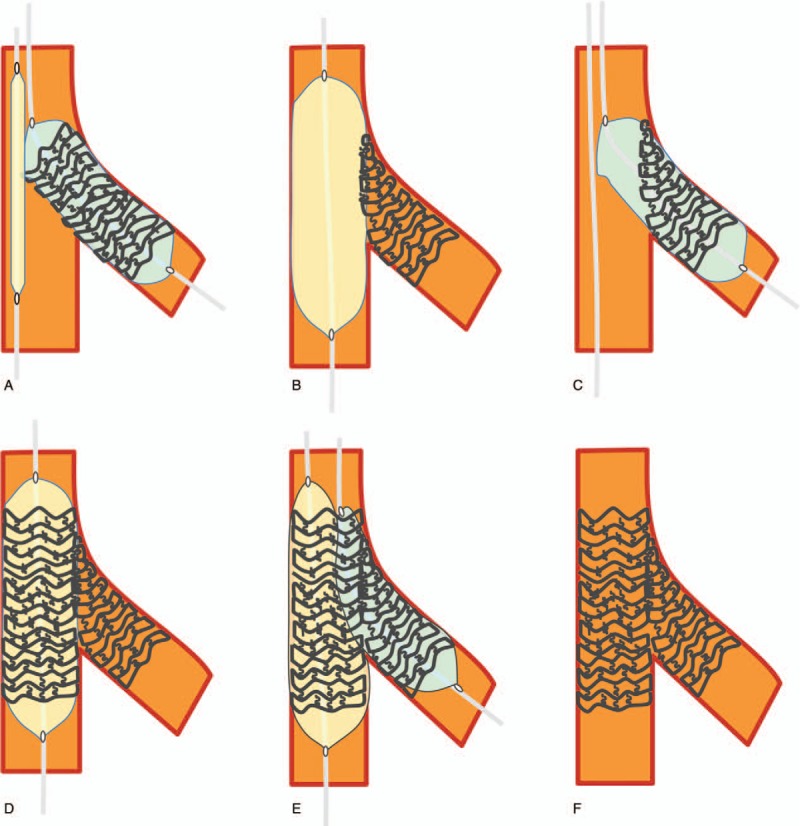
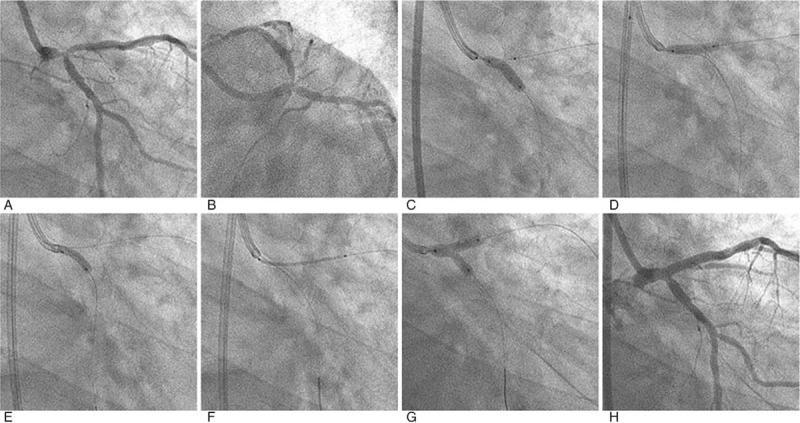
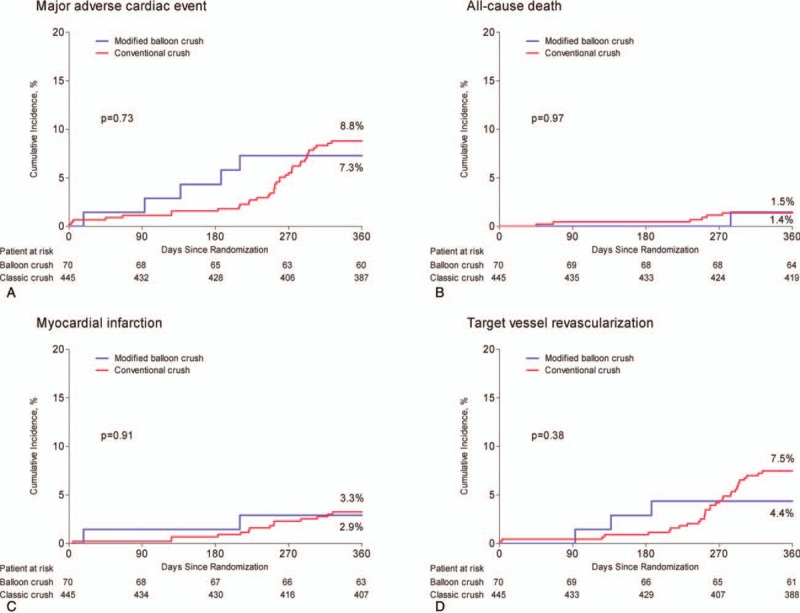
This study aimed to investigate the feasibility and safety of the modified balloon crush technique.The conventional crush technique accompanies difficult and suboptimal final kissing balloon inflation (FKI)In a single-center percutaneous coronary intervention registry, 515 patients with 515 bifurcation lesions were treated with the modified balloon technique (n = 70) or the conventional crush technique (n = 445). In contrast to the conventional crush technique, where the implanted side branch (SB) stent is crushed by expansion of the main branch (MB) stent, the modified balloon crush technique uses balloon crushing and additional SB ballooning across the crushed SB stent before MB stenting to facilitate FKI. The primary outcome of interest was major adverse cardiovascular event (MACE), a composite of all-cause death, spontaneous myocardial infarction, and target vessel revascularization.Baseline clinical and angiographic characteristics were similar between the 2 treatment groups. FKI had comparable success rates in both groups (97.1% for the modified balloon group and 98.4% for the conventional crush group; P = .35). There were no differences in procedure time, fluoroscopic time, or contrast amount between the 2 groups. At 1-year follow up, the cumulative MACE incidences were comparable between the 2 groups (7.3% vs 8.8%; P = .73). The incidence of target lesion revascularization (TLR) was significantly lower after the modified balloon crush technique compared with the conventional crush technique (0% vs 5.6%; P = .048).The modified balloon crush technique appears to be a feasible and safe alternative to the conventional crush technique with the potential to reduce the revascularization rate.
Conflict of interest statement
The authors declare no conflicts of interest.
Figures
References
-
- Chen SL, Sheiban I, Xu B, et al. Impact of the complexity of bifurcation lesions treated with drug-eluting stents: the DEFINITION study (Definitions and impact of complEx biFurcation lesIons on clinical outcomes after percutaNeous coronary IntervenTIOn using drug-eluting steNts). JACC Cardiovasc Interv 2014;7:1266–76. - PubMed
-
- Iakovou I, Ge L, Colombo A. Contemporary stent treatment of coronary bifurcations. J Am Coll Cardiol 2005;46:1446–55. - PubMed
-
- Costa RA, Mintz GS, Carlier SG, et al. Bifurcation coronary lesions treated with the “crush” technique: an intravascular ultrasound analysis. J Am Coll Cardiol 2005;46:599–605. - PubMed
-
- Ormiston JA, Currie E, Webster MW, et al. Drug-eluting stents for coronary bifurcations: insights into the crush technique. Catheter Cardiovasc Interv 2004;63:332–6. - PubMed
-
- Chen SL, Santoso T, Zhang JJ, et al. A randomized clinical study comparing double kissing crush with provisional stenting for treatment of coronary bifurcation lesions: results from the DKCRUSH-II (Double Kissing Crush versus Provisional Stenting Technique for Treatment of Coronary Bifurcation Lesions) trial. J Am Coll Cardiol 2011;57:914–20. - PubMed
Publication types
MeSH terms
LinkOut - more resources
Full Text Sources
Medical
Miscellaneous
