


Sevoflurane is an effective adjuvant to propofol-based total intravenous anesthesia for attenuating cough reflex in nonintubated video-assisted thoracoscopic surgery
- PMID: 30335029
- PMCID: PMC6211903
- DOI: 10.1097/MD.0000000000012927
Sevoflurane is an effective adjuvant to propofol-based total intravenous anesthesia for attenuating cough reflex in nonintubated video-assisted thoracoscopic surgery
Abstract
Background: Nonintubated video-assisted thoracic surgery (VATS) has been widely developed during the recent years. Cough reflex is an inevitably encountered problem while approaching lung lesions, and it may induce major bleeding. Sevoflurane anesthesia may attenuate cough reflex by inhibiting the pulmonary irritant receptors. However, the incidence of postoperative nausea and vomiting (PONV) in inhalational anesthesia is higher than in the propofol-based total intravenous anesthesia (TIVA). We investigated the effect of sevoflurane combination with propofol-based TIVA on cough reflex and PONV in nonintubated VATS.
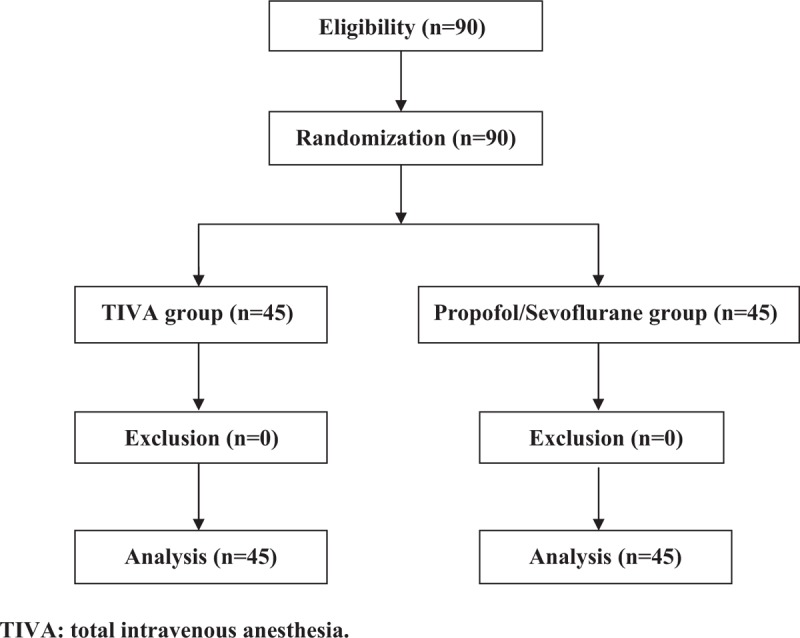
Methods: Ninety patients undergoing nonintubated VATS with laryngeal mask airway (LMA) and spontaneous breathing were randomly assigned for TIVA or propofol/sevoflurane anesthesia. In the TIVA group (n = 45), anesthesia was induced and maintained with propofol and fentanyl; in the propofol/sevoflurane (P/S) group (n = 45), 1% sevoflurane anesthesia was added to propofol and fentanyl anesthesia. The primary outcome measurements were cough reflex. In addition, the incidence of PONV and extubation time were investigated.
Results: Patients with cough reflex were significantly fewer in the P/S group than in the TIVA group (10/45 vs 34/45; P < .001). The cough severity (35/5/5/0 vs 11/17/17/0; P < .001) and limb movement (40/5/0/0 vs 28/17/0/0; P < .001) were lower in the P/S group than in the TIVA group. Besides, incremental fentanyl bolus for cough reflex was 5 (0 [0-1]) in the P/S group and 17 (0 [0-3]) in the TIVA group (P < .05). And there was no conversion to general anesthesia, postoperative hemorrhage, aspiration pneumonia, or PONV in the 2 groups. Besides, there was no significant difference in extubation time (TIVA: 5.04 ± 2.88 vs P/S: 4.44 ± 2.98 minutes; P = .33).
Conclusion: Sevoflurane attenuated cough reflex under propofol-based TIVA and did not increase the incidence of PONV and extubation time in nonintubated VATS.
Conflict of interest statement
Competing Interests: The authors declare no competing interests.
The authors have no conflicts of interest to disclose.
Figures
References
-
- Melnyk V, Ibinson JW, Kentor ML, et al. Updated retrospective single-center comparative analysis of peripheral nerve block complications using landmark peripheral nerve stimulation versus ultrasound guidance as a primary means of nerve localization. J Ultrasound Med 2018;doi: 10.1002/jum.14603. [Epub ahead of print]. - PubMed
-
- Reynolds RP, Effer GW, Bendeck MP. The upper esophageal sphincter in the cat: the role of central innervation assessed by transient vagal blockade. Can J Physiol Pharmacol 1987;65:96–9. - PubMed
-
- Neville AL, Crookes P, Velmahos GC, et al. Esophageal dysfunction in cervical spinal cord injury: a potentially important mechanism of aspiration. J Trauma 2005;59:905–11. - PubMed
Publication types
MeSH terms
Substances
LinkOut - more resources
Full Text Sources
Medical
