Effects of reward on spatial working memory in schizophrenia
- PMID: 30335439
- PMCID: PMC6197071
- DOI: 10.1037/abn0000369
Effects of reward on spatial working memory in schizophrenia
Abstract
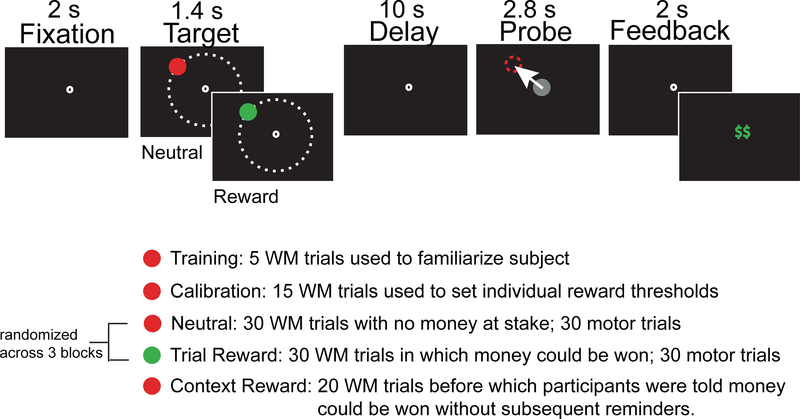
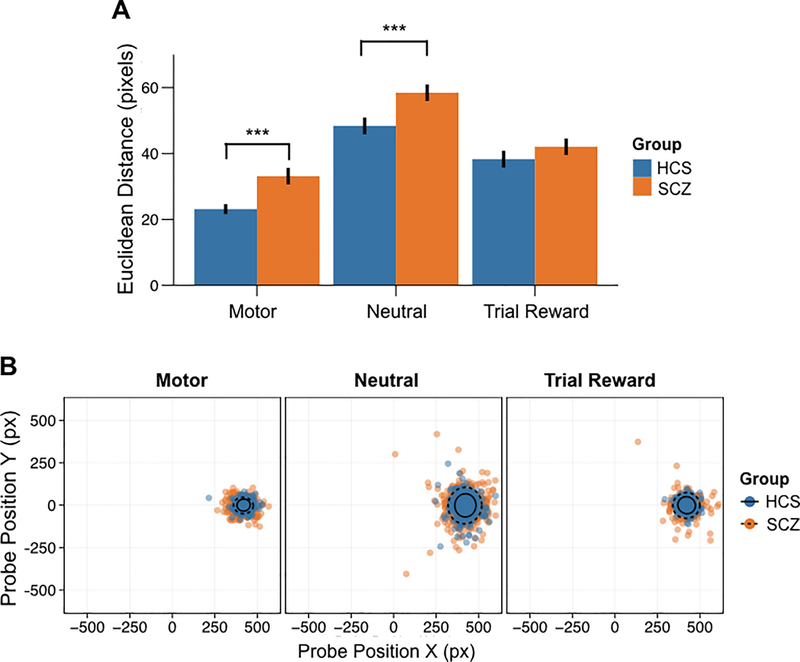
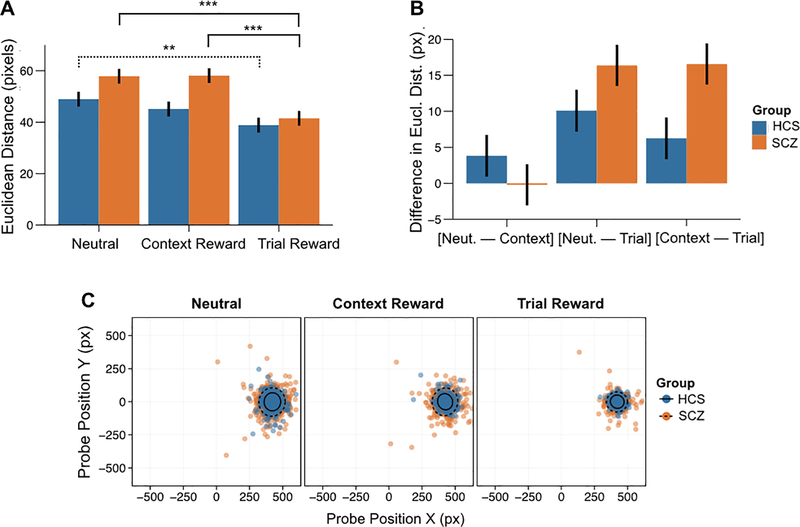
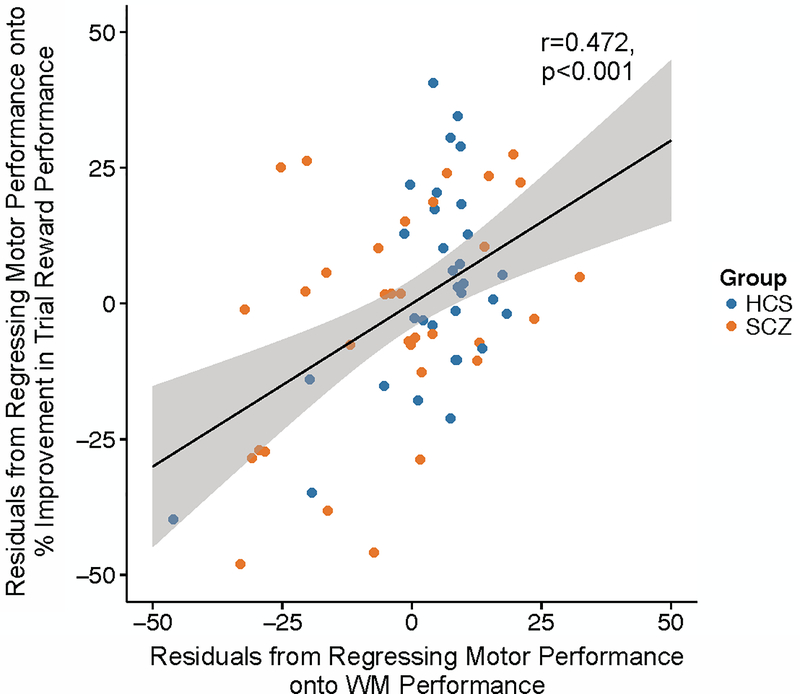
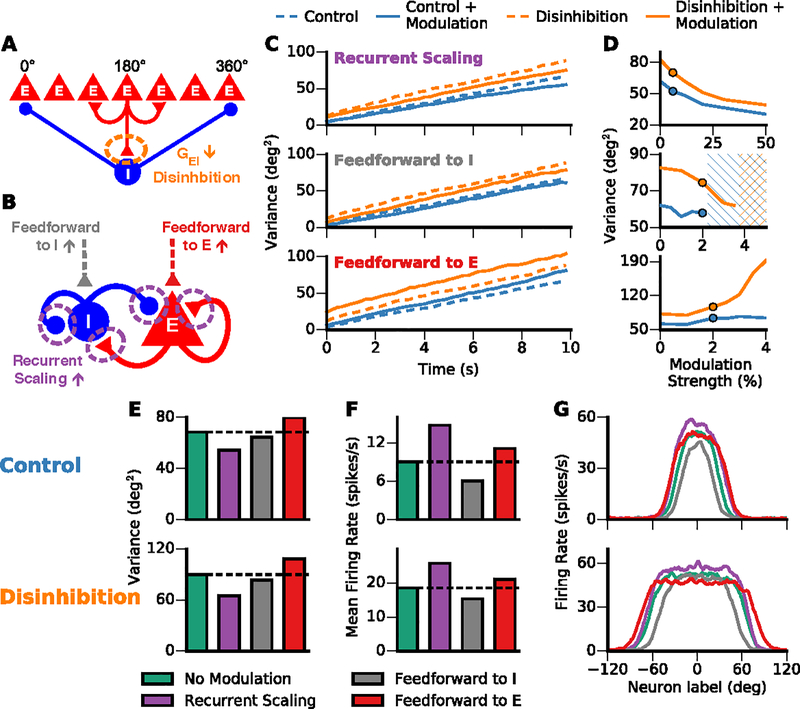
Reward processing and cognition are disrupted in schizophrenia (SCZ), yet how these processes interface is unknown. In SCZ, deficits in reward representation may affect motivated, goal-directed behaviors. To test this, we examined the effects of monetary reward on spatial working memory (WM) performance in patients with SCZ. To capture complimentary effects, we tested biophysically grounded computational models of neuropharmacologic manipulations onto a canonical fronto-parietal association cortical microcircuit capable of WM computations. Patients with SCZ (n = 33) and healthy control subjects (HCS; n = 32) performed a spatial WM task with 2 reward manipulations: reward cues presented prior to each trial, or contextually prior to a block of trials. WM performance was compared with cortical circuit models of WM subjected to feed-forward glutamatergic excitation, feed-forward GABAergic inhibition, or recurrent modulation strengthening local connections. Results demonstrated that both groups improved WM performance to reward cues presented prior to each trial (HCS d = -0.62; SCZ d = -1.0), with percent improvement correlating with baseline WM performance (r = .472, p < .001). However, rewards presented contextually before a block of trials did not improve WM performance in patients with SCZ (d = 0.01). Modeling simulations achieved improved WM precision through strengthened local connections via neuromodulation, or feed-forward inhibition. Taken together, this work demonstrates that patients with SCZ can improve WM performance to short-term, but not longer-term rewards-thus, motivated behaviors may be limited by strength of reward representation. A potential mechanism for transiently improved WM performance may be strengthening of local fronto-parietal microcircuit connections via neuromodulation or feed-forward inhibitory drive. (PsycINFO Database Record (c) 2018 APA, all rights reserved).
Figures
References
-
- Andreasen N, & Grove W (1986). Evaluation of positive and negative symptoms in schizophrenia. Psychiatry and Psychobiology, 1, 108–121.
-
- Anticevic A, Gancsos M, Murray JD, Repovs G, Driesen NR, Ennis DJ, . . . Corlett PR (2012). NMDA receptor function in large-scale anticorrelated neural systems with implications for cognition and schizophrenia. Proc Natl Acad Sci U S A, 109(41), 16720–16725. doi:10.1073/pnas.1208494109 - DOI - PMC - PubMed
-
- Anticevic A, & Murray JD (2017). Computational Psychiatry, Mathematical Modeling of Mental Illness, 1st edition. Academic Press.