


doi: 10.1164/rccm.201807-1279LE.
IL-5 Levels in Nasosorption and Sputosorption Correlate with Sputum Eosinophilia in Allergic Asthma
Affiliations
- PMID: 30335470
- PMCID: PMC6353000
- DOI: 10.1164/rccm.201807-1279LE
Item in Clipboard
IL-5 Levels in Nasosorption and Sputosorption Correlate with Sputum Eosinophilia in Allergic Asthma
Am J Respir Crit Care Med.
.
No abstract available
Figures
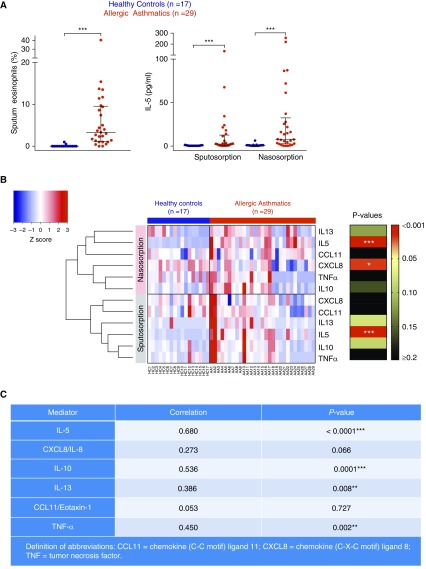
Sputosorption and nasosorption reveal IL-5 to be selectively increased in the asthmatic airway. (A) Sputum eosinophil levels (left) and nasosorption and sputosorption IL-5 levels (right) in healthy control patients (HCs; n = 17) and patients with asthma (n = 29). Bars represent median and interquartile range. Between-group comparisons by Mann-Whitney U test; ***P < 0.001. (B) Heat map of nasosorption and sputosorption levels of a panel of cytokines and chemokines (IL-5, IL-10, IL-13, tumor necrosis factor-α, CXCL8/IL-8, and CCL11) in HCs and allergic asthmatics (AAs). Mediator levels were normalized (Z scores) and were hierarchically clustered. Levels of mediators between HCs and AAs were compared using Mann-Whitney test and corresponding P values summarized: *P < 0.05; ***P < 0.001. (C) Spearman rank correlations between matched sputosorption and nasosorption samples in HCs and AAs: **P < 0.01; ***P < 0.001.
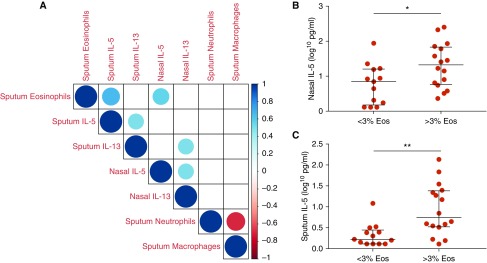
Airway IL-5 levels are closely associated with eosinophilic asthma. (A) Correlation matrix of nasosorption and sputosorption ILs and sputum eosinophils, neutrophils, and macrophages in patients with asthma (n = 29); blank squares denote insignificant correlations; color denotes Spearman R value. (B) Nasosorption IL-5 levels in allergic asthmatics stratified on a 3% cut-off for defining sputum eosinophilia (Eos). (C) Sputosorption IL-5 levels in allergic asthmatics with the 3% threshold for defining sputum eosinophilia. (<3% Eos: n = 13, >3%Eos: n = 16). *P = 0.037; **P = 0.001.
References
-
- Israel E, Reddel HK. Severe and difficult-to-treat asthma in adults. N Engl J Med. 2017;377:965–976. - PubMed
-
- Pavord ID, Beasley R, Agusti A, Anderson GP, Bel E, Brusselle G, et al. After asthma: redefining airways diseases. Lancet. 2018;391:350–400. - PubMed
-
- Hansel TT, Tunstall T, Trujillo-Torralbo MB, Shamji B, Del-Rosario A, Dhariwal J, et al. A comprehensive evaluation of nasal and bronchial cytokines and chemokines following experimental rhinovirus infection in allergic asthma: increased interferons (IFN-γ and IFN-λ) and type 2 inflammation (IL-5 and IL-13) EBioMedicine. 2017;19:128–138. - PMC - PubMed
-
- Bousquet J, Khaltaev N, Cruz AA, Denburg J, Fokkens WJ, Togias A, et al. World Health Organization; GA(2)LEN; AllerGen. Allergic Rhinitis and its Impact on Asthma (ARIA) 2008 update (in collaboration with the World Health Organization, GA(2)LEN and AllerGen) Allergy. 2008;63:8–160. - PubMed
Publication types
MeSH terms
Substances
LinkOut - more resources
Full Text Sources
Other Literature Sources
Medical
