


Virtual Reality, Augmented Reality, and In Vivo Exposure Therapy: A Preliminary Comparison of Treatment Efficacy in Small Animal Phobia
- PMID: 30335525
- PMCID: PMC6352498
- DOI: 10.1089/cyber.2017.0672
Virtual Reality, Augmented Reality, and In Vivo Exposure Therapy: A Preliminary Comparison of Treatment Efficacy in Small Animal Phobia
Abstract
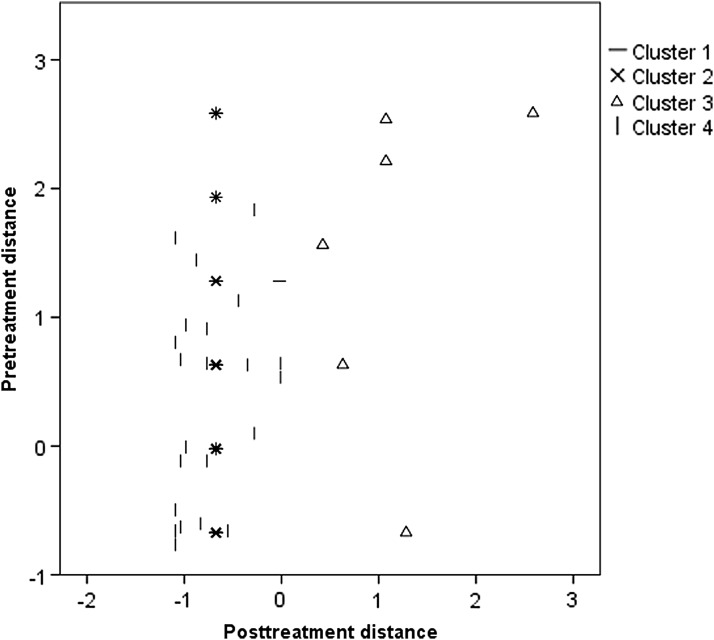
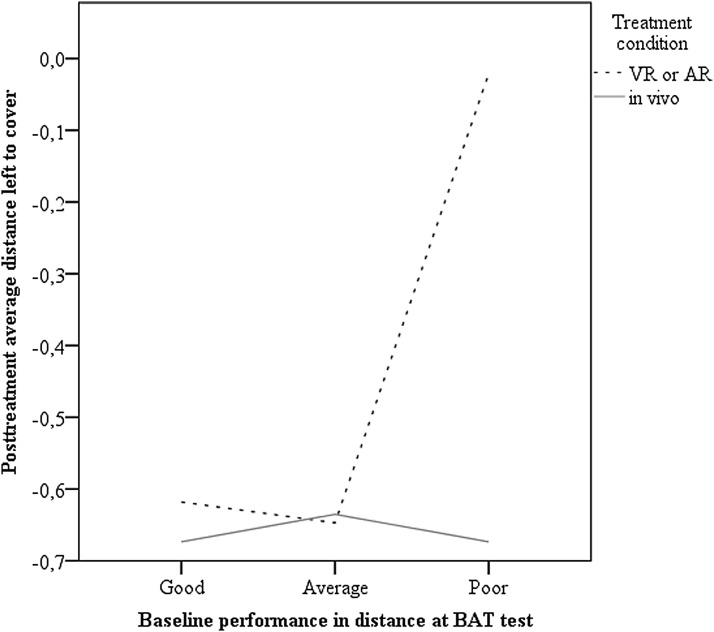
This study aggregated data from three randomized control trials to explore the differential efficacy of three forms of exposure therapy, namely, in vivo (iVET), virtual reality (VRET), and augmented reality (ARET), in the treatment of small animal phobia. Additionally, baseline patient characteristics were used to detect subgroups of patients who showed a differential response to certain treatment modalities. Primary measures were distance covered, anxiety during the behavioral avoidance test (BAT), and overall fear of small animals. A repeated-measures analysis of variance was used to explore the overall treatment effect across the exposure modalities. A cluster analysis and an analysis of moderation were conducted to explore differential response to treatments. The main study finding was that the three treatment conditions were similarly efficacious in the treatment of small animal phobia for all study outcomes. Only for distance covered, our results revealed a tendency for iVET to be more effective than VRET and ARET in participants with worse performance on the BAT before treatment. The present study findings provide further evidence for the comparable efficacy of the three forms of exposure. Our results also suggest that, overall, treatments are likely to be similarly effective, regardless of the individual baseline characteristics (i.e., fear, anxiety, and age), whereas pretreatment scores on distance covered in the avoidance test might be used to personalize treatments (iVET may be preferable when participants perform worse at pretreatment).
Keywords: exposure therapy; augmented reality exposure therapy; small animal phobia; virtual reality exposure therapy.
Conflict of interest statement
No competing financial interests exist.
Figures
References
-
- Becker ES, Rinck M, Türke V, et al. Epidemiology of specific phobia subtypes: findings from the Dresden Mental Health Study. European Psychiatry 2007; 22:69–74 - PubMed
-
- Curtis GC, Magee WJ, Eaton WW, et al. Specific fears and phobias. Epidemiology and classification. British Journal of Psychiatry 1998; 173:212–217 - PubMed
-
- Depla MFIA, ten Have ML, van Balkom AJLM, et al. Specific fears and phobias in the general population: results from the Netherlands Mental Health Survey and Incidence Study (NEMESIS). Social Psychiatry and Psychiatric Epidemiology 2008; 43:200–208 - PubMed
-
- Fredrikson M, Annas P, Fischer H, et al. Gender and age differences in the prevalence of specific fears and phobias. Behaviour Research and Therapy 1996; 34:33–39 - PubMed
-
- Morina N, Ijntema H, Meyerbröker K, Emmelkamp PMG. Can virtual reality exposure therapy gains be generalized to real-life? A meta-analysis of studies applying behavioral assessments. Behaviour Research and Therapy 2015; 74:18–24 - PubMed
Publication types
MeSH terms
Supplementary concepts
LinkOut - more resources
Full Text Sources
Medical
