


West Nile Virus and Other Nationally Notifiable Arboviral Diseases - United States, 2017
- PMID: 30335737
- PMCID: PMC6193690
- DOI: 10.15585/mmwr.mm6741a1
West Nile Virus and Other Nationally Notifiable Arboviral Diseases - United States, 2017
Abstract
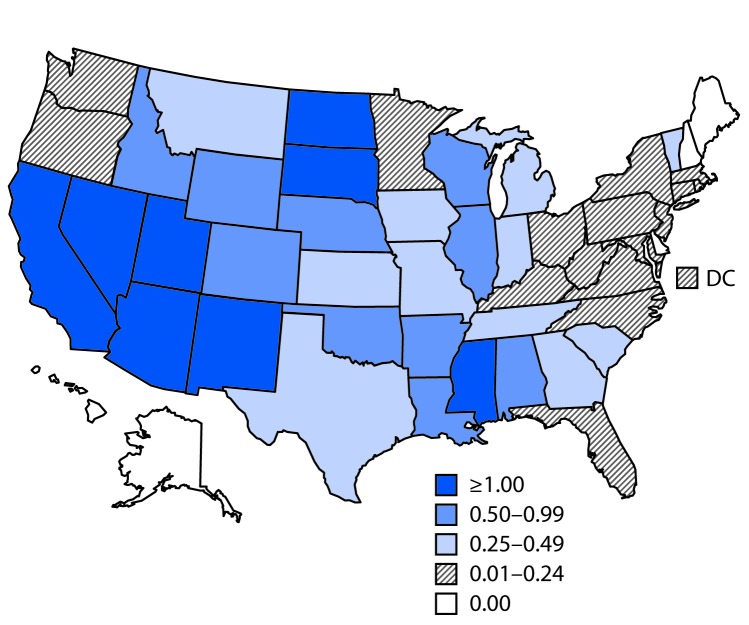
Arthropodborne viruses (arboviruses) are transmitted to humans primarily through the bites of infected mosquitoes or ticks. West Nile virus (WNV) is the leading cause of domestically acquired arboviral disease in the continental United States (1). Other arboviruses, including Jamestown Canyon, La Crosse, Powassan, St. Louis encephalitis, and eastern equine encephalitis viruses, cause sporadic cases of disease and occasional outbreaks. This report summarizes surveillance data reported to CDC from U.S. states in 2017 for nationally notifiable arboviruses. It excludes dengue, chikungunya, and Zika viruses because, in the continental United States, these viruses are acquired primarily through travel. In 2017, 48 states and the District of Columbia (DC) reported 2,291 cases of domestic arboviral disease, including 2,097 (92%) WNV disease cases. Among the WNV disease cases, 1,425 (68%) were classified as neuroinvasive disease (e.g., meningitis, encephalitis, or acute flaccid paralysis), for a national rate of 0.44 cases per 100,000 population. More Jamestown Canyon and Powassan virus disease cases were reported in 2017 than in any previous year. Because arboviral diseases continue to cause serious illness, maintaining surveillance is important to direct and promote prevention activities.
Conflict of interest statement
All authors have completed and submitted the ICMJE form for disclosure of potential conflicts of interest. No potential conflicts of interest were disclosed.
Figures
References
-
- American Academy of Pediatrics. Arboviruses. In: Kimberlin DW, Brady MT, Jackson MA, Long SS, eds. Red book: 2018 report of the Committee on Infectious Diseases. 31st ed. Elk Grove Village, IL: American Academy of Pediatrics; 2018:220–7.
-
- CDC. Arboviral diseases, neuroinvasive and non-neuroinvasive: 2015 case definition. Atlanta, GA: US Department of Health and Human Services, CDC; 2014. https://www.cdc.gov/nndss/conditions/arboviral-diseases-neuroinvasive-an...
-
- CDC. West Nile virus: statistics & maps. Fort Collins, CO: US Department of Health and Human Services, CDC; 2015. https://www.cdc.gov/westnile/statsMaps/index.html
MeSH terms
LinkOut - more resources
Full Text Sources
Medical
