


Development and application of a Bacillus anthracis protective antigen domain-1 in-house ELISA for the detection of anti-protective antigen antibodies in cattle in Zambia
- PMID: 30335853
- PMCID: PMC6193699
- DOI: 10.1371/journal.pone.0205986
Development and application of a Bacillus anthracis protective antigen domain-1 in-house ELISA for the detection of anti-protective antigen antibodies in cattle in Zambia
Erratum in
-
Correction: Development and application of a Bacillus anthracis protective antigen domain-1 in-house ELISA for the detection of anti-protective antigen antibodies in cattle in Zambia.PLoS One. 2019 Jan 25;14(1):e0211592. doi: 10.1371/journal.pone.0211592. eCollection 2019. PLoS One. 2019. PMID: 30682188 Free PMC article.
Abstract
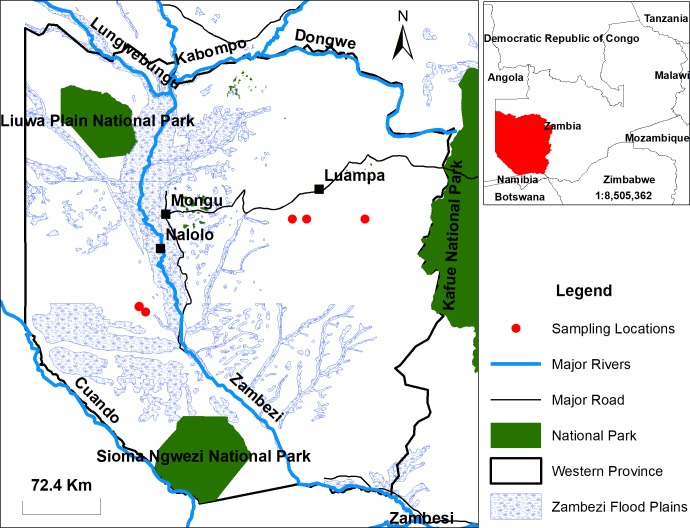
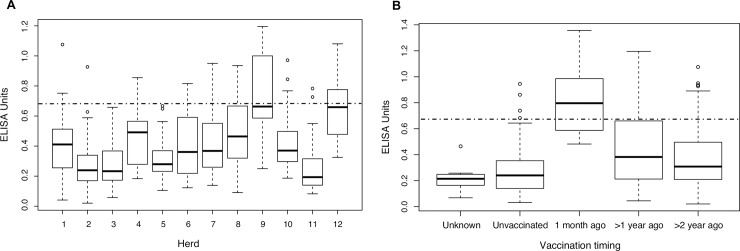
In Zambia, anthrax outbreaks among cattle are reported on nearly an annual basis. Presently, there is a lack of serological assays and information to develop an anthrax management and control strategy. In this study, an indirect enzyme-linked immunosorbent assay (ELISA) based on recombinant protective antigen domain 1 (rPA-D1) of Bacillus anthracis was developed and used to detect anti-PA antibodies in cattle in Zambia. An antigen coating of 10 ng/well and a serum dilution of 1:100 were determined to be the optimal rPA-D1 ELISA titration conditions. The intra- and inter-assay % coefficients of variation were less than 10% and 15%, respectively. The rPA-D1 ELISA could detect seroconversion in the cattle 1 month after anthrax vaccination. In a cross-sectional study conducted in the Western Province, Zambia, 187 serum samples from 8 herds of cattle were screened for anti-PA antibodies using the rPA-D1 ELISA. The seropositive rate of the serum samples was 8%, and the mean anti-PA antibody was 0.358 ELISA units. Additionally, we screened 131 cattle serum samples from Lusaka, which is a nonendemic area, and found no significant association between the antibody levels and sampling area (endemic versus nonendemic area). Conversely, significant differences were observed between the anti-PA antibody levels and herds, anti-PA antibody levels and vaccination status and anti-PA antibody levels and vaccination timing. Collectively, these findings suggest that the rPA-D1 ELISA is a useful tool for the detection of anti-PA antibodies in cattle in Zambia. The low proportion of seropositive sera indicates that there is inadequate cattle vaccination in the Western Province and, in addition to other epidemiological factors, this may precipitate the anthrax outbreak recurrence.
Conflict of interest statement
The authors have declared that no competing interests exist.
Figures


References
-
- World Health Organization Anthrax in Humans and Animals, 4th edn. Geneva: WHO. 2008, pp 10–14. Available at http://www.who.int/csr/resources/publications/AnthraxGuidelines2008/en/ (accessed 15 January 2017).
-
- Republic of Zambia, Ministry of Agriculture and Livestock, Department of Livestock Veterinary Development. Annual Report. 2010.
Publication types
MeSH terms
Substances
LinkOut - more resources
Full Text Sources
