


APOE4 Genotype Exerts Greater Benefit in Lowering Plasma Cholesterol and Apolipoprotein B than Wild Type (E3/E3), after Replacement of Dietary Saturated Fats with Low Glycaemic Index Carbohydrates
- PMID: 30336580
- PMCID: PMC6213759
- DOI: 10.3390/nu10101524
APOE4 Genotype Exerts Greater Benefit in Lowering Plasma Cholesterol and Apolipoprotein B than Wild Type (E3/E3), after Replacement of Dietary Saturated Fats with Low Glycaemic Index Carbohydrates
Abstract
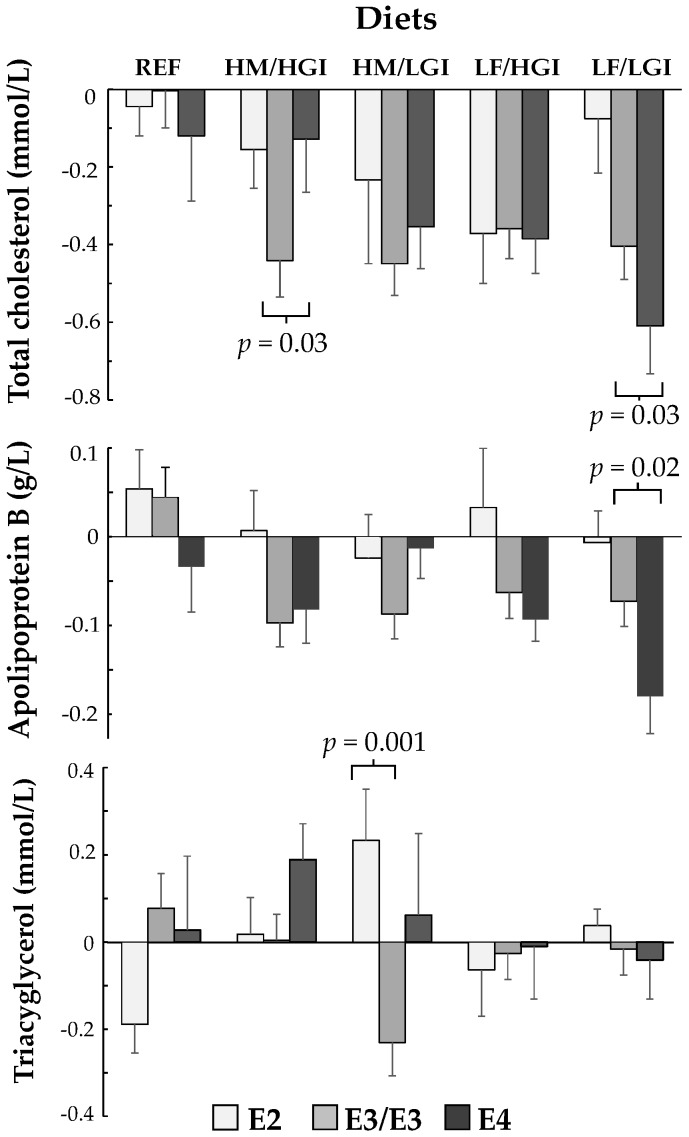
We examined the impact of APOE genotype on plasma lipids and glucose in a secondary analysis of data from a five-arm, randomised controlled, parallel dietary intervention trial ('RISCK' study), to investigate the impact of replacing saturated fatty acids (SFA) with either monounsaturated fat (MUFA) or carbohydrate of high or low glycaemic index (GI) on CVD risk factors and insulin sensitivity. We tested the impact of APOE genotype (carriage of E2 and E4 alleles versus E3/E3), determined retrospectively, on plasma lipids, lipoproteins and glucose homeostasis at baseline (n = 469), and on the change in these variables after 24 weeks of dietary intervention (n = 389). At baseline, carriers of E2 (n = 70), E4 (n = 125) and E3/E3 (n = 274) expressed marked differences in total plasma cholesterol (TC, p = 0.001), low density lipoprotein cholesterol (LDL-C, p < 0.0001), apolipoprotein B (apo B, p < 0.0001) and total to high density lipoprotein cholesterol ratio (TC:HDL-C, p = 0.002), with plasma concentrations decreasing in the order E4 > E3/E3 > E2. Following intervention, there was evidence of a significant diet x genotype interaction with significantly greater decreases in TC (p = 0.02) and apo B (p = 0.006) among carriers of E4 when SFA was replaced with low GI carbohydrate on a lower fat diet (TC -0.28 mmol/L p = 0.03; apo B -0.1 g/L p = 0.02), and a relative increase in TC (in comparison to E3/E3) when SFA was replaced with MUFA and high GI carbohydrates (TC 0.3 mmol/L, p = 0.03). Among carriers of E2 (compared with E3/E3) there was an increase in triacylglycerol (TAG) when SFA was replaced with MUFA and low GI carbohydrates 0.46 mmol/L p = 0.001). There were no significant interactions between APOE genotype and diet for changes in indices of glucose homeostasis. In conclusion, variations in APOE genotype led to differential effects on the lipid response to the replacement of SFA with MUFA and low GI carbohydrates.
Keywords: LDL cholesterol; apolipoprotein E genotype; polymorphism; saturated fat; ‘RISCK’ study.
Conflict of interest statement
The authors declare no conflicts of interest.
Figures
References
-
- Astrup A., Dyerberg J., Elwood P., Hermansen K., Hu F.B., Jakobsen M.U., Kok F.J., Krauss R.M., Lecerf J.M., LeGrand P., et al. The role of reducing intakes of saturated fat in the prevention of cardiovascular disease: Where does the evidence stand in 2010? Am. J. Clin. Nutr. 2010;93:684–688. doi: 10.3945/ajcn.110.004622. - DOI - PMC - PubMed
Publication types
MeSH terms
Substances
Grants and funding
LinkOut - more resources
Full Text Sources
Medical
Molecular Biology Databases
Miscellaneous
