. 2018 Oct 18;6(1):183.
doi: 10.1186/s40168-018-0572-7.

Consistent responses of soil microbial taxonomic and functional attributes to mercury pollution across China

Affiliations

Consistent responses of soil microbial taxonomic and functional attributes to mercury pollution across China

Yu-Rong Liu et al. Microbiome. .

Abstract

Background: The ecological consequences of mercury (Hg) pollution-one of the major pollutants worldwide-on microbial taxonomic and functional attributes remain poorly understood and largely unexplored. Using soils from two typical Hg-impacted regions across China, here, we evaluated the role of Hg pollution in regulating bacterial abundance, diversity, and co-occurrence network. We also investigated the associations between Hg contents and the relative abundance of microbial functional genes by analyzing the soil metagenomes from a subset of those sites.

Results: We found that soil Hg largely influenced the taxonomic and functional attributes of microbial communities in the two studied regions. In general, Hg pollution was negatively related to bacterial abundance, but positively related to the diversity of bacteria in two separate regions. We also found some consistent associations between soil Hg contents and the community composition of bacteria. For example, soil total Hg content was positively related to the relative abundance of Firmicutes and Bacteroidetes in both paddy and upland soils. In contrast, the methylmercury (MeHg) concentration was negatively correlated to the relative abundance of Nitrospirae in the two types of soils. Increases in soil Hg pollution correlated with drastic changes in the relative abundance of ecological clusters within the co-occurrence network of bacterial communities for the two regions. Using metagenomic data, we were also able to detect the effect of Hg pollution on multiple functional genes relevant to key soil processes such as element cycles and Hg transformations (e.g., methylation and reduction).

Conclusions: Together, our study provides solid evidence that Hg pollution has predictable and significant effects on multiple taxonomic and functional attributes including bacterial abundance, diversity, and the relative abundance of ecological clusters and functional genes. Our results suggest an increase in soil Hg pollution linked to human activities will lead to predictable shifts in the taxonomic and functional attributes in the Hg-impacted areas, with potential implications for sustainable management of agricultural ecosystems and elsewhere.

Keywords: Co-occurrence network; Functional gene; Mercury pollution; Metagenomics; Soil microbial community.


Conflict of interest statement

Ethics approval and consent to participate

Not applicable.

Consent for publication

Not applicable.

Competing interests

The authors declare that they have no competing interests.

Publisher’s Note

Springer Nature remains neutral with regard to jurisdictional claims in published maps and institutional affiliations.

Figures
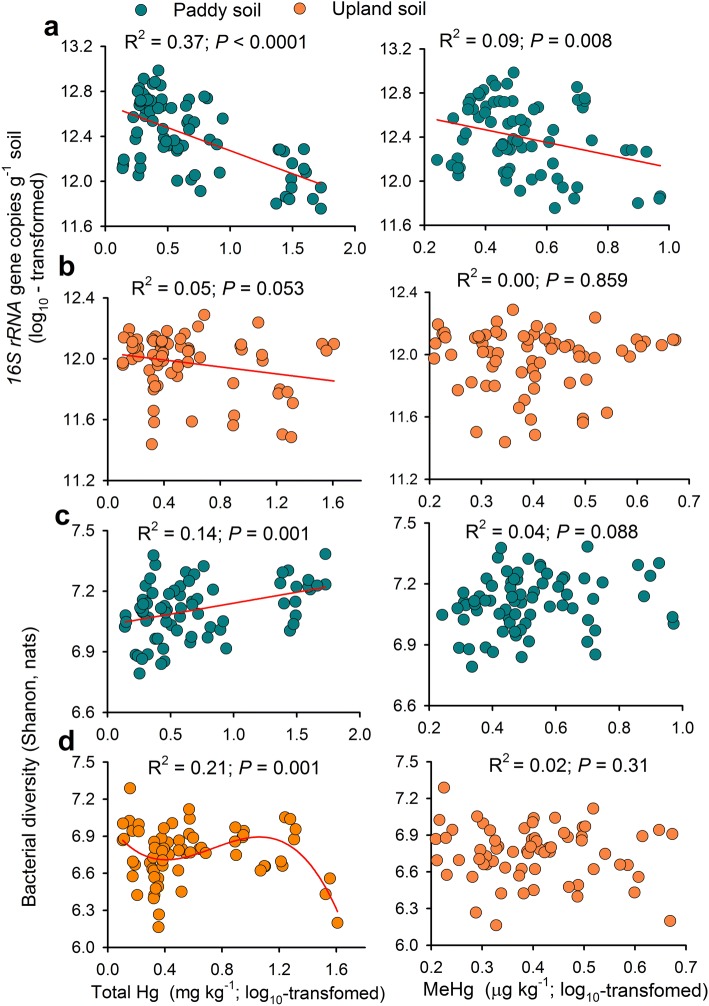
Fig. 1
Fig. 1
Relationships between soil mercury (Hg, including total Hg and methylmercury, MeHg) and the bacterial abundance (a, b), and diversity (c, d) in paddy and upland soils. Green and yellow dots represent samples from paddy and upland fields, respectively. Red lines represent regressions with linear (straight) and cubic (curve) functions (P < 0.05)
Fig. 2
Fig. 2
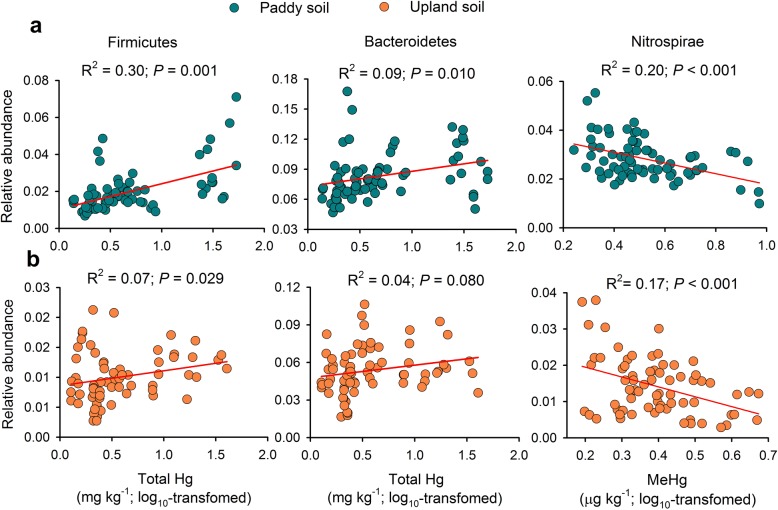
Linear relationships between soil Hg contents and the relative abundance of selected bacterial phyla in paddy (a) and upland (b) soils. Correlations between Hg concentrations and the relative abundance of all major bacterial phyla are available in Additional file 1: Table S1
Fig. 3
Fig. 3
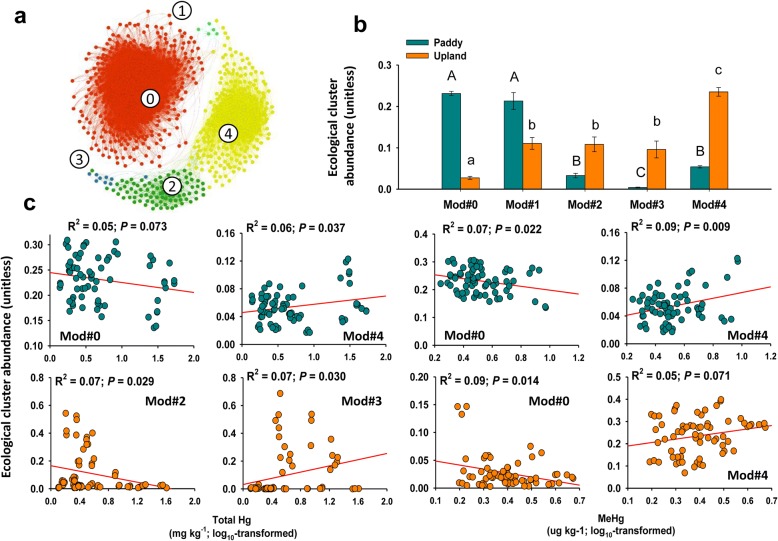
Microbial correlation network. Panel a represents a network diagram with nodes (taxa) colored by each of the major five ecological clusters (modules, Mod) within co-occurrence network of bacterial communities; Panel b includes the relative abundance of the five modules. Capital letters indicate the significant differences between the paddy soils (P < 0.05). Lowercase letters indicate the significant differences between the upland soils (P < 0.05); Panel c includes the linear relationships between soil Hg pollution (total Hg and MeHg) and the relative abundance of the selected ecological clusters
Fig. 4
Fig. 4
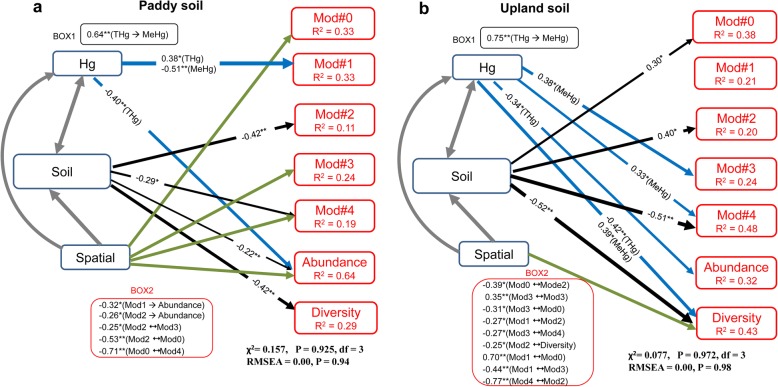
Mechanistic modeling identifying the direct and indirect effects of Hg on bacterial abundance, diversity, and the relative abundance of ecological clusters (modules, Mod) within co-occurrence networks in paddy (a) and upland (b) soils. The Hg box includes total Hg and methylmercury, and the spatial box includes longitude and latitude. The soil box includes soil properties that were represented by the three major components by performing principal component analysis of soil variables including pH, soil organic carbon (SOC), C: N, and others (Additional file 1: Table S3). The thickness of the arrow represents the strength of the relationship when significant, while no arrow is showed when the effect is not significant. Numbers adjacent to arrows are path coefficients with significant levels. R2 denotes the proportion of variance explained. Spatial (latitude and longitude) influence was included to control spatial autocorrelation; however, in this case, path coefficients were not included for simplicity. The BOX2 includes the significant correlations between modules, diversity, and abundance. The rest of significant effects are available in Additional file 1: Table S4 (P < 0.05).*P < 0.05, **P < 0.01
Fig. 5
Fig. 5
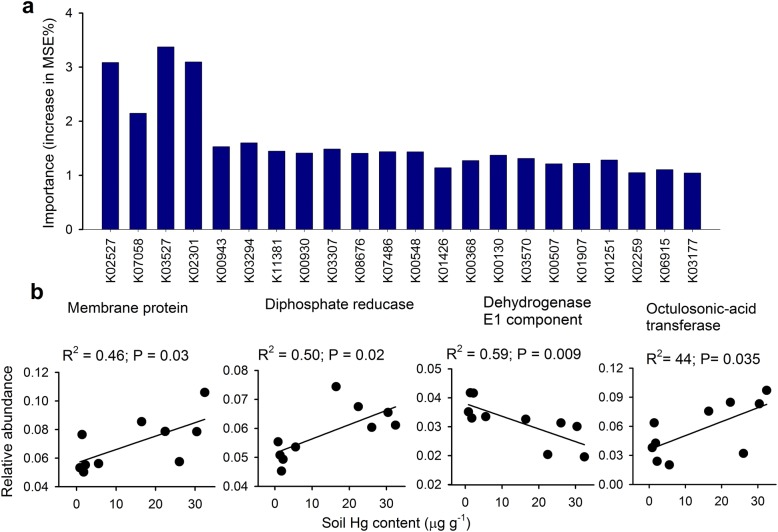
Random forest (RF) analyses identifying the significant (P < 0.05) gene predictors of soil total Hg (a). Panel b includes relationships between total Hg contents and selected functional genes. These functional genes were annotated according to Kyoto Encyclopedia of Genes and Genomes (KEGG) using metagenomic data derived from a subset of our soil samples. Additional information on the KEGG genes is available in Additional file 1: Table S5

References

    1. Bissett A, Brown MV, Siciliano SD, Thrall PH. Microbial community responses to anthropogenically induced environmental change: towards a systems approach. Ecol Lett. 2013;16:128–139. doi: 10.1111/ele.12109. - DOI - PubMed
    1. Griffiths BS, Philippot L. Insights into the resistance and resilience of the soil microbial community. FEMS Microbiol Rev. 2013;37(2):112–129. doi: 10.1111/j.1574-6976.2012.00343.x. - DOI - PubMed
    1. Jiao S, Zhang Z, Yang F, Lin Y, Chen W, Wei G. Temporal dynamics of microbial communities in microcosms in response to pollutants. Mol Ecol. 2017;26(3):923–936. doi: 10.1111/mec.13978. - DOI - PubMed
    1. Alava JJ, Cheung WWL, Ross PS, Sumaila UR. Climate change–contaminant interactions in marine food webs: toward a conceptual framework. Glob Chang Biol. 2017;23(10):3984–4001. doi: 10.1111/gcb.13667. - DOI - PubMed
    1. Obrist D, Agnan Y, Jiskra M, Olson CL, Colegrove DP, Hueber J, Moore CW, Sonke JE, Helmig D. Tundra uptake of atmospheric elemental mercury drives Arctic mercury pollution. Nature. 2017;547(7662):201–204. doi: 10.1038/nature22997. - DOI - PubMed

Publication types