


Remote ischemic conditioning in ST-segment elevation myocardial infarction - an update
- PMID: 30338313
- PMCID: PMC6191186
Remote ischemic conditioning in ST-segment elevation myocardial infarction - an update
Abstract
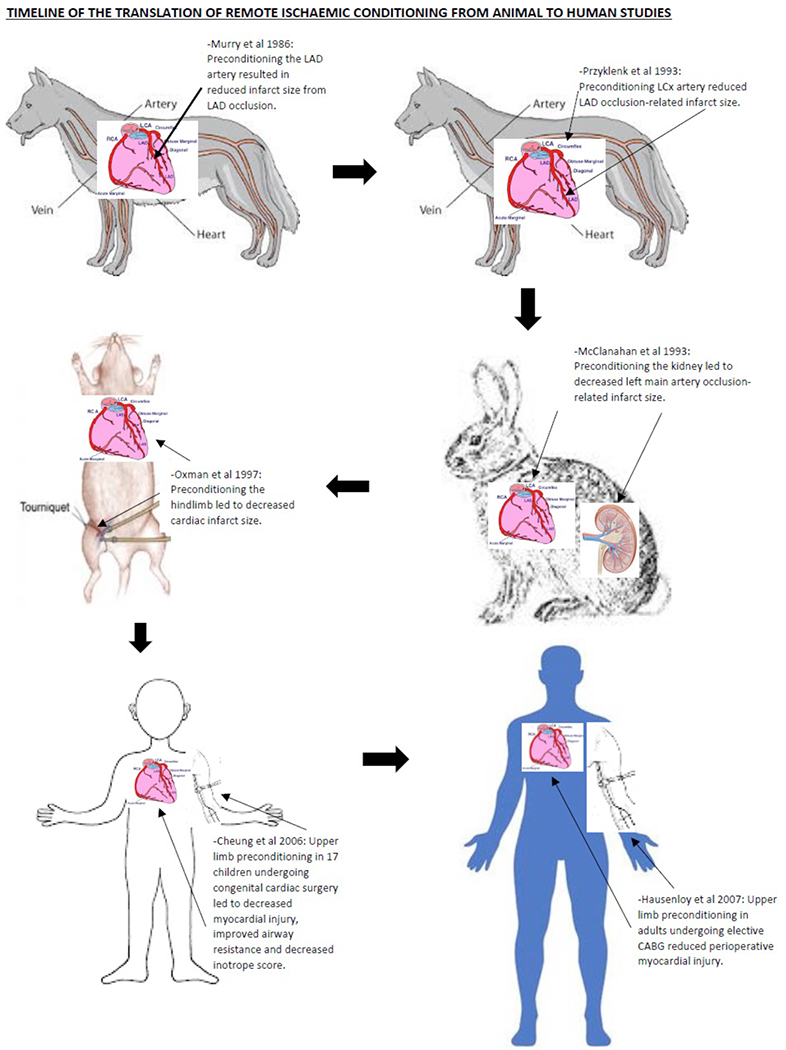
Acute myocardial infarction (AMI) and the heart failure (HF) that often results are among the leading causes of death and disability in the world. As such, novel strategies are required to protect the heart against the detrimental effects of acute ischemia/reperfusion injury (IRI), in order to reduce myocardial infarct (MI) size and prevent the onset of HF. The endogenous cardioprotective strategy of remote ischemic conditioning (RIC), in which cycles of brief ischemia and reperfusion are applied to a tissue or organ away from the heart, has been reported in experimental studies to reduce MI size in animal models of acute IRI. In the clinical setting, RIC can be induced by simply inflating and deflating a cuff placed on the upper arm or thigh to induce brief cycles of ischemia and reperfusion, a strategy which has been shown to reduce MI size in ST-segment elevation myocardial infarction (STEMI) patients undergoing primary percutaneous coronary intervention (PPCI). The results of the ongoing CONDI2/ERIC-PPCI trial are eagerly awaited, and will provide definitive answers with regards to the cardioprotective effect and clinical outcome benefits of RIC in STEMI.
Figures
References
-
- Ali ZA, Callaghan CJ, Lim E, Ali AA, Nouraei SA AAM et al. (2007) Remote ischemic preconditioning reduces myocardial and renal injury after elective abdominal aortic aneurysm repair: a randomized controlled trial. Circulation 116:I98–I105. - PubMed
-
- Baumgardt SL, Paterson M, Leucker TM, Fang J, Zhang DX, Bosnjak ZJ, Warltier DC, Kersten JR, Ge Z-D (2016) Chronic Co-Administration of Sepiapterin and L-Citrulline Ameliorates Diabetic Cardiomyopathy and Myocardial Ischemia/Reperfusion Injury in Obese Type 2 Diabetic Mice. Circ Heart Fail 9:e002424. - PMC - PubMed
-
- Bautin AE, Galagudza MM, Datsenko S V, Tashkhanov DM, Marichev AO, Bakanov AI, Malaia EI, Naimushin A V, Rubinchik VE, Gordeev ML (2014) [Effects of remote ischemic preconditioning on perioperative period in elective aortic valve replacement]. Anesteziol Reanimatol:11–17. - PubMed
-
- Birnbaum Y, Hale SL KRA (1997) Ischemic preconditioning at a distance: reduction of myocardial infarct size by partial reduction of blood supply combined with rapid stimulation of the gastrocnemius muscle in the rabbit. . Circ 96:1641–1646. - PubMed
Grants and funding
LinkOut - more resources
Full Text Sources
Other Literature Sources
Research Materials
Miscellaneous