


Responses of Endothelial Cells Towards Ischemic Conditioning Following Acute Myocardial Infarction
- PMID: 30338315
- PMCID: PMC6191189
Responses of Endothelial Cells Towards Ischemic Conditioning Following Acute Myocardial Infarction
Abstract
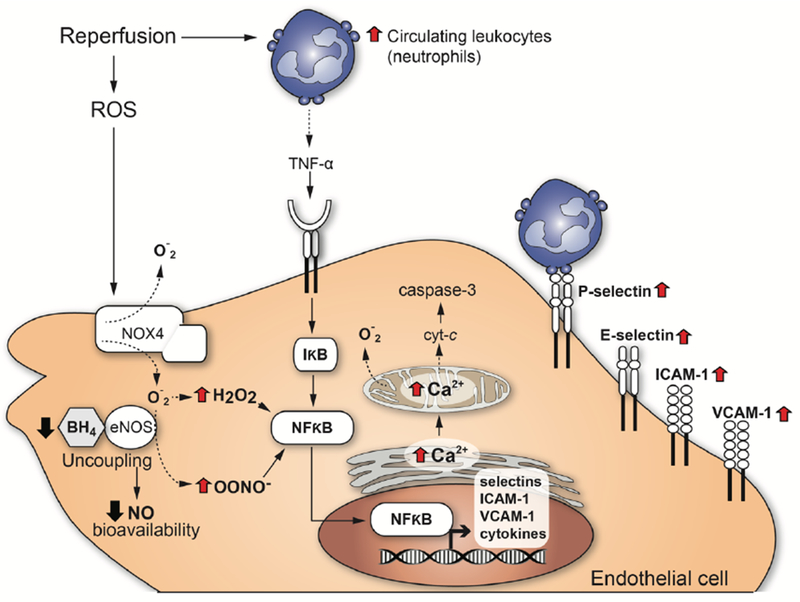
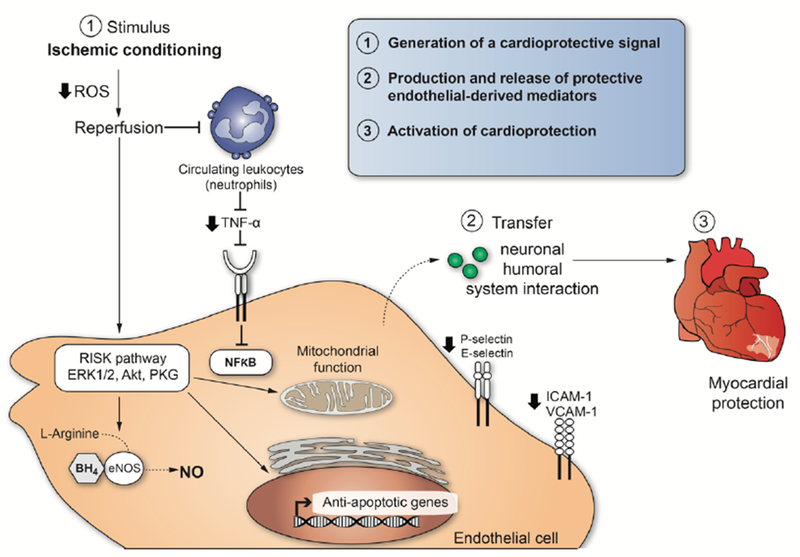
One of the primary therapeutic goals of modern cardiology is to design strategies aimed at minimizing myocardial infarct size and optimizing cardiac function following acute myocardial infarction (AMI). Patients with AMI who underwent reperfusion therapy display dysfunction of the coronary endothelium. Consequently, ischemic endothelial cells become more permeable and weaken their natural anti-thrombotic and anti-inflammatory potential. Ischemia-reperfusion injury (IRI) is associated with activation of the humoral and cellular components of the hemostatic and innate immune system, and also with excessive production of reactive oxygen species (ROS), the inhibition of nitric oxide synthase, and with inflammatory processes. Given its essential role in the regulation of vascular homeostasis, involving platelets and leukocytes among others, dysfunctional endothelium can lead to increased risk of coronary vasospasm and thrombosis. Endothelial dysfunction can be prevented by ischemic conditioning with a protective intervention based on limited intermittent periods of ischemia and reperfusion. The molecular mechanisms and signal transduction pathways underlying conditioning phenomena in the coronary endothelium have been described as involving less ROS production, reduced adhesion of neutrophils to endothelial cells and diminished inflammatory reactions. This review summarizes our current understanding of the cellular and molecular mechanisms regulating IRI-affected and -damaged coronary endothelium, and how ischemic conditioning may preserve its function.
Keywords: cardioprotection; endothelium; inflammation; ischemia reperfusion injury; ischemic conditioning.
Conflict of interest statement
Conflicts of interest The authors declare that they have no conflicts of interest.
Figures
References
-
- Ampofo E, Lachnitt N, Rudzitis-Auth J, Schmitt BM, Menger MD, Laschke MW (2017) Indole-3-carbinol is a potent inhibitor of ischemia-reperfusion-induced inflammation. J Surg Res 215:34–46. - PubMed
-
- Anderson TJ, Uehata A, Gerhard MD, Meredith IT, Knab S, Delagrange D, Lieberman EH, Ganz P, Creager MA, Yeung AC, et al. (1995) Close relation of endothelial function in the human coronary and peripheral circulations. Journal of the American College of Cardiology 26:1235–1241. - PubMed
-
- Aoki M, Nata T, Morishita R, Matsushita H, Nakagami H, Yamamoto K, Yamazaki K, Nakabayashi M, Ogihara T, Kaneda Y (2001) Endothelial apoptosis induced by oxidative stress through activation of NF-kappaB: antiapoptotic effect of antioxidant agents on endothelial cells. Hypertension 38:48–55. - PubMed
-
- Asai M, Takeuchi K, Saotome M, Urushida T, Katoh H, Satoh H, Hayashi H, Watanabe H (2009) Extracellular acidosis suppresses endothelial function by inhibiting store-operated Ca2+ entry via non-selective cation channels. Cardiovasc Res 83:97–105. - PubMed
-
- Auchampach JA, Gross GJ (1993) Adenosine A1 receptors, KATP channels, and ischemic preconditioning in dogs. The American journal of physiology 264:H1327–1336. - PubMed
Grants and funding
LinkOut - more resources
Full Text Sources