


Adipose tissue expression of CCL19 chemokine is positively associated with insulin resistance
- PMID: 30339734
- PMCID: PMC6587962
- DOI: 10.1002/dmrr.3087
Adipose tissue expression of CCL19 chemokine is positively associated with insulin resistance
Abstract
Background: Chemokines produced by adipose tissue (AT) are involved in the development of chronic low-grade inflammation in obese humans and rodents. AT CCL19 expression in obesity and its association with metabolic inflammation and insulin resistance are poorly understood. This study aimed to investigate the effects of CCL19 gene expression on inflammatory markers in subcutaneous AT and insulin resistance.
Methods: Subcutaneous adipose samples were collected from 56 non-diabetic (26-obese, 21-overweight, and 9-lean) individuals. Expression of CCL19 and inflammatory markers was determined using real-time RT-PCR. Plasma C-reactive protein (CRP) and adiponectin were measured by ELISA. Insulin sensitivity was assessed using homeostasis model assessment index (HOMA).
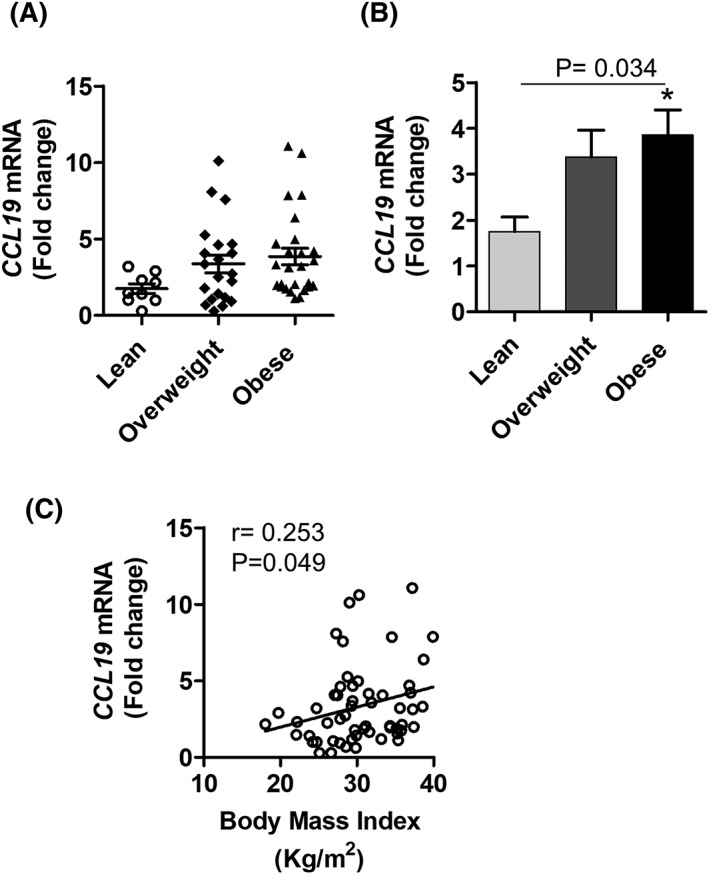
Results: CCL19 expression was significantly higher in obese compared with lean individuals (P < 0.034). The elevated expression of CCL19 associated positively with body mass index (r = 0.253; P = 0.049). CCL19 expression correlated positively with IL-8 (r = 0.39; P = 0.006), IL-12 (r = 0.43; P = 0.003), IP-10 (r = 0.25; P = 0.07), CCL5 (r = 0.37; P = 0.011), CCR2 (r = 0.44; P = 0.001), and CCR5 (r = 0.35; P = 0.009). Additionally, CCL19 was positively correlated with triglycerides (TG: r = 0.41; P = 0.001), fasting blood glucose (FBG: r = 0.49; P < 0.0001), glycated haemoglobin (HbA1c: r = 0.396; P = 0.001), and CRP (r = 0.387; P = 0.019) whereas it had negative association with HDL cholesterol (r = -0.282; P = 0.035) and adiponectin (-0.393; P = 0.019). Notably, HOMA-IR correlated positively with CCL19 (r = 0.38; P = 0.01). In multiple regression analysis, CCL19 is an independent predictor of IL-8 and IL-12.
Conclusions: These data demonstrate that increased AT expression of CCL19 in obesity may represent a molecular link between metabolic inflammation and insulin resistance.
Keywords: CCL19; adipose tissue; insulin resistance; metabolic inflammation; obesity.
© 2018 The Authors. Diabetes/Metabolism Research and Reviews Published by John Wiley & Sons Ltd.
Conflict of interest statement
None declared.
Figures
References
-
- Civera M, Urios A, Garcia‐Torres ML, et al. Relationship between insulin resistance, inflammation and liver cell apoptosis in patients with severe obesity. Diabetes Metab Res Rev. 2010;26(3):187‐192. - PubMed
-
- Tilg H, Moschen AR. Adipocytokines: mediators linking adipose tissue, inflammation and immunity. Nat Rev Immunol. 2006;6(10):772‐783. Epub 2006/09/26 - PubMed
-
- Sjöholm A, Nyström T. Inflammation and the etiology of type 2 diabetes. Diabetes Metab Res Rev. 2006;22(1):4‐10. - PubMed
-
- Akash MSH, Rehman K, Liaqat A. Tumor necrosis factor‐alpha: role in development of insulin resistance and pathogenesis of type 2 diabetes mellitus. J Cell Biochem. 2018;119(1):105‐110. Epub 2017/06/02 - PubMed
-
- Rehman K, Akash MSH, Liaqat A, Kamal S, Qadir MI, Rasul A. Role of Interleukin‐6 in development of insulin resistance and type 2 diabetes mellitus. Crit Rev Eukaryot Gene Expr. 2017;27(3):229‐236. Epub 2017/12/05 - PubMed
Publication types
MeSH terms
Substances
LinkOut - more resources
Full Text Sources
Medical
Research Materials
Miscellaneous
