


Adherence to inhaled therapy and its impact on chronic obstructive pulmonary disease (COPD)
- PMID: 30340565
- PMCID: PMC6194635
- DOI: 10.1186/s12890-018-0724-3
Adherence to inhaled therapy and its impact on chronic obstructive pulmonary disease (COPD)
Abstract
Background: COPD is a treatable disease with increasing prevalence worldwide. Treatment aims to stop disease progression, to improve quality of life, and to reduce exacerbations. We aimed to evaluate the association of the stage of COPD on adherence to inhaled therapy and the relationship between adherence and COPD exacerbations.
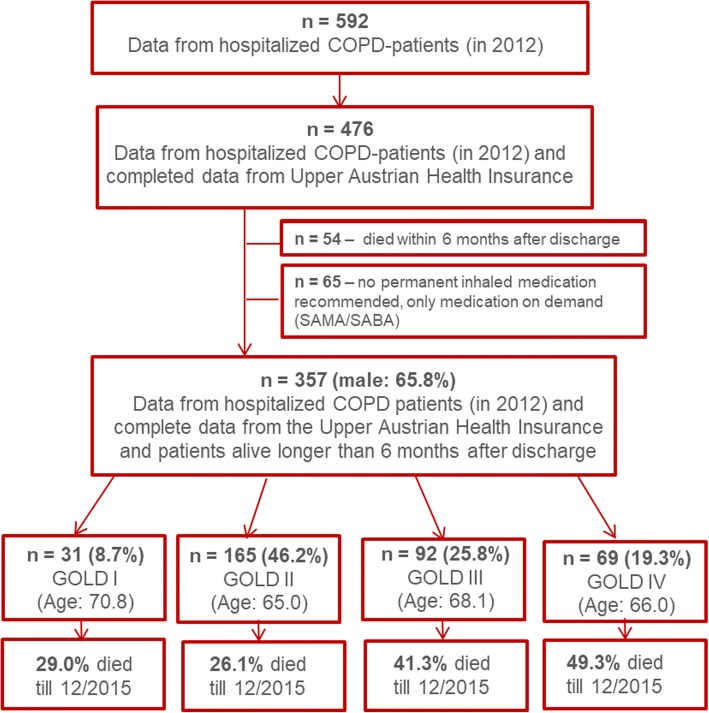
Methods: A retrospective analysis of patients hospitalized for acute exacerbation of COPD in a tertiary care hospital in Upper Austria and discharged with a guideline conform inhaled therapy was performed. Follow-up data on medical utilization was recorded for the subsequent 24 months. Adherence to inhaled therapy was defined according to the percentage of prescribed inhalers dispensed to the patient and classified as complete (> 80%), partial (50-80%) or low (< 50%).
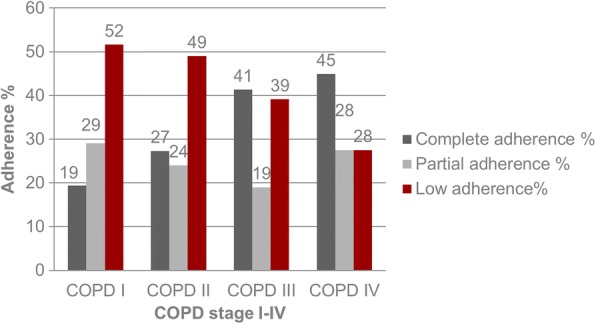
Results: Out of 357 patients, 65.8% were male with a mean age of 66.5 years and a mean FEV1 of 55.0%pred. Overall, 35.3% were current smokers, and only 3.9% were never-smokers. In 77.0% inhaled triple therapy (LAMA + LABA + ICS) was prescribed. 33.6% showed complete adherence to their therapy (33.2% in men, 34.4% in women), with a mean age of 67.0 years. Mean medication possession ratio by GOLD spirometry class I - IV were 0.486, 0.534, 0.609 and 0.755, respectively (p = 0.002). Hence, subjects with complete adherence to therapy had a significantly lower FEV1 compared to those with low adherence (49.2%pred. vs 59.2%pred., respectively; p < 0.001). The risk of exacerbations leading to hospitalization was 10-fold higher in GOLD spirometry class IV compared to GOLD spirometry class I, which was even more evident in multivariate analysis (OR 13.62).
Conclusion: Complete adherence to inhaled therapy was only seen in 33.6% and was higher among those with more severe COPD.
Trial registration: Not applicable.
Keywords: Adherence; Chronic obstructive pulmonary disease; Inhaled therapy.
Conflict of interest statement
Ethics approval and consent to participate
The current work was approved by the local ethical review committee (“Ethikkommission des Landes Oberösterreich”) under the following reference number: I-16-15.
Consent for publication
Not applicable.
Competing interests
The authors declare that they have no competing interests. AL and BK are employees of the Upper Austrian Health Insurance.
Publisher’s Note
Springer Nature remains neutral with regard to jurisdictional claims in published maps and institutional affiliations.
Figures
References
-
- Buist AS, McBurnie MA, Vollmer WM, Gillespie S, Burney P, Mannino DM, Menezes AM, Sullivan SD, Lee TA, Weiss KB, et al. International variation in the prevalence of COPD (the BOLD study): a population-based prevalence study. Lancet. 2007;370(9589):741–750. doi: 10.1016/S0140-6736(07)61377-4. - DOI - PubMed
MeSH terms
LinkOut - more resources
Full Text Sources
Medical
