


Genetic diversity of Bovine Viral Diarrhea Virus from cattle in Chile between 2003 and 2007
- PMID: 30340596
- PMCID: PMC6194550
- DOI: 10.1186/s12917-018-1641-7
Genetic diversity of Bovine Viral Diarrhea Virus from cattle in Chile between 2003 and 2007
Abstract
Background: Bovine Viral Diarrhea Virus causes significant economic losses in cattle. BVDV has high genomic diversity, with two species, BVDV-1 and BVDV-2, and at least twenty-one subgenotypes for BVDV-1 and four subgenotypes for BVDV-2. Vaccines are important tools to reduce the economic losses caused by this virus. However, vaccine strains must correspond to the antigenic profile of the viruses present in the region where the vaccine is applied. A restricted phylogenetic study with 14 viruses isolated from cattle between 1993 and 2001 showed that the genetic profile of BVDV in Chile consisted of viruses of both species and sub-genotypes 1a, 1b, 1c (currently 1j) and 2a. To determine more accurately the genetic profile of BVDV in Chile, in this study a larger number of viruses obtained from bovines between 2003 and 2007 were typed.
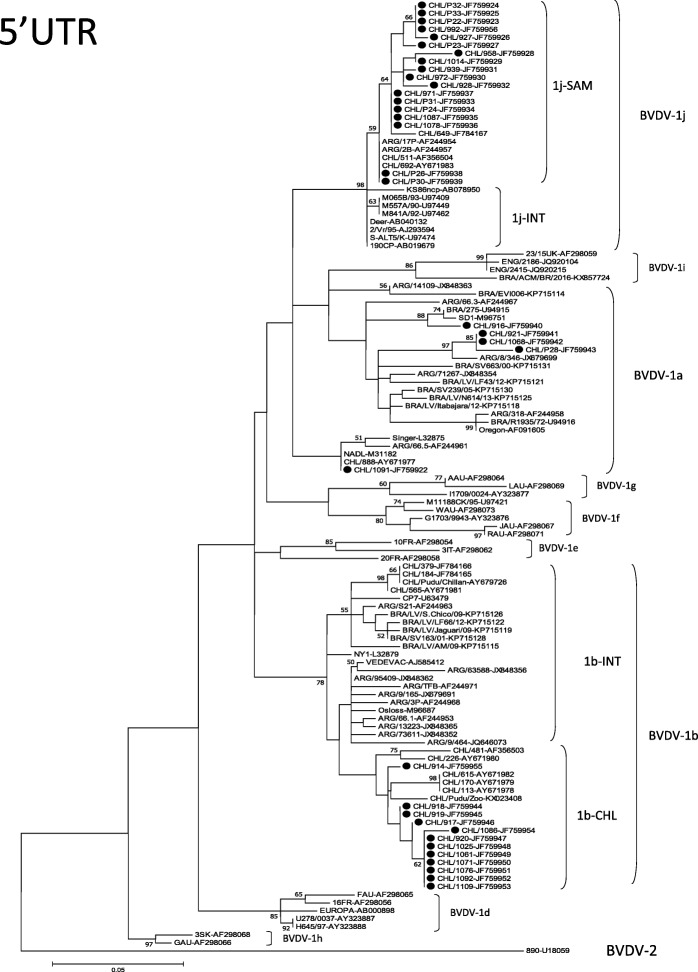
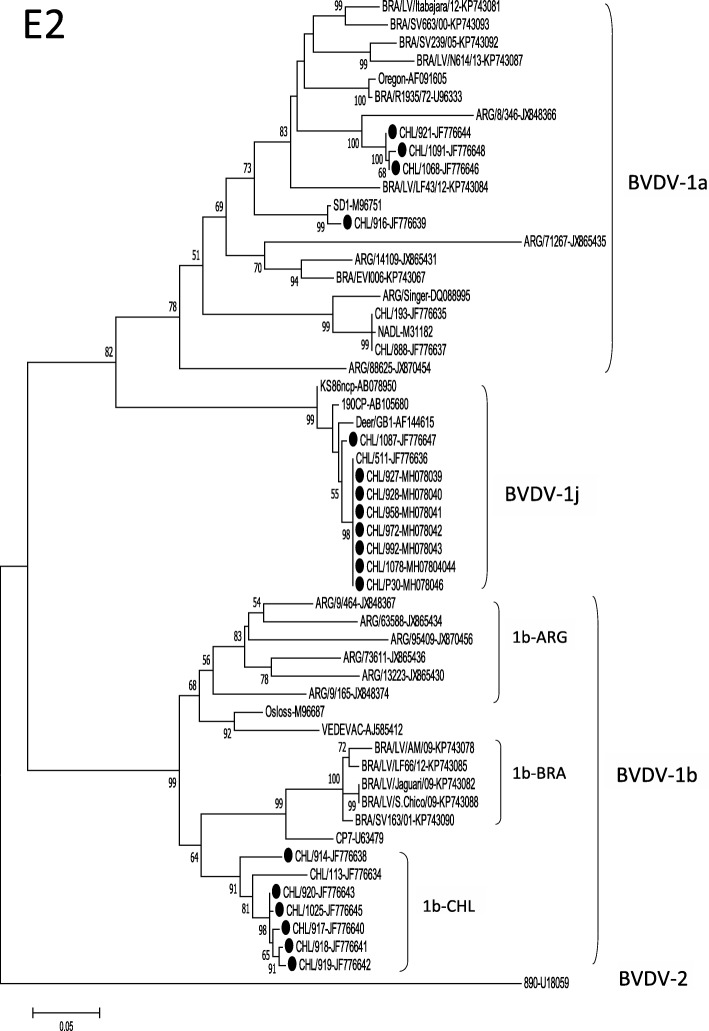
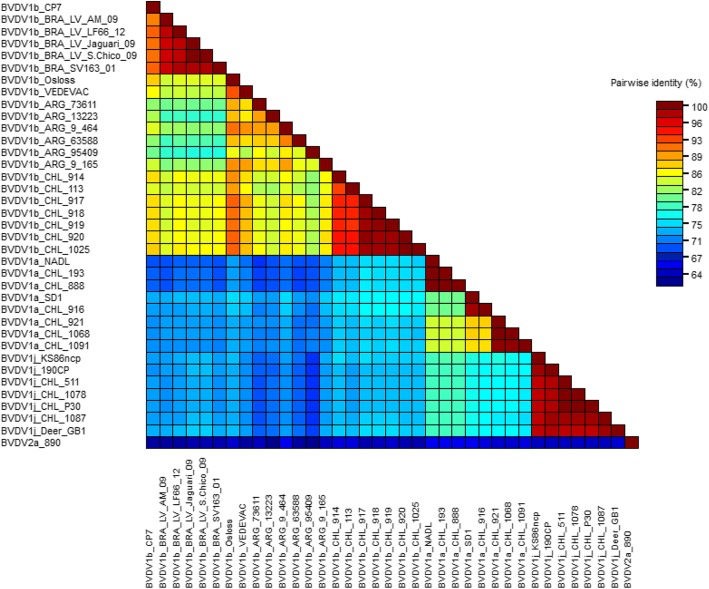
Results: The study was performed using partial sequences from the 5' noncoding region (5'UTR) and E2 coding region of the viral genome of thirty-five Chilean viruses isolated from geographic regions that have 84.6% of the Chilean cattle. All tested viruses belonged to species BVDV-1. Eighteen viruses belonged to BVDV-1j subgenotype (51.4%), twelve belonged to BVDV-1b (34.3%) and five belonged to BVDV-1a (14.3%). The Chilean BVDV-1j viruses showed low genetic diversity, both among themselves and with the BVDV-1j present in other regions of the world. This could be explained by a relatively recent introduction of this viral subgenotype in cattle, which agrees with its low geographical distribution worldwide. Otherwise, Chilean BVDV-1b viruses grouped into a single cluster, different even than the viruses present in Argentina and Brazil, countries geographically close to Chile, a process of local evolution that could generate antigenic differences between the Chilean viruses and the viruses used as vaccine strains.
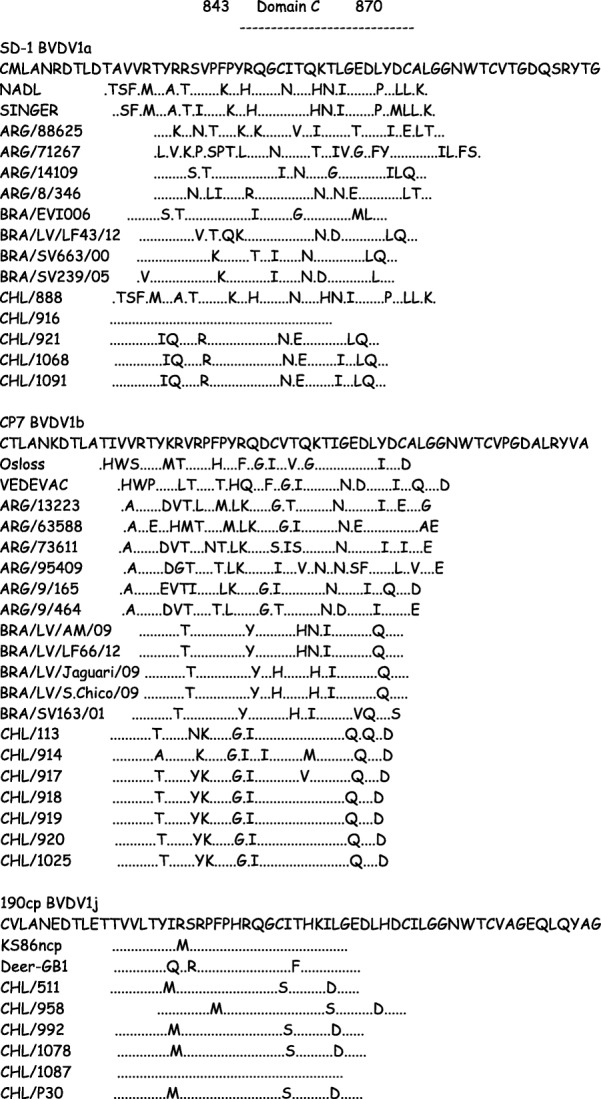
Conclusions: The high presence of viruses of the BVDV-1j subgenotype, which show major antigenic differences with BVDV-1a and BVDV-1b subgenotypes used in the commercial vaccines, suggest that BVDV-1j viruses could be an emergent subgenotype of BVDV in cattle in South America and suggest evaluating an update of the vaccines used in Chile.
Keywords: 5’UTR; BVDV; Bovine viral diarrhea virus; E2; Genetic diversity; Pestivirus.
Conflict of interest statement
Ethics approval
Animal procedures were carried out according to good veterinary practices following the guidelines of the Manual of Standards for Biosafety (2008) from the National Commission for Scientific and Technological Research (CONICYT-Chile), the Institutional Animal Care and Use Committees of the Universidad de Chile, and the revised Animals (Scientific Procedures) Act 1986.
Consent for publication
Not applicable
Competing interests
The authors declare that they have no competing interests.
Publisher’s Note
Springer Nature remains neutral with regard to jurisdictional claims in published maps and institutional affiliations.
Figures
References
-
- Baker JC. Bovine viral diarrhea virus: a review. J Am Vet Med Assoc. 1987;190:1449–1457. - PubMed
-
- Brownlie J, Clarke MC, Howard CJ, Pocock DH. Pathogenesis and epidemiology of bovine virus diarrhoea virus infection of cattle. Ann Rech Vet. 1987;18:157–166. - PubMed
-
- Corapi WV, Elliott RD, French TW, Arthur DG, Bezek DM, Dubovi EJ. Thrombocytopenia and hemorrhages in veal calves infected with bovine viral diarrhea virus. J Am Vet Med Assoc. 1990;196:590–596. - PubMed
MeSH terms
Substances
Grants and funding
LinkOut - more resources
Full Text Sources
