


Exosomes Produced from 3D Cultures of MSCs by Tangential Flow Filtration Show Higher Yield and Improved Activity
- PMID: 30341012
- PMCID: PMC6277553
- DOI: 10.1016/j.ymthe.2018.09.015
Exosomes Produced from 3D Cultures of MSCs by Tangential Flow Filtration Show Higher Yield and Improved Activity
Abstract
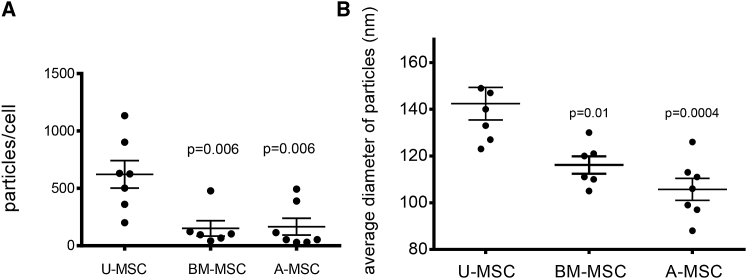
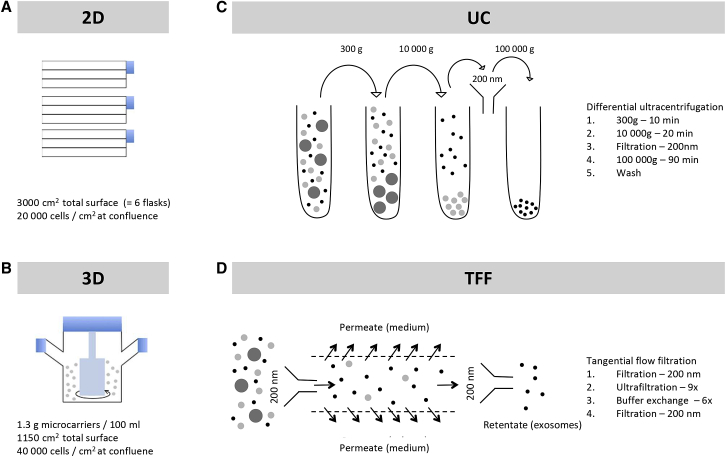
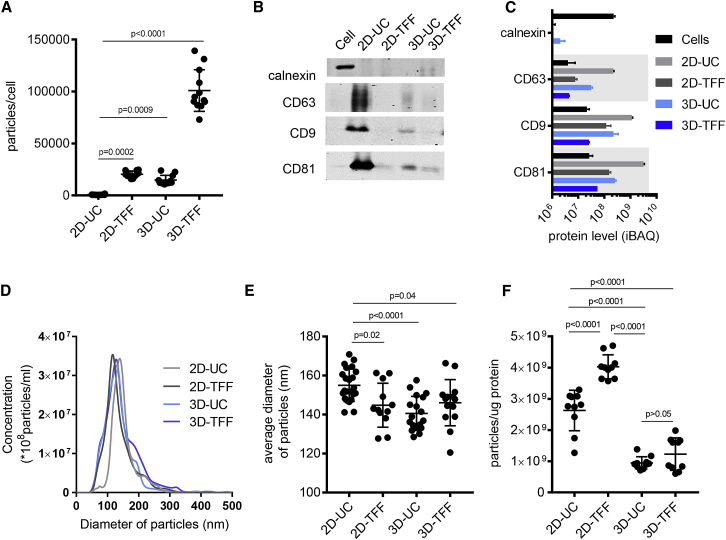
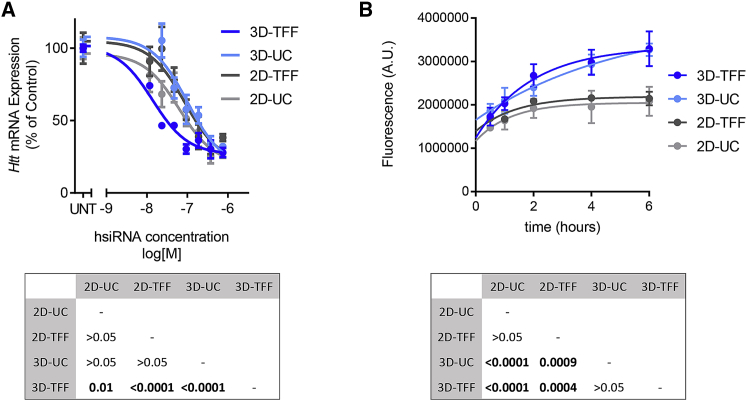
Exosomes can deliver therapeutic RNAs to neurons. The composition and the safety profile of exosomes depend on the type of the exosome-producing cell. Mesenchymal stem cells are considered to be an attractive cell type for therapeutic exosome production. However, scalable methods to isolate and manufacture exosomes from mesenchymal stem cells are lacking, a limitation to the clinical translation of exosome technology. We evaluate mesenchymal stem cells from different sources and find that umbilical cord-derived mesenchymal stem cells produce the highest exosome yield. To optimize exosome production, we cultivate umbilical cord-derived mesenchymal stem cells in scalable microcarrier-based three-dimensional (3D) cultures. In combination with the conventional differential ultracentrifugation, 3D culture yields 20-fold more exosomes (3D-UC-exosomes) than two-dimensional cultures (2D-UC-exosomes). Tangential flow filtration (TFF) in combination with 3D mesenchymal stem cell cultures further improves the yield of exosomes (3D-TFF-exosomes) 7-fold over 3D-UC-exosomes. 3D-TFF-exosomes are seven times more potent in small interfering RNA (siRNA) transfer to neurons compared with 2D-UC-exosomes. Microcarrier-based 3D culture and TFF allow scalable production of biologically active exosomes from mesenchymal stem cells. These findings lift a major roadblock for the clinical utility of mesenchymal stem cell exosomes.
Keywords: exosomes; mesenchymal stem cell; tangential flow filtration.
Copyright © 2018. Published by Elsevier Inc.
Figures
References
-
- Heijnen H.F., Schiel A.E., Fijnheer R., Geuze H.J., Sixma J.J. Activated platelets release two types of membrane vesicles: microvesicles by surface shedding and exosomes derived from exocytosis of multivesicular bodies and alpha-granules. Blood. 1999;94:3791–3799. - PubMed
-
- Valadi H., Ekström K., Bossios A., Sjöstrand M., Lee J.J., Lötvall J.O. Exosome-mediated transfer of mRNAs and microRNAs is a novel mechanism of genetic exchange between cells. Nat. Cell Biol. 2007;9:654–659. - PubMed
-
- Skog J., Würdinger T., van Rijn S., Meijer D.H., Gainche L., Sena-Esteves M., Curry W.T., Jr., Carter B.S., Krichevsky A.M., Breakefield X.O. Glioblastoma microvesicles transport RNA and proteins that promote tumour growth and provide diagnostic biomarkers. Nat. Cell Biol. 2008;10:1470–1476. - PMC - PubMed
Publication types
MeSH terms
Substances
Grants and funding
LinkOut - more resources
Full Text Sources
Other Literature Sources
Medical
