. 2018 Oct 19;9(1):4344.
doi: 10.1038/s41467-018-06787-w.

Dimethyl fumarate is an allosteric covalent inhibitor of the p90 ribosomal S6 kinases

Affiliations

Dimethyl fumarate is an allosteric covalent inhibitor of the p90 ribosomal S6 kinases

Jacob Lauwring Andersen et al. Nat Commun. .

Abstract

Dimethyl fumarate (DMF) has been applied for decades in the treatment of psoriasis and now also multiple sclerosis. However, the mechanism of action has remained obscure and involves high dose over long time of this small, reactive compound implicating many potential targets. Based on a 1.9 Å resolution crystal structure of the C-terminal kinase domain of the mouse p90 Ribosomal S6 Kinase 2 (RSK2) inhibited by DMF we describe a central binding site in RSKs and the closely related Mitogen and Stress-activated Kinases (MSKs). DMF reacts covalently as a Michael acceptor to a conserved cysteine residue in the αF-helix of RSK/MSKs. Binding of DMF prevents the activation loop of the kinase from engaging substrate, and stabilizes an auto-inhibitory αL-helix, thus pointing to an effective, allosteric mechanism of kinase inhibition. The biochemical and cell biological characteristics of DMF inhibition of RSK/MSKs are consistent with the clinical protocols of DMF treatment.


Conflict of interest statement

The authors declare no competing interests.

Figures
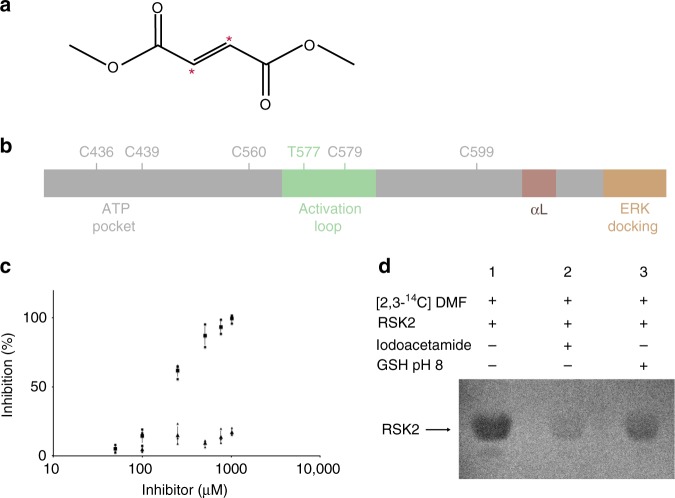
Fig. 1
Fig. 1
DMF inhibits RSK2. a DMF with Michael acceptor reactive carbons marked with red asterisks. b Schematic representation of RSK2CTKD and position of cysteine residues. c Inhibition of RSK2CTKD by DMF (squares) and MMF (triangles). Error bars indicate the standard deviation of mean values (n = 3, all data points included). d Covalent modification of RSK2CTKD by DMF. Purified murine RSK2 (5 nmol) was incubated with 14C-labelled DMF (25 nmol). DMF binding is reduced by preincubation of RSK2 with 10-fold molar excess of iodoacetamide or GSH, respectively. The + and – signs represent inclusion or absence of the respective components
Fig. 2
Fig. 2
DMF binds to C436 and C599 in RSK2 crystals. a Cartoon representation of RSK2 with DMF covalently bound at C599 (DMF1) and C436 (DMF2). b Covalent binding of DMF (orange) to C599 and C436 of RSK2 (light grey). Final 2Fo–Fc electron density map depicted in blue represent a contour level of 1.0σ and a bias-reduced simulated annealing Fo–Fc difference maps is contoured in green at 3.0 σ, both on the C436 and C599 dimethyl binding site, respectively. c DMF binding pocket. The regulatory αL-helix, the activation loop, nitrogens and oxygens are coloured in brown, light green, blue, and red, respectively. d Activation of RSK2 (light grey) leads to the phosphorylation of a threonine residue in the activation loop (light green). The movement of the activation loop has been determined by X-ray crystallography for several kinases and is shown in light blue for the related kinase p70S6K1 (PDB ID 3A62). The hinge region is undergoing large structural rearrangements during activation and covalent binding of DMF (in spheres) to C599 could abolish this by steric hindrance. A second DMF modification site, C436 was observed, but it was less well defined
Fig. 3
Fig. 3
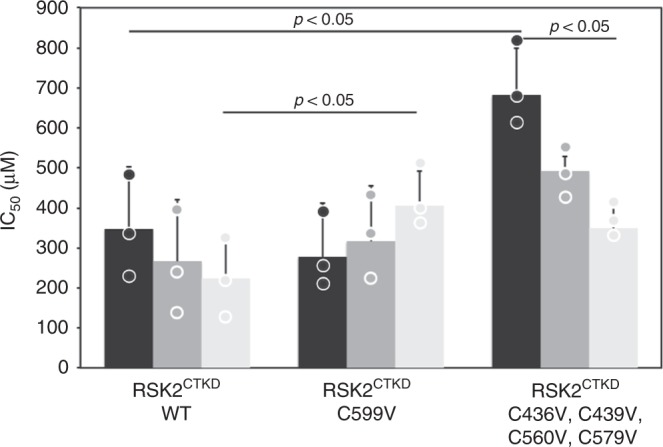
Time course of DMF inhibition. In vitro determination of apparent IC50 values of DMF on RSK2CTKD activity following incubation with DMF at different time points (1 h: black, 24 h: dark grey, and 48 h light grey) prior to ERK2 activation (n = 3, all data points indicated by circles)
Fig. 4
Fig. 4
Mutational studies of DMF inhibition in cells. Mutational analysis of HEK293 cells transfected with RSK2, MSK1, or cysteine mutants hereof. HEK293 cells were supplemented with DMF (140 μM) and stimulated with epidermal growth factor (EGF, 1 ng ml–1). a, b Representative western blots from RSK2 and MSK1 mutational analysis respectively. c, d RSK2CTKD and MSK1CTKD activity determined as the autophosphorylation of S386 and S376, respectively, relative to WT. The activity of EGF-induced wild-type was set to 100% (n = 5 and n = 4, respectively; all data points indicated by black, filled circles)
Fig. 5
Fig. 5
Model of DMF inhibition. Schematic figure of the activation loop transition between inactive and activated state of the C-terminal kinase domain (consisting of the ATP binding domain and the helix bundle domain). DMF targets an allosteric site and blocks kinase activation, and vice versa

References

    1. Mrowietz U, et al. Efficacy and safety of LAS41008 (dimethyl fumarate) in adults with moderate-to-severe chronic plaque psoriasis: a randomized, double-blind, Fumaderm(R) - and placebo-controlled trial (BRIDGE) Br. J. Dermatol. 2017;176:615–623. doi: 10.1111/bjd.14947. - DOI - PubMed
    1. Blair HA. Dimethyl fumarate: a review in moderate to severe plaque psoriasis. Drugs. 2018;78:123–130. doi: 10.1007/s40265-017-0854-6. - DOI - PubMed
    1. Gold R, et al. Placebo-controlled phase 3 study of oral BG-12 for relapsing multiple sclerosis. N. Engl. J. Med. 2012;367:1098–107. doi: 10.1056/NEJMoa1114287. - DOI - PubMed
    1. Schmidt TJ, Ak M, Mrowietz U. Reactivity of dimethyl fumarate and methylhydrogen fumarate towards glutathione and N-acetyl-L-cysteine--preparation of S-substituted thiosuccinic acid esters. Bioorg. Med. Chem. 2007;15:333–42. doi: 10.1016/j.bmc.2006.09.053. - DOI - PubMed
    1. Rostami-Yazdi M, Clement B, Schmidt TJ, Schinor D, Mrowietz U. Detection of metabolites of fumaric acid esters in human urine: implications for their mode of action. J. Invest. Dermatol. 2009;129:231–4. doi: 10.1038/jid.2008.197. - DOI - PubMed

Publication types