. 2018 Nov;13(11):2615-2642.
doi: 10.1038/s41596-018-0055-0.

Defining CRISPR-Cas9 genome-wide nuclease activities with CIRCLE-seq

Affiliations

Defining CRISPR-Cas9 genome-wide nuclease activities with CIRCLE-seq

Cicera R Lazzarotto et al. Nat Protoc. 2018 Nov.

Abstract

Circularization for in vitro reporting of cleavage effects by sequencing (CIRCLE-seq) is a sensitive and unbiased method for defining the genome-wide activity (on-target and off-target) of CRISPR-Cas9 nucleases by selective sequencing of nuclease-cleaved genomic DNA (gDNA). Here, we describe a detailed experimental and analytical protocol for CIRCLE-seq. The principle of our method is to generate a library of circularized gDNA with minimized numbers of free ends. Highly purified gDNA circles are treated with CRISPR-Cas9 ribonucleoprotein complexes, and nuclease-linearized DNA fragments are then ligated to adapters for high-throughput sequencing. The primary advantages of CIRCLE-seq as compared with other in vitro methods for defining genome-wide genome editing activity are (i) high enrichment for sequencing nuclease-cleaved gDNA/low background, enabling sensitive detection with low sequencing depth requirements; and (ii) the fact that paired-end reads can contain complete information on individual nuclease cleavage sites, enabling use of CIRCLE-seq in species without high-quality reference genomes. The entire protocol can be completed in 2 weeks, including time for gRNA cloning, sequence verification, in vitro transcription, library preparation, and sequencing.


Conflict of interest statement

Competing Financial Interests

J.K.J. has financial interests in Beam Therapeutics, Editas Medicine, Monitor Biotechnologies, Pairwise Plants, Poseida Therapeutics, and Transposagen Biopharmaceuticals. S.Q.T. has financial interests in Monitor Biotechnologies. J.K.J.’s interests were reviewed and are managed by Massachusetts General Hospital and Partners HealthCare in accordance with their conflict of interest policies. J.K.J. and S.Q.T. are co-inventors on a patent describing the CIRCLE-seq method that has been licensed to Monitor Biotechnologies.

Figures
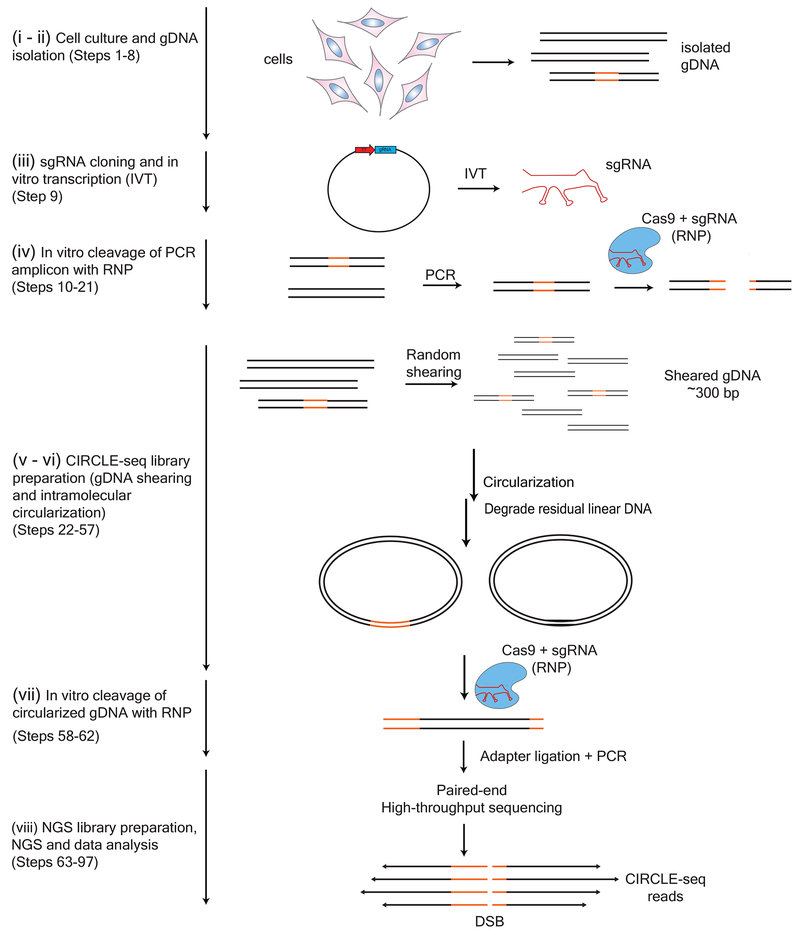
Figure 1 |
Figure 1 |
Overview of CIRCLE-seq workflow. (i-ii) Genomic DNA is isolated from cells (Steps 1-8). (iii) sgRNA is cloned into an in vitro transcription plasmid and in vitro transcribed (Step 9). (iv) Cas9:sgRNA RNP complex is first functionally tested for its ability to functionally cleave a PCR amplicon containing the intended target site to near completion (Steps 10-21). (v-vi) gDNA is sheared in an average length of 300 bp and circularized by intramolecular ligation in a procedure outlined in detail in Figure 2. Remaining uncircularized (linear) DNA molecules are degraded with exonuclease treatment (Steps 22-57). (vii) Circular DNA molecules containing on- and off-target sites can subsequently be linearized with Cas9, releasing newly cleaved DNA ends (Steps 58-62) for (viii) adapter ligation, PCR amplification, and paired-end high-throughput sequencing (Steps 63-97). (Figure adapted with permission from Tsai et al, 2017.)
Figure 2 |
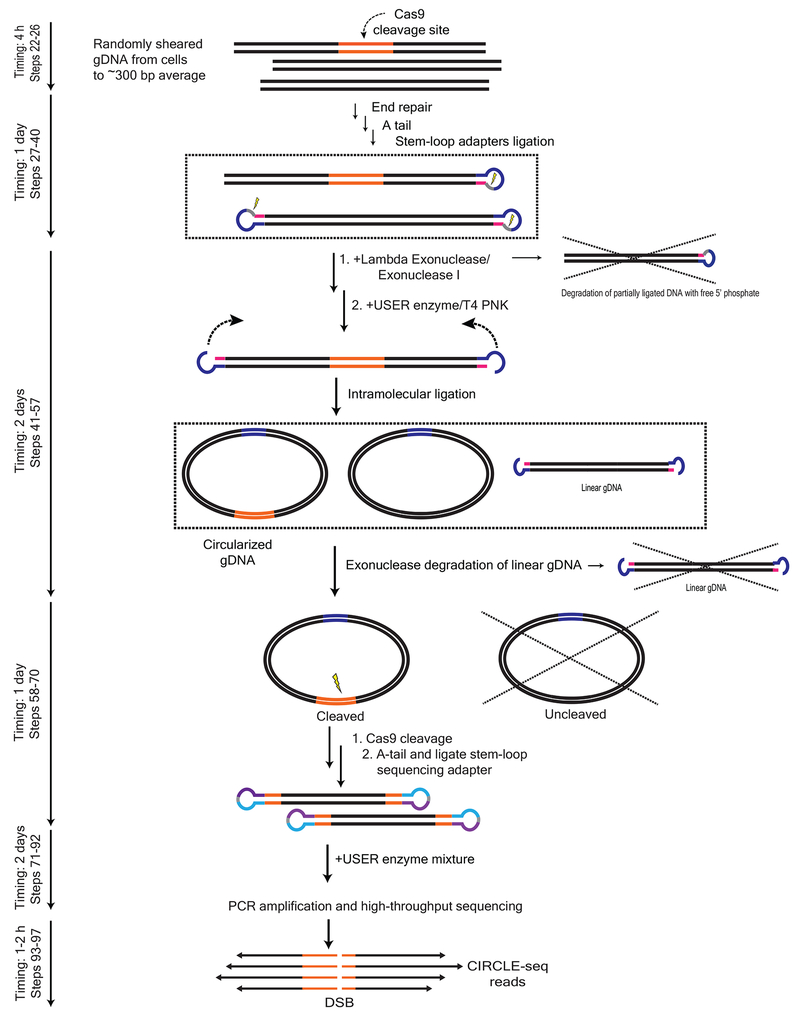
Figure 2 |
Detailed schematic overview of CIRCLE-seq method. Genomic DNA is randomly sheared to an average of ~300 bp, end-repaired, A-tailed, and ligated to uracil-containing stem-looped adapters. DNA molecules covalently closed with stem-looped adapters ligated to both ends are selected by treatment with a mixture of Lambda exonuclease I and E. coli exonuclease I, where partially ligated DNA with free 5’ phosphate are degraded. The adapter–ligated DNA is treated with USER enzyme and T4 PNK, releasing 4 bp overhangs. DNA molecules are circularized at low concentrations, favoring intramolecular ligation. Unwanted linear DNA is degraded with Plasmid-Safe ATP-dependent DNase. Circular DNA is cleaved with Cas9:sgRNA complex. Linearized DNA is ligated to sequencing adapters and amplified for high-throughput sequencing (Figure adapted with permission from Tsai et al, 2017).
Figure 3 |
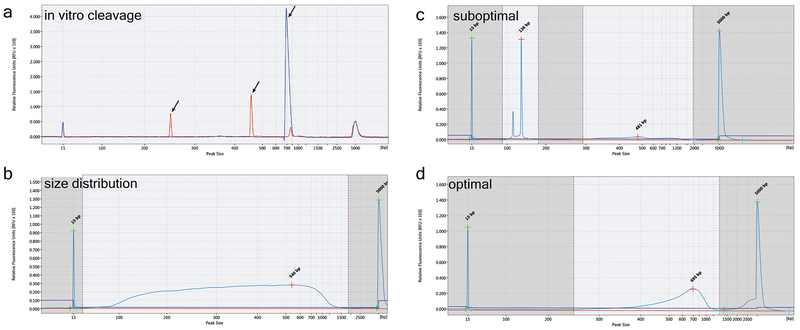
Figure 3 |. Quality control of CIRCLE-seq library preparation.
(a) Electropherogram showing in vitro cleavage of PCR amplicon containing the intended target site by Cas9:sgRNA RNP complex (red) versus an untreated control PCR product (blue). The red arrows indicate the expected cleavage products. Accuracy limitations of capillary electrophoretic size determination of higher molecular weight products explains the slight difference between the expected and observed sizes of the uncleaved PCR product. (b) QIAxcel electropherogram showing distribution of sheared genomic DNA; the median size of the fragmented DNA is 300 bp. (c) Example of electropherogram of suboptimal PCR for CIRCLE-seq library enrichment with high adapter-dimer percentage and (d) Example of electropherogram of optimal CIRCLE-seq library amplified after size-selection of adapter-ligated DNA fragments. DNA size-selection removes adapter dimers that compete with the adapter-ligated DNA fragments during PCR cycles.
Figure 4 |
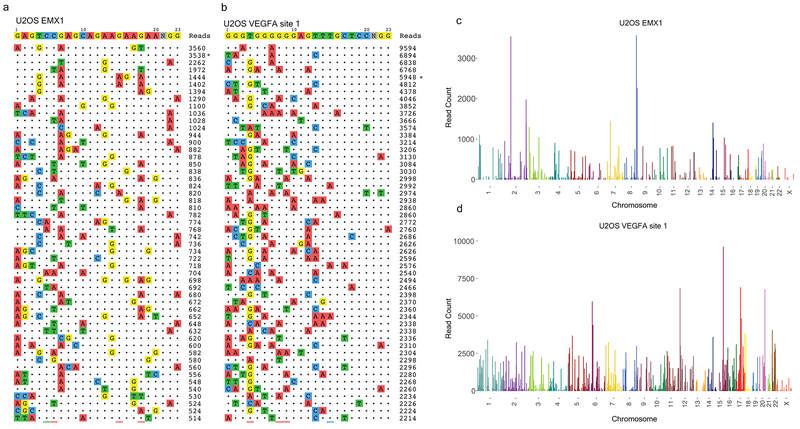
Figure 4 |. Expected results of CIRCLE-seq experiments.
(a, b) Visualization of detected off-targets identified by CIRCLE-seq aligned against intended target site for Cas9:sgRNA complexes targeted against EMX1 and VEGFA genes, respectively. The intended target sequence is shown in the top line and off-target sites are ordered top to bottom by CIRCLE-seq read count. Mismatches to the intended target sequence are indicated by colored nucleotides, and read counts shown at the end of each line. The on-target site is marked with a star. For space considerations, this figure shows a listing of only the top CIRCLE-seq off-target sites detected in this experiment. (c, d) Manhattan plots of CIRCLE-seq detected off-target sites, with bar heights representing read count and organized by chromosomal position for EMX1 and VEGFA site 1, respectively.

References

    1. Silva G et al. Meganucleases and other tools for targeted genome engineering: perspectives and challenges for gene therapy. Curr. Gene Ther 11, 11–27 (2011). - PMC - PubMed
    1. Urnov FD, Rebar EJ, Holmes MC, Zhang HS & Gregory PD Genome editing with engineered zinc finger nucleases. Nature 11, 636–646 (2010). - PubMed
    1. Cermak T et al. Efficient design and assembly of custom TALEN and other TAL effector based constructs for DNA targeting. Nucleic Acids Res 39 (12) (2011). - PMC - PubMed
    1. Sander JD & Joung JK CRISPR-Cas systems for editing, regulating and targeting genomes. Nat. Biotechnol 32, 347–355 (2014). - PMC - PubMed
    1. Doudna JA & Charpentier E Genome editing. The new frontier of genome engineering with CRISPR-Cas9. Science 346, 1258096 (2014). - PubMed

Publication types

MeSH terms

Substances