Review
. 2019 Feb;76(3):495-504.
doi: 10.1007/s00018-018-2946-1. Epub 2018 Oct 19.

Long non-coding RNAs involved in cancer metabolic reprogramming

Affiliations
Review

Long non-coding RNAs involved in cancer metabolic reprogramming

Hui Liu et al. Cell Mol Life Sci. 2019 Feb.

Abstract

Metabolic reprogramming has now been accepted as a hallmark of cancer. Compared to normal cells, cancer cells exhibit different metabolic features, including increased glucose uptake, aerobic glycolysis, enhanced glutamine uptake and glutaminolysis, altered lipid metabolism, and so on. Cancer metabolic reprogramming, which supports excessive cell proliferation and growth, has been widely regulated by activation of oncogenes or loss of tumor suppressors. Here, we review that long non-coding RNAs (lncRNAs) can affect cancer metabolism by mutual regulation with oncogenes or tumor suppressors. Additionally, the interaction of lncRNAs with crucial transcription factors, metabolic enzymes or microRNAs can also effectively modulate the processes of cancer metabolism. LncRNAs-derived metabolism reprogramming allows cancer cells to maintain deregulated proliferation and withstand hostile microenvironment such as energy stress. Understanding the functions of lncRNAs in cancer metabolic reprogramming that contributes to carcinogenesis and cancer development may help to develop novel and effective strategies for cancer diagnosis, prognosis and treatment.

Keywords: Cancer; Long non-coding RNA; Metabolism.


Figures
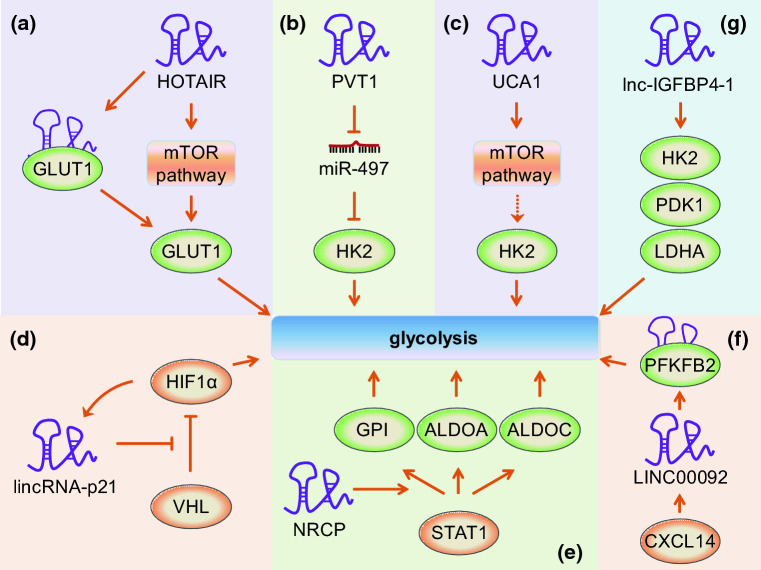
Fig. 1
Fig. 1
Regulation of glucose metabolism by lncRNAs. a HOTAIR enhances GLUT1 expression through activating the mTOR pathway, or through interacting with GLUT1 directly. b PVT1 acts as a molecular sponge of miR-497, which directly targets and suppresses the expression of HK2. c UCA1 promotes glycolysis by activating the mTOR pathway, which regulates the expression of HK2. d Under conditions of hypoxia, HIF-1α activates the transcription of lincRNA-p21. In return, lincRNA-p21 stabilizes HIF-1α by inhibiting VHL-mediated HIF-1α ubiquitination and degradation. e NRCP promotes glycolysis by enhancing the regulation of STAT1 to its downstream target genes, including GPI, ALDOA, and ALDOC. f LINC00092 is induced by CXCL14 and enhances glycolysis by interaction with PFKFB2. g Lnc-IGFBP4-1 enhances glycolysis by upregulating the expression of metabolic enzyme genes, including HK2, PDK1, and LDHA. Please see more detail in the text. “down arrow” indicates a promotion effect, but “perpendicular sign” indicates an inhibition effect. Solid line indicates a direct effect, but dashed line indicates an indirect effect. HOTAIR HOX transcript antisense intergenic RNA, GLUT1 glucose transporter 1, PVT1 plasmacytoma variant translocation 1, HK2 hexokinase 2, UCA1 urothelial cancer-associated 1, NRCP long non-coding RNA ceruloplasmin, GPI glucose-6-phosphate isomerase, ALDOA aldolase, fructose-bisphosphate A, ALDOC aldolase, fructose-bisphosphate C, PFKFB2 6-phosphofructo-2-kinase/fructose-2,6-biphosphatase, PDK1 pyruvate dehydrogenase kinase 1, LDHA lactate dehydrogenase A
Fig. 2
Fig. 2
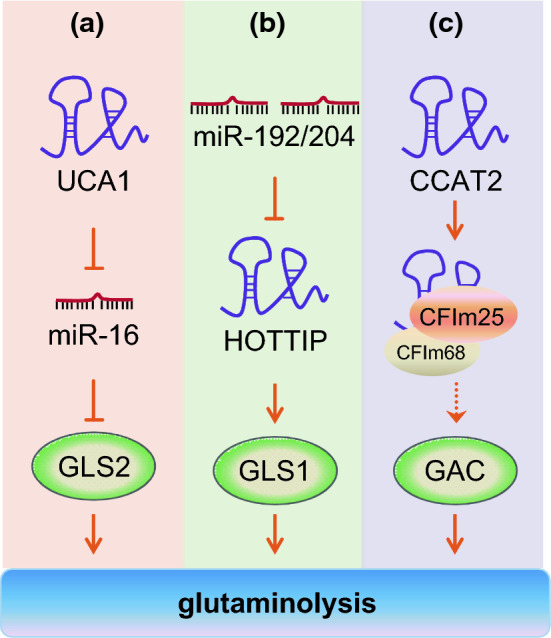
Regulation of glutamine metabolism by lncRNAs. a UCA1 functions as a molecular sponge of miR-16 and releases the expression of its target GLS2, which converts glutamine into glutamate. b HOTTIP, a target of both miR-192 and miR-204, is involved in glutaminolysis through its downstream gene GLS1. c CCAT2 alleles bind the CFIm complex, regulate the alternative splicing of GLS, and induce the production of GAC, which promotes the cancer progression. Please see more detail in the text. GLS glutaminase, HOTTIP HOXA transcript at the distal tip, CCAT2 colon cancer-associated transcript 2, CFIm cleavage factor I, GAC glutaminase isoform C
Fig. 3
Fig. 3
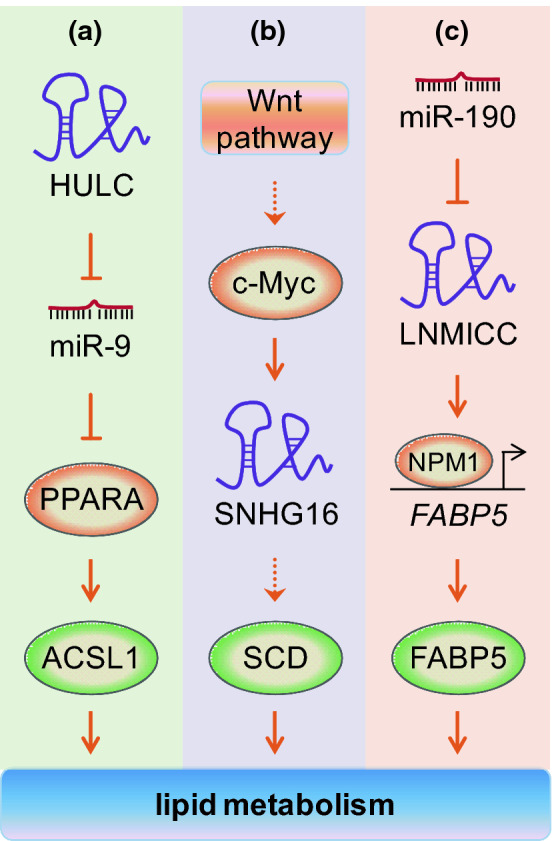
Regulation of lipid metabolism by lncRNAs. a HULC modulates lipid metabolism by miR-9/PPARA/ACSL1 pathway in hepatoma cells. b SNHG16, which is activated by the Wnt pathway/c-Myc axis in colorectal cancer, promotes the expression of genes involved in fatty acid biosynthesis, such as SCD. c LNMICC, a target of miR-190, induces binding of NPM1 to the promoter of FABP5 and activates its expression in cervical cancer. Consequently, FABP5 regulates the reprogramming of fatty acid metabolism. Please see more detail in the text. HULC highly upregulated in liver cancer, PPARA peroxisome proliferator activated receptor alpha, ACSL1 acyl-CoA synthetase long chain family member 1, SNHG16 snoRNA host gene 16, SCD stearoyl-CoA desaturase, LNMICC lncRNA associated with lymph node metastasis in cervical cancer, NPM1 nucleophosmin 1, FABP5 fatty acid binding protein 5
Fig. 4
Fig. 4
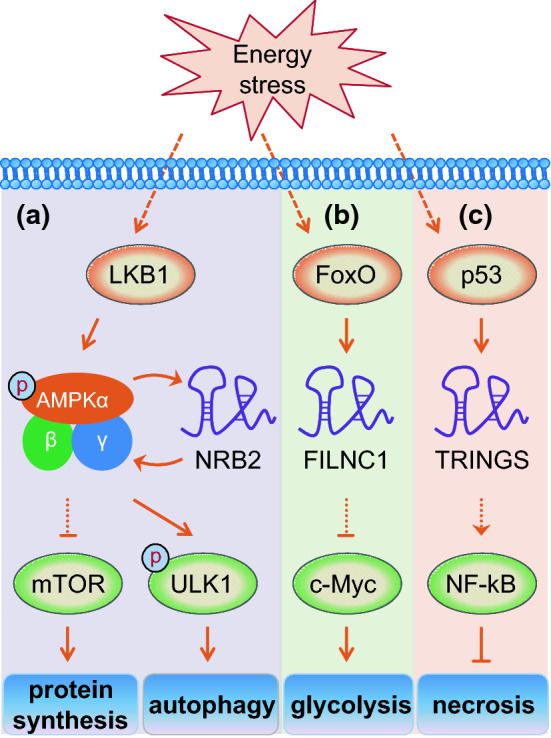
Response of lncRNAs to energy stress. Under the condition of energy stress such as glucose starvation, the expression of lncRNAs NBR2, FILNC1, and TRINGS are activated by LKB1–AMPK pathway, p53, and FoxO, respectively. a NBR2 enhances AMPK activity under energy stress by interaction with its kinase domain AMPKα. On the one hand, AMPK inhibits mTOR signaling that mediates protein synthesis. On the other hand, AMPK directly phosphorylates and activates the autophagy regulator ULK1. b FILNC1 suppresses the protein level of c-Myc, a master regulator of glycolysis. c NF-kB signaling is promoted by TRINGS and protect cancer cells from necrosis. Please see more detail in the text. NBR2 neighbour of BRCA1 gene 2, FILNC1 FoxO-induced long non-coding RNA 1, TRINGS Tp53-regulated inhibitor of necrosis under glucose starvation

References

    1. Hanahan D, Weinberg RA. Hallmarks of cancer: the next generation. Cell. 2011;144:646–674. doi: 10.1016/j.cell.2011.02.013. - DOI - PubMed
    1. Li Z, Zhang H. Reprogramming of glucose, fatty acid and amino acid metabolism for cancer progression. Cell Mol Life Sci (CMLS) 2016;73:377–392. doi: 10.1007/s00018-015-2070-4. - DOI - PMC - PubMed
    1. Daye D, Wellen KE. Metabolic reprogramming in cancer: unraveling the role of glutamine in tumorigenesis. Semin Cell Dev Biol. 2012;23:362–369. doi: 10.1016/j.semcdb.2012.02.002. - DOI - PubMed
    1. Beloribi-Djefaflia S, Vasseur S, Guillaumond F. Lipid metabolic reprogramming in cancer cells. Oncogenesis. 2016;5:e189. doi: 10.1038/oncsis.2015.49. - DOI - PMC - PubMed
    1. de Bari L, Atlante A. Including the mitochondrial metabolism of l-lactate in cancer metabolic reprogramming. Cell Mol Life Sci (CMLS) 2018;75:2763–2776. doi: 10.1007/s00018-018-2831-y. - DOI - PMC - PubMed

MeSH terms

LinkOut - more resources