


Terrorism and post-traumatic stress disorder: a historical review
- PMID: 30342864
- PMCID: PMC9939936
- DOI: 10.1016/S2215-0366(18)30335-3
Terrorism and post-traumatic stress disorder: a historical review
Abstract
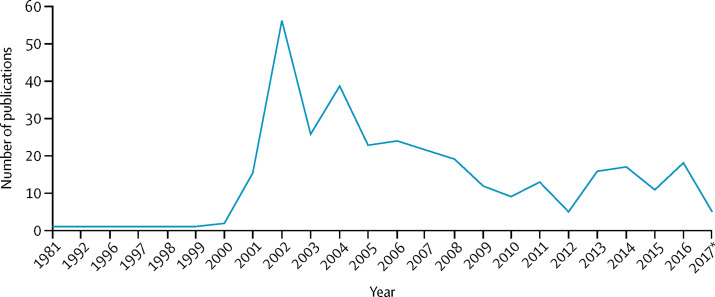
Terror is a psychological state. Historically, most studies of terrorism focused on its societal purpose and structural consequences rather than mental health effects. That emphasis began to change shortly before the Sept 11, 2001, terrorist attacks. A vast expansion of research into post-traumatic stress disorder accompanied revisions to the classification of mental health disorders. The effect of terrorist incidents on those people now deemed vulnerable, both directly and indirectly, was actively sought. However, a review of more than 400 research articles (mostly published after Sept 11) on the association between terrorism and mental health reached the largely overlooked conclusion that terrorism is not terrorising-at least not in a way that causes a greater than expected frequency of post-traumatic stress disorder than other traumatic events. This conclusion is surprising given the emphasis on the psychological effects of terrorism in political discourse, media commentary, contemporary culture, and academic inquiry. Authorities might prefer to encourage an interpretation of terrorist incidents that highlights fortitude and courage rather than psychological vulnerability.
Copyright © 2019 Elsevier Ltd. All rights reserved.
Figures
Comment in
-
Victims and front-line services still need clinical input.Lancet Psychiatry. 2019 Mar;6(3):199. doi: 10.1016/S2215-0366(18)30508-X. Lancet Psychiatry. 2019. PMID: 30798890 No abstract available.
References
-
- Holtz TH, Leighton J, Balter S, Weiss D, Blank S, Weisfuse I. In: Terrorism and public health: a balanced approach to strengthening systems and protecting people. Levy BS, Sidel VW, editors. Oxford University Press; Oxford: 2003. The public health response to the World Trade Center disaster; pp. 19–48.
-
- Silke A. Wiley; Chichester: 2003. Terrorists, victims and society: psychological perspectives on terrorism and its consequences.
-
- Schmid AP, Jongman AJ. 2nd edn. North-Holland Publishing Company; Oxford: 1988. Political terrorism.
-
- WHO . In: Basic Documents. 48th edn. WHO, editor. World Health Organization; Geneva: 2014. Constitution of the World Health Organization.
-
- Institute of Medicine . The National Academies Press; Washington, DC: 1988. The future of public health.
Publication types
MeSH terms
LinkOut - more resources
Full Text Sources
Medical
