


Effects of renal denervation on blood-pressure response to hemorrhagic shock in spontaneously hypertensive rats
- PMID: 30342984
- PMCID: PMC6235792
- DOI: 10.1016/j.cjtee.2018.09.001
Effects of renal denervation on blood-pressure response to hemorrhagic shock in spontaneously hypertensive rats
Erratum in
-
Erratum regarding missing Declaration of Competing Interest statements in previously published articles.Chin J Traumatol. 2025 Sep;28(5):390. doi: 10.1016/j.cjtee.2020.12.006. Epub 2020 Dec 30. Chin J Traumatol. 2025. PMID: 33386196 Free PMC article. No abstract available.
Abstract
Purpose: Renal denervation (RD) has been demonstrated to be an effective approach to reduce blood pressure for those with resistant hypertension. Yet, we aimed to explore the effect and possible mechanism of RD on blood-pressure response to hemorrhagic shock in spontaneously hypertensive rats.
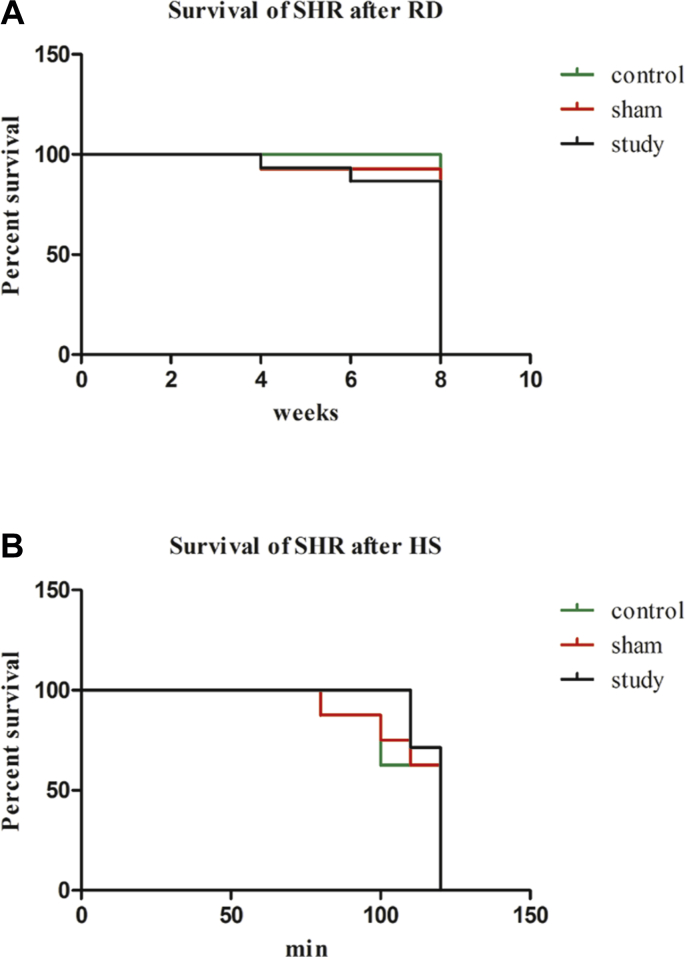
Methods: A total of 48 male spontaneously hypertensive rats were randomized to three groups: study group, sham-operation group and control group. RD was achieved by cutting off renal nerves and swabbing phenol on it. Ten weeks after RD, 8 rats in each group were sacrificed to collect the kidney and heart tissues. The remaining rats were subjected to an operation to induce hemorrhagic shock which would lead to 40% loss of total blood volume, and observed for 120 min. The serum concentration of norepinephrine was measured before and three weeks after RD.
Results: The blood-pressure and norepinephrine levels were reduced significantly after RD (p < 0.05). Systolic blood pressure and diastolic blood pressure of the surgery group were higher than those in the sham and control groups at 15, 30 and 45 min after hemorrhagic shock (p < 0.05), while no significant difference was observed at 60, 90 and 120 min (p > 0.05). Additionally, the beta-1 adrenergic receptor (β1-AR) in the study group was significantly higher than those in the other two groups (p < 0.05) after hemorrhagic shock.
Conclusion: This study demonstrated that RD could to some extent improve blood-pressure response to hemorrhagic shock in an established model of severe hemorrhagic shock in spontaneously hypertensive rats. The mechanism might be associated with up-regulation of β1-AR.
Keywords: Beta-1 adrenergic receptor; Hemorrhage; Renal denervation; Spontaneously hypertensive rats.
Copyright © 2018. Production and hosting by Elsevier B.V.
Figures



References
-
- Zambon A., Arfè A., Corrao G. Relationships of different types of event to cardiovascular death in trials of antihypertensive treatment: an aid to definition of total cardiovascular disease risk in hypertension. J Hypertens. 2014;32:495–508. - PubMed
-
- Gorostidi M., Banegas J.R., De la Sierra A. Ambulatory blood pressure monitoring in daily clinical practice-the Spanish ABPM Registry experience. Eur J Clin Invest. 2016;46:92–98. - PubMed
-
- Kumbhani D.J., Steg P.G., Cannon C.P. Resistant hypertension: a frequent and ominous finding among hypertensive patients with atherothrombosis. Eur Heart J. 2013;34:1204–1214. - PubMed
-
- Manolis A.J., Poulimenos L.E., Kallistratos M.S. Sympathetic overactivity in hypertension and cardiovascular disease. Curr Vasc Pharmacol. 2014;12:4–15. - PubMed
MeSH terms
LinkOut - more resources
Full Text Sources
Medical
Research Materials
Miscellaneous