


Trends in the socioeconomic patterning of overweight/obesity in India: a repeated cross-sectional study using nationally representative data
- PMID: 30344181
- PMCID: PMC6196932
- DOI: 10.1136/bmjopen-2018-023935
Trends in the socioeconomic patterning of overweight/obesity in India: a repeated cross-sectional study using nationally representative data
Abstract
Objectives: We aimed to examine trends in prevalence of overweight/obesity among adults in India by socioeconomic position (SEP) between 1998 and 2016.
Design: Repeated cross-sectional study using nationally representative data from India collected in 1998/1999, 2005/2006 and 2015/2016. Multilevel regressions were used to assess trends in prevalence of overweight/obesity by SEP.
Setting: 26, 29 and 36 Indian states or union territories, in 1998/99, 2005/2006 and 2015/2016, respectively.
Participants: 628 795 ever-married women aged 15-49 years and 93 618 men aged 15-54 years.
Primary outcome measure: Overweight/obesity defined by body mass index >24.99 kg/m2.
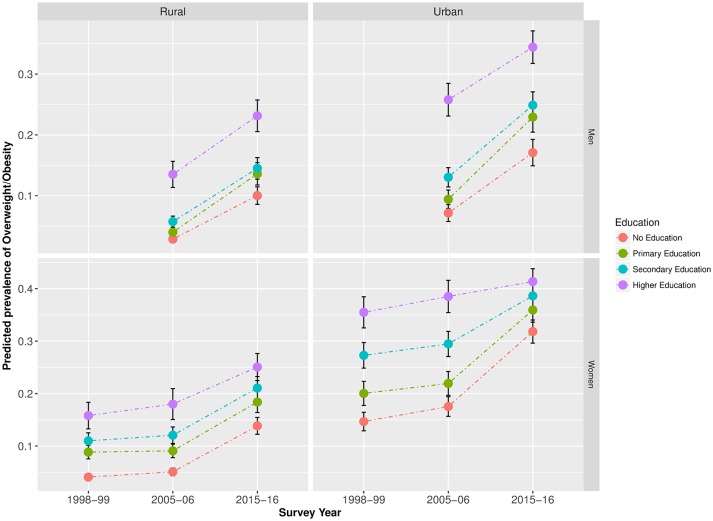
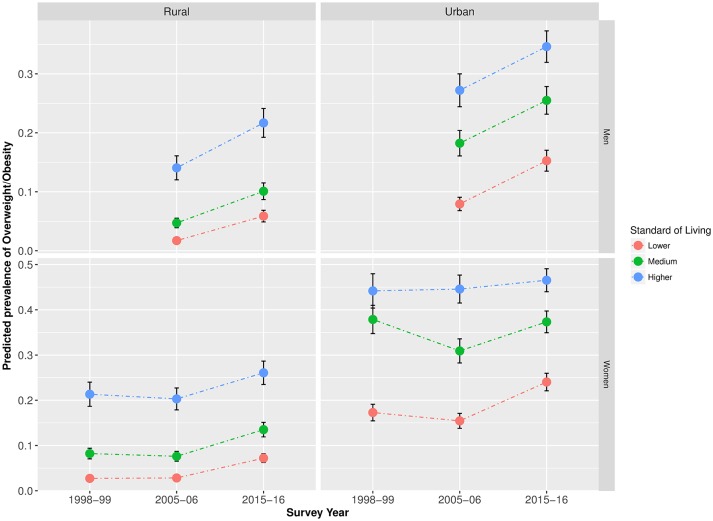
Results: Between 1998 and 2016, overweight/obesity prevalence increased among men and women in both urban and rural areas. In all periods, overweight/obesity prevalence was consistently highest among higher SEP individuals. In urban areas, overweight/obesity prevalence increased considerably over the study period among lower SEP adults. For instance, between 1998 and 2016, overweight/obesity prevalence increased from approximately 15%-32% among urban women with no education. Whereas the prevalence among urban men with higher education increased from 26% to 34% between 2005 and 2016, we did not observe any notable changes among high SEP urban women between 1998 and 2016. In rural areas, more similar increases in overweight/obesity prevalence were found among all individuals across the study period, irrespective of SEP. Among rural women with higher education, overweight/obesity increased from 16% to 25% between 1998 and 2016, while the prevalence among rural women with no education increased from 4% to 14%.
Conclusions: We identified some convergence of overweight/obesity prevalence across SEP in urban areas among both men and women, with fewer signs of convergence across SEP groups in rural areas. Efforts are therefore needed to slow the increasing trend of overweight/obesity among all Indians, as we found evidence suggesting it may no longer be considered a 'diseases of affluence'.
Keywords: multilevel logistic regression; obesity; overweight; rural India; socioeconomic position; urban India.
© Author(s) (or their employer(s)) 2018. Re-use permitted under CC BY-NC. No commercial re-use. See rights and permissions. Published by BMJ.
Conflict of interest statement
Competing interests: None declared.
Figures

References
-
- World Health Organization, 2016. Fact Sheet 311: obesity and overweight. Available at http://www.who.int/mediacentre/factsheets/fs311/en/ (accessed 13 Jul 2017).
-
- International Institute for Population Sciences (IIPS) and ORC Macro. National Family Health Survey (NFHS-4), 2014-15. India. Mumbai: IIPS, 2017.
-
- DeSA, U.N. World population prospects: the 2012 revision. New York: Population division of the department of economic and social affairs of the United Nations Secretariat, 2013.
-
- International Institute for Population Sciences (IIPS) and Macro International. National Family Health Survey (NFHS-3), 2005-06. India: Mumbai: IIPS, 2007.
-
- International Institute for Population Sciences (IIPS) and ORC Macro. National Family Health Survey (NFHS-2), 1998-99. India. Mumbai: IIPS, 2000.
Publication types
MeSH terms
LinkOut - more resources
Full Text Sources
Medical
