


On the Morphology and Composition of Particulate Matter in an Urban Environment
- PMID: 30344547
- PMCID: PMC6192059
- DOI: 10.4209/aaqr.2017.09.0340
On the Morphology and Composition of Particulate Matter in an Urban Environment
Abstract
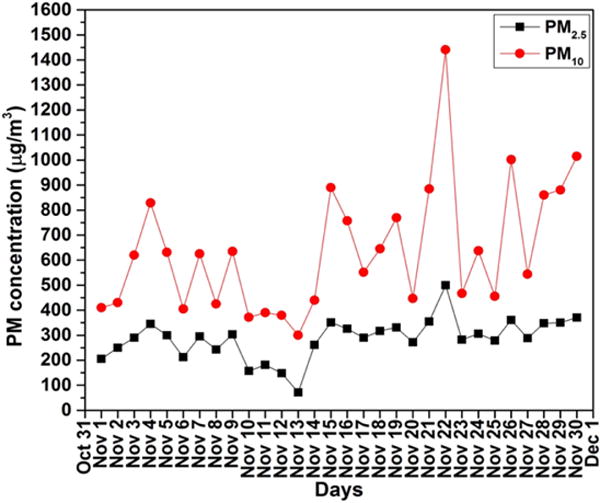
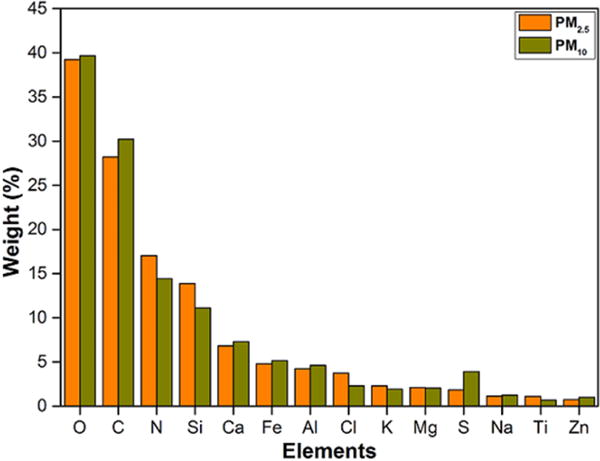
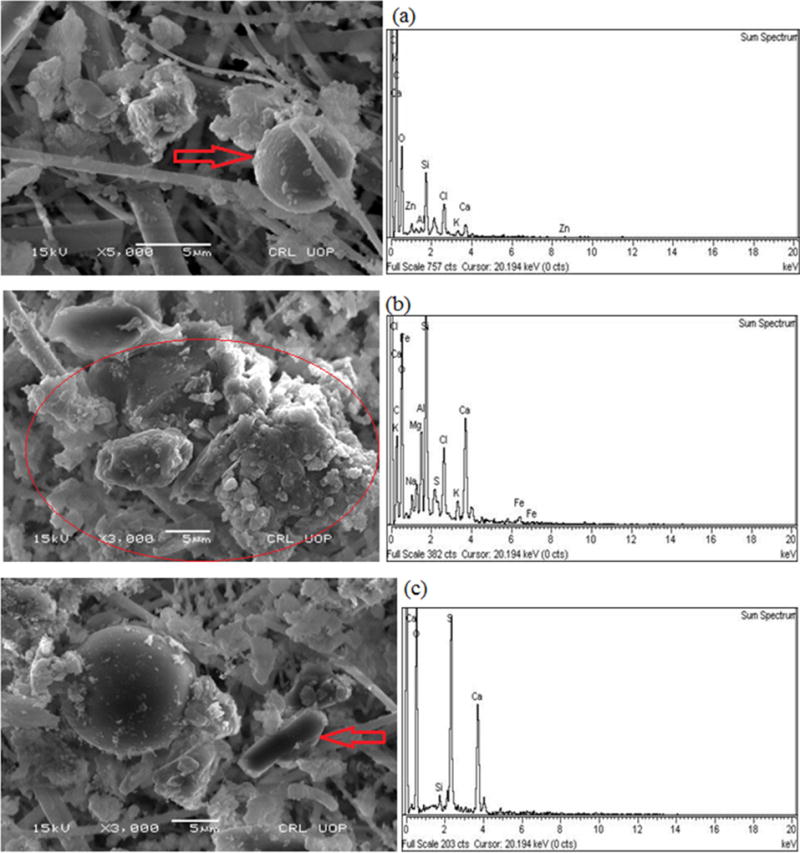
Particulate matter (PM) plays a vital role in altering air quality, human health, and climate change. There are sparse data relevant to PM characteristics in urban environments of the Middle East, including Peshawar city in Pakistan. This work reports on the morphology and composition of PM in two size fractions (PM2.5 and PM10) during November 2016 in Peshawar. The 24 hous mass concentration of PM2.5 varied from 72 μg m-3 to 500 μg m-3 with an average value of 286 μg m-3. The 24 hours PM10 concentration varied from 300 μg m-3 to 1440 μg m-3 with an average of 638 μg m-3. The morphology, size, and elemental composition of PM were measured using Fourier Transform Infra Red (FT-IR) Spectroscopy and Scanning Electron Microscopy (SEM) with Energy Dispersive X-ray (EDX) Spectroscopy. The size of the analyzed particles by EDX ranged from 916 nm to 22 μm. Particles were classified into the following groups based on their elemental composition and morphology: silica (12%), aluminosilicates (23%), calcium rich (3%), chloride (2%), Fe/Ti oxides (3%), carbonaceous (49%), sulfate (5%), biogenic (3%). The major identified sources of PM are vehicular emissions, biomass burning, soil and re-suspended road dust, biological emissions, and construction activities in and around the vicinity of the sampling site.
Keywords: Energy Dispersive X-ray; Fourier Transform Infra Red Spectroscopy; Morphology and elemental composition; Particulate matter; Scanning Electron Microscopy.
Figures






References
-
- Adachi K, Chung SH, Buseck PR. Shapes of soot aerosol particles and implications for their effects on climate. J Geophys Res. 2010;115:D15206.
-
- Alam K, Blaschke T, Madl P, Mukhtar A, Hussain M, Trautmann T, Rahman S. Aerosol size distribution and mass concentration measurements in various cities of Pakistan. J Environ Monit. 2011;13:1944–1952. - PubMed
-
- Alam K, Rahman N, Khan HU, Haq BS, Rahman S. Particulate matter and its source apportionment in Peshawar, Northern Pakistan. Aerosol Air Qual Res. 2015;15:634–647.
-
- Alexander DTL, Crozier PA, Anderson JR. Brown carbon spheres in east Asian outflow and their optical properties. Science. 2008;321:833–836. - PubMed
-
- Allen DT, Palen EJ, Haimov MI, Hering SV, Young JR. Fourier transform infrared spectroscopy of aerosol collected in a low pressure impactor (LPI/FTIR): Method development and field calibration. Aerosol Sci Technol. 1994;21:325–342.
Grants and funding
LinkOut - more resources
Full Text Sources