


Application of Radiomics and Decision Support Systems for Breast MR Differential Diagnosis
- PMID: 30344618
- PMCID: PMC6174735
- DOI: 10.1155/2018/7417126
Application of Radiomics and Decision Support Systems for Breast MR Differential Diagnosis
Abstract
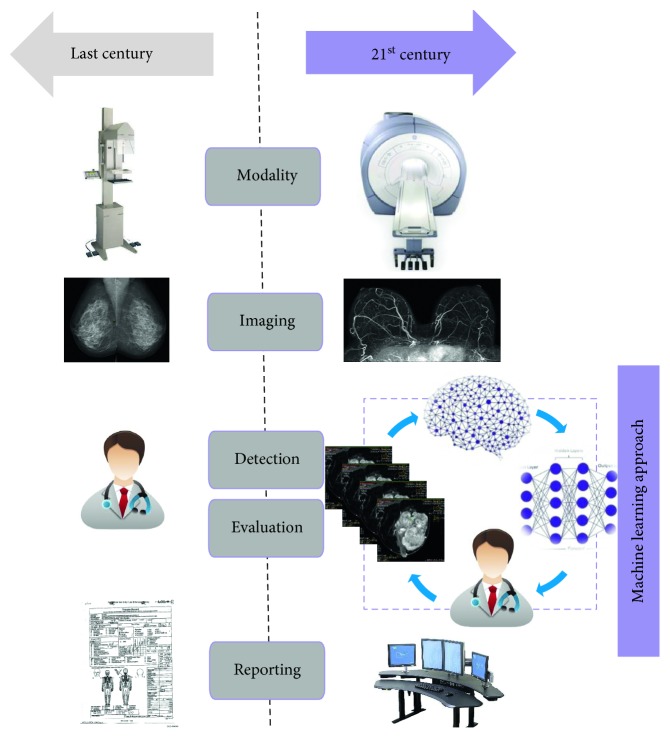
Over the years, MR systems have evolved from imaging modalities to advanced computational systems producing a variety of numerical parameters that can be used for the noninvasive preoperative assessment of breast pathology. Furthermore, the combination with state-of-the-art image analysis methods provides a plethora of quantifiable imaging features, termed radiomics that increases diagnostic accuracy towards individualized therapy planning. More importantly, radiomics can now be complemented by the emerging deep learning techniques for further process automation and correlation with other clinical data which facilitate the monitoring of treatment response, as well as the prediction of patient's outcome, by means of unravelling of the complex underlying pathophysiological mechanisms which are reflected in tissue phenotype. The scope of this review is to provide applications and limitations of radiomics towards the development of clinical decision support systems for breast cancer diagnosis and prognosis.
Figures
References
-
- Clarke G. M., Peressotti C., Constantinou P., Hosseinzadeh D., Martel A., Yaffe M. J. Increasing specimen coverage using digital whole-mount breast pathology: implementation, clinical feasibility and application in research. Computerized Medical Imaging and Graphics. 2011;35(7-8):531–541. doi: 10.1016/j.compmedimag.2011.05.002. - DOI - PubMed
Publication types
MeSH terms
Substances
LinkOut - more resources
Full Text Sources
Medical
