Old muscle in young body: an aphorism describing the Chronic Fatigue Syndrome
- PMID: 30344981
- PMCID: PMC6176399
- DOI: 10.4081/ejtm.2018.7688
Old muscle in young body: an aphorism describing the Chronic Fatigue Syndrome
Abstract
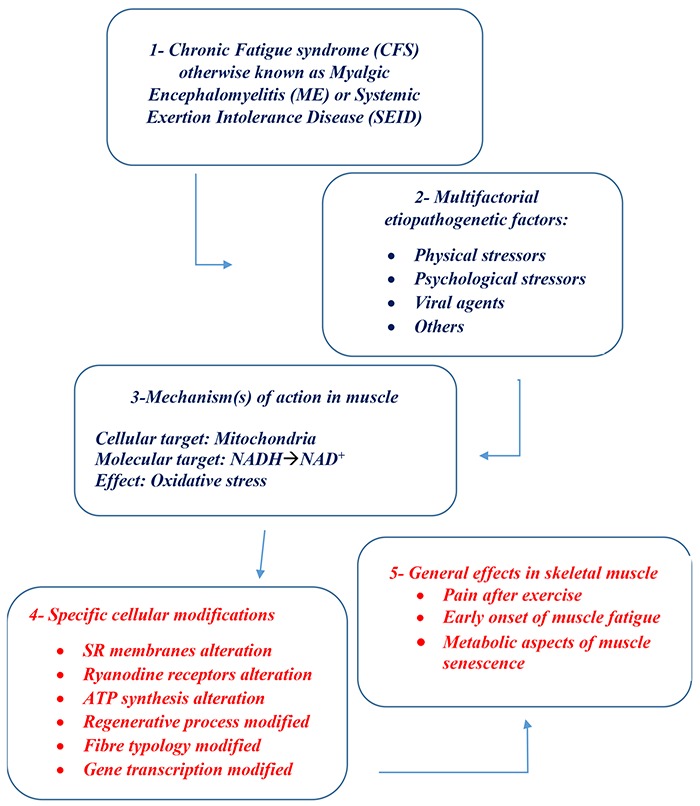
The chronic fatigue syndrome (CFS) otherwise known as myalgic encephalomyelitis (ME), is a debilitating syndrome whose identification is very complex due to lack of precise diagnostic criteria. This pathology begins with limitations in duration and intensity of exercise and rapid onset of pain during physical activity. Its etiology is unknown, and symptoms are not limited to the muscles. Epidemiology is rather difficult to delimit, even if it affects mainly young (20-40 years), female subjects. The results of muscular research show some peculiarities that can justify what has been observed in vivo. In particular, 1. presence of oxidative damage of lipid component of biological membranes and DNA not compensated by the increase of the scavenger activity; 2. Excitation-Contraction (E-C) alteration with modification of Ca2+ transport; 3. passage from slow to fast fiber phenotype; 4. inability to increase glucose uptake; 5. presence of mitochondrial dysfunction; and 6. genes expressed differentially (particularly those involved in energy production). The skeletal muscles of CFS / ME patients show a significant alteration of the oxidative balance due to mitochondrial alteration and of the fiber phenotype composition as shown in sarcopenic muscles of the elderly. Vice versa, the muscle catabolism does not appear to be involved in the onset of this syndrome. The data support the hypothesis that patients with CFS are subjected to some of the problems typical for muscle aging, which is probably related to disorders of muscle protein synthesis and biogenesis of mitochondria. Patients with CFS can benefit from an appropriate training program because no evidence suggests that physical exercise worsens symptoms. Type, intensity and duration of any physical activity that activates muscle contraction (including Electrical Stimulation) require further investigation even if it is known that non-exhaustive physical activity decreases painful symptomatology.
Keywords: Chronic Fatigue Syndrome; Myalgic Encephalomyelitis; Systemic Exertion Intolerance Disease; painful symptomatology; physical exercise; skeletal muscle.
Conflict of interest statement
Conflict of Interest: All authors declare no conflicts of interests.
Figures
References
-
- Norheim KB, Jonsson G, Omdal R. Biological mechanisms of chronic fatigue. Rheumatology (Oxford) 2011;50:1009-18. - PubMed
-
- Clayton EW. Beyond myalgic encephalomyelitis/ chronic fatigue syndrome: an IOM report on redefining an illness. JAMA 2015;313:1101-2. - PubMed
-
- Nicolson GL, Gan R, Haier J. Multiple co-infections (Mycoplasma, Chlamydia, human herpes virus-6) in blood of chronic fatigue syndrome patients: association with signs and symptoms. APMIS 2003;111:557-66. - PubMed
-
- Morris G, Anderson G, Maes M. Hypothalamic-Pituitary-Adrenal Hypofunction in Myalgic Encephalomyelitis (ME)/Chronic Fatigue Syndrome (CFS) as a Consequence of Activated Immune-Inflammatory and Oxidative and Nitrosative Pathways. Mol Neurobiol 2017;54:6806-19. - PubMed
LinkOut - more resources
Full Text Sources
Other Literature Sources
Miscellaneous