FUT2 secretor genotype and susceptibility to infections and chronic conditions in the ALSPAC cohort
- PMID: 30345375
- PMCID: PMC6171556
- DOI: 10.12688/wellcomeopenres.14636.2
FUT2 secretor genotype and susceptibility to infections and chronic conditions in the ALSPAC cohort
Abstract
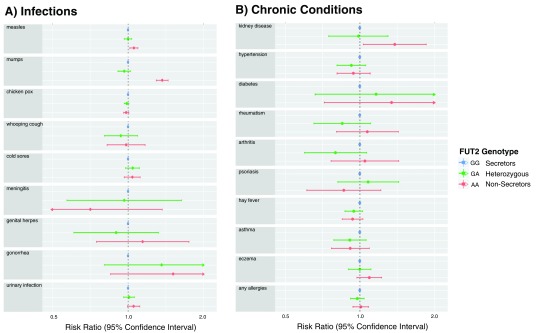
Background: The FUT2 (fucosyltransferase-2) gene determines blood group secretor status. Being homozygous for the inactive "non-secretor" rs601338(A) allele confers resistance to certain infections (e.g. Norovirus, Rotavirus) and susceptibility to others (e.g. Haemophilus influenza, Streptococcus pneumonia). Non-secretors also have an increased risk of type 1 diabetes and inflammatory bowel disease. We examined FUT2 genotype, infections and chronic conditions in a population-based cohort. Methods: We studied 7,582 pregnant women from the ALSPAC pregnancy cohort. Infections (measles, mumps, chicken pox, whooping cough, meningitis, herpes, gonorrhea and urinary infections) and chronic conditions (kidney disease, hypertension, diabetes, rheumatism, arthritis, psoriasis, hay fever, asthma, eczema and allergies) were self-reported. FUT2 secretor status was determined from the rs601338 genotype. ABO blood type was obtained from clinical records. Results: Overall, 1920 women (25.3%) were homozygous for the non-secretor allele (AA). Secretor status was associated with mumps, with 68% of non-secretors experiencing this infection, compared to 48% of secretors (RR, 1.40; 95% CI, 1.34-1.46). A weaker association was observed for measles infection (76% vs. 72%; RR, 1.05; 95% CI, 1.02-1.09). Non-secretors also experienced an increased risk of kidney disease (5.4% vs. 3.9%; RR, 1.39; 95% CI, 1.11-1.75). Independent of secretor status, AB blood type was a risk factor for mumps (RR 1.15; 95%CI, 1.03, 1.28 compared to type O). We found no evidence of interaction between secretor status and blood type. For some conditions, including asthma and arthritis, FUT2 heterozygosity (GA) appeared to confer an intermediate phenotype. There was no strong evidence of association between secretor status and other infections or chronic conditions, although statistical power was limited for rare outcomes. Conclusion: Our results identify an association between FUT2 secretor status and self-reported kidney disease, and confirm a recently reported association with susceptibility to mumps infection. The clinical implications of these associations warrant further investigation.
Keywords: ALSPAC; FUT2; chronic disease; infection; kidney disease; mumps; secretor status.
Conflict of interest statement
No competing interests were disclosed.
Figures
References
-
- Kelly RJ, Rouquier S, Giorgi D, et al. : Sequence and expression of a candidate for the human Secretor blood group alpha(1,2)fucosyltransferase gene ( FUT2). Homozygosity for an enzyme-inactivating nonsense mutation commonly correlates with the non-secretor phenotype. J Biol Chem. 1995;270(9):4640–4649. 10.1074/jbc.270.9.4640 - DOI - PubMed
Grants and funding
LinkOut - more resources
Full Text Sources