Review
. 2019 Feb;18(1):e12841.
doi: 10.1111/acel.12841. Epub 2018 Oct 22.

Integrating cellular senescence with the concept of damage accumulation in aging: Relevance for clearance of senescent cells

Affiliations
Review

Integrating cellular senescence with the concept of damage accumulation in aging: Relevance for clearance of senescent cells

Mikolaj Ogrodnik et al. Aging Cell. 2019 Feb.

Erratum in

  • Corrigendum.
    [No authors listed] [No authors listed] Aging Cell. 2019 Apr;18(2):e12942. doi: 10.1111/acel.12942. Aging Cell. 2019. PMID: 30860671 Free PMC article. No abstract available.

Abstract

Understanding the aging process and ways to manipulate it is of major importance for biology and medicine. Among the many aging theories advanced over the years, the concept most consistent with experimental evidence posits the buildup of numerous forms of molecular damage as a foundation of the aging process. Here, we discuss that this concept integrates well with recent findings on cellular senescence, offering a novel view on the role of senescence in aging and age-related disease. Cellular senescence has a well-established role in cellular aging, but its impact on the rate of organismal aging is less defined. One of the most prominent features of cellular senescence is its association with macromolecular damage. The relationship between cell senescence and damage concerns both damage as a molecular signal of senescence induction and accelerated accumulation of damage in senescent cells. We describe the origin, regulatory mechanisms, and relevance of various damage forms in senescent cells. This view on senescent cells as carriers and inducers of damage puts new light on senescence, considering it as a significant contributor to the rise in organismal damage. Applying these ideas, we critically examine current evidence for a role of cellular senescence in aging and age-related diseases. We also discuss the differential impact of longevity interventions on senescence burden and other types of age-related damage. Finally, we propose a model on the role of aging-related damage accumulation and the rate of aging observed upon senescent cell clearance.

Keywords: aging; cellular senescence; deleteriome; evolutionary biology; lifespan; molecular damage; theories of aging.


Figures

Figure 1
Figure 1
Examples of macromolecular damage. A single macromolecule (protein) can be affected by a wide variety of damage types whose heterogeneity is only partially understood. Different damage types, some of which are individually illustrated in the figure, can coexist in the same macromolecule and affect its functionality
Figure 2
Figure 2
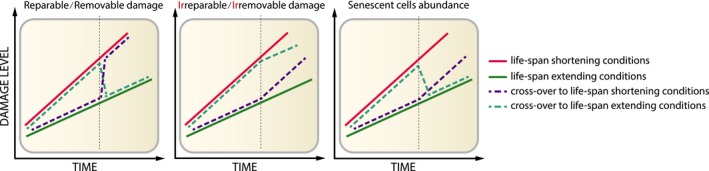
Accumulation patterns of damage types and senescent cells in an organism subjected to lifespan‐modifying interventions. (left graph) Repairable damage, such as oxidative damage, exhibits a full reversal of the phenotype so that an intervention extending the lifespan sharply decreases damage level, while an intervention decreasing lifespan elevates damage. (middle graph) Level of irreparable damage, such as lipofuscin, is not changed by lifespan‐modulating interventions, in contrast to the rate of its accumulation, demonstrating the importance of life history on irreparable damage accumulation. (right graph) Markers of cell senescence change independently of damage markers. Upon entering a lifespan‐extending treatment, an organism shows a long‐lasting decrease in senescence markers. Changing the conditions to lifespan shortening does not affect the current status of senescence markers but might impact on the rate of senescent cell accumulation
Figure 3
Figure 3
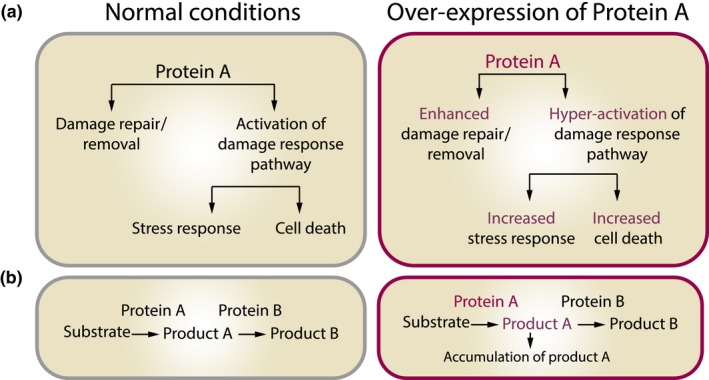
Unexpected effects of overexpression of proteins involved in macromolecular damage repair and/or removal. Overexpression of a protein may yield unexpected results, which are related to (a) multifunctionality of proteins and (b) accumulation of products of the enzymatic reaction carried by the overexpressed protein
Figure 4
Figure 4
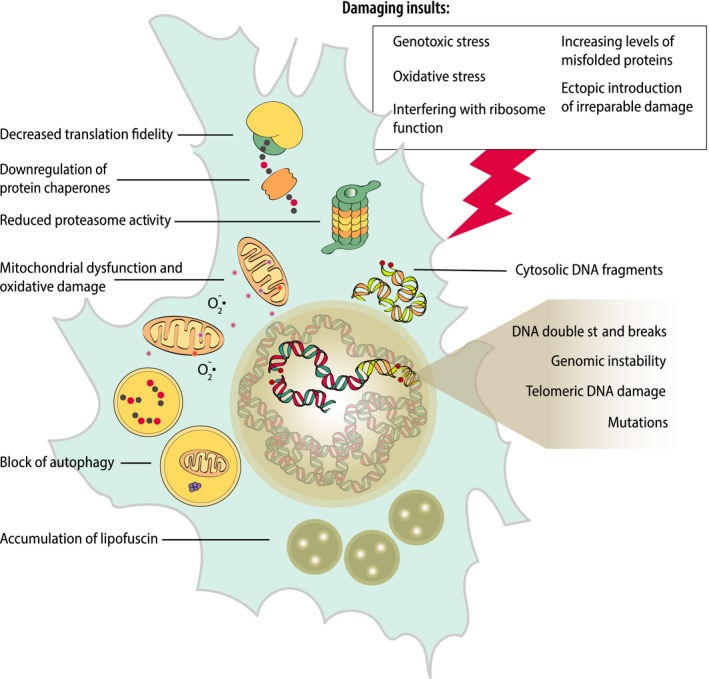
A summary of damage types known to accumulate in senescent cells and damage‐dependent triggers of cellular senescence. Cells induced to senesce by damaging insults exhibit higher than healthy cells basal levels of damage and generate damage at a higher rate
Figure 5
Figure 5
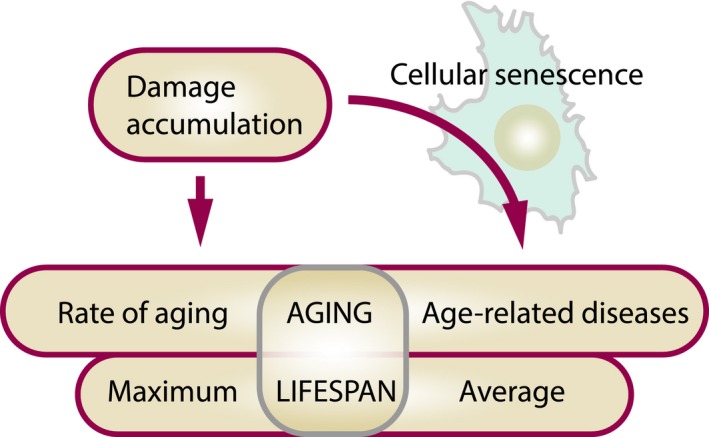
Damage accumulation accounts for both organismal and cellular aging. Accumulation of damage causes cellular senescence, which contributes to age‐related diseases and, by doing so, affects the average lifespan. Accumulation of damage can affect the maximum lifespan/rate of aging in a senescence‐independent manner (as damage accumulates in all the cells, not only in senescent) and average lifespan/age‐related diseases through the “damage amplification loop” represented by cellular senescence

References

    1. Acosta, J. C. , Banito, A. , Wuestefeld, T. , Georgilis, A. , Janich, P. , Morton, J. P. , … Gil, J. (2013). A complex secretory program orchestrated by the inflammasome controls paracrine senescence. Nature Cell Biology, 15, 978–990. 10.1038/ncb2784 - DOI - PMC - PubMed
    1. Adams, P. D. , Jasper, H. , & Rudolph, K. L. (2015). Aging‐induced stem cell mutations as drivers for disease and cancer. Cell Stem Cell, 16, 601–612. 10.1016/j.stem.2015.05.002 - DOI - PMC - PubMed
    1. Akare, S. , Jean‐Louis, S. , Chen, W. , Wood, D. J. , Powell, A. A. , & Martinez, J. D. (2006). Ursodeoxycholic acid modulates histone acetylation and induces differentiation and senescence. International Journal of Cancer, 119, 2958–2969. 10.1002/(ISSN)1097-0215 - DOI - PubMed
    1. Ando, K. , Beppu, M. , Kikugawa, K. , Nagai, R. , & Horiuchi, S. (1999). Membrane proteins of human erythrocytes are modified by advanced glycation end products during aging in the circulation. Biochemical and Biophysical Research Communications, 258, 123–127. 10.1006/bbrc.1999.0606 - DOI - PubMed
    1. Andziak, B. , O'Connor, T. P. , Qi, W. , DeWaal, E. M. , Pierce, A. , Chaudhuri, A. R. , … Buffenstein, R. (2006). High oxidative damage levels in the longest‐living rodent, the naked mole‐rat. Aging Cell, 5, 463–471. 10.1111/j.1474-9726.2006.00237.x - DOI - PubMed

Publication types

LinkOut - more resources