Review
. 2019 Jan 1;21(1):14-25.
doi: 10.1093/neuonc/noy170.

Viral and other therapies for recurrent glioblastoma: is a 24-month durable response unusual?

Affiliations
Review

Viral and other therapies for recurrent glioblastoma: is a 24-month durable response unusual?

E Antonio Chiocca et al. Neuro Oncol. .

Abstract

A phase I trial of an engineered poliovirus for the treatment of recurrent glioblastoma (GBM) has attracted attention due to 8 survivors reaching the 24-month and 5 reaching the 36-month survival landmarks.1 Genetically engineered viruses (oncolytic viruses) have been in trials for GBM for almost two decades.2 These replication-competent (tumor-selective, oncolytic, replication-conditional) viruses or replication-defective viral vectors (gene therapy) deliver cytotoxic payloads to tumors, leading to immunogenic death and intratumoral inflammatory responses. This transforms the tumor microenvironment from immunologically naïve ("cold") to inflamed ("hot"), increasing immune cell recognition of tumor antigens and the durable responses observed in virotherapy.3,4 Several current and past virotherapy trials have reported a "tail" of apparent responders at the 24-month landmark. Other modalities have also reported a "tail" of seemingly long-term survivors. These trials seem to show that these responder "tails" characterize a defined subset of GBM patients.


Figures
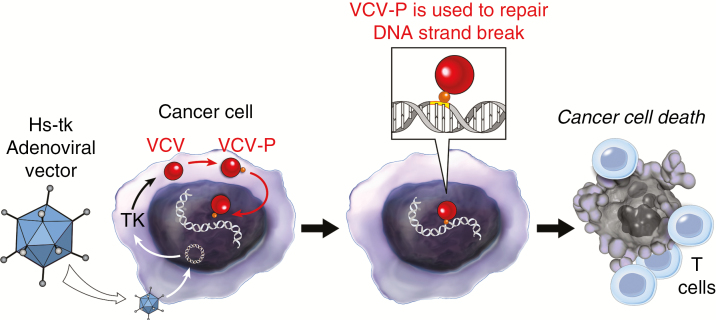
Fig. 1
Fig. 1
Replication-defective viral vectors infect cancer cells and deliver an anticancer gene but do not replicate. Adenoviral vectors have been engineered to deliver the herpes simplex thymidine kinase gene (Hs-tk). Once inside the cell, the adenoviral DNA exists as an extrachromosomal element in the nucleus and transcribes/translates the tk gene. Thymidine kinase phosphorylates nucleoside analogs, such as valacyclovir (VCV). The phosphorylated VCV (VCP-P) molecules are then used by the cancer cell DNA polymerases to repair DNA strand break (caused by radiation), leading to DNA replication arrest and immunogenic cell death. This leads to increased recognition of tumor antigens by immune effector cells.
Fig. 2
Fig. 2
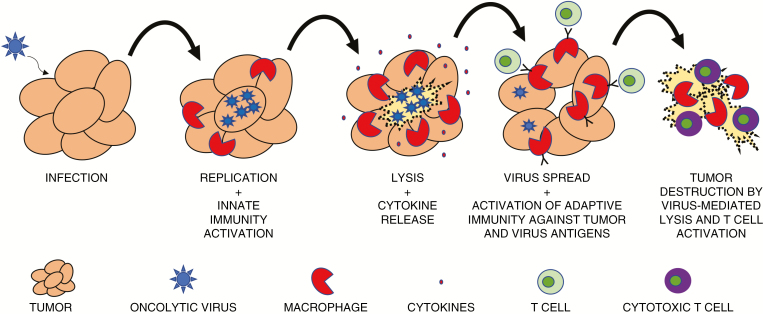
Replication-competent viruses infect tumor cells and replicate. As they lead to tumor cell cytotoxicity and spread an infection to surrounding tumor cells, innate immune cells, such as macrophages, are activated and release cytokines, inflaming the tumor microenvironment. Lysis of tumor cells is thought to improve antigen presentation and infiltration of activated effector T cells against tumor and viral antigens. This leads to durable antitumor responses.
Fig. 3
Fig. 3
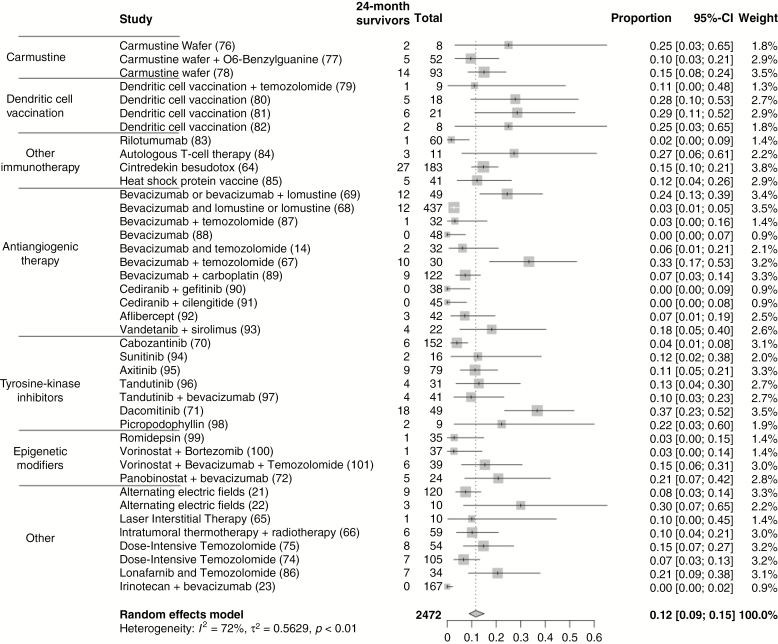
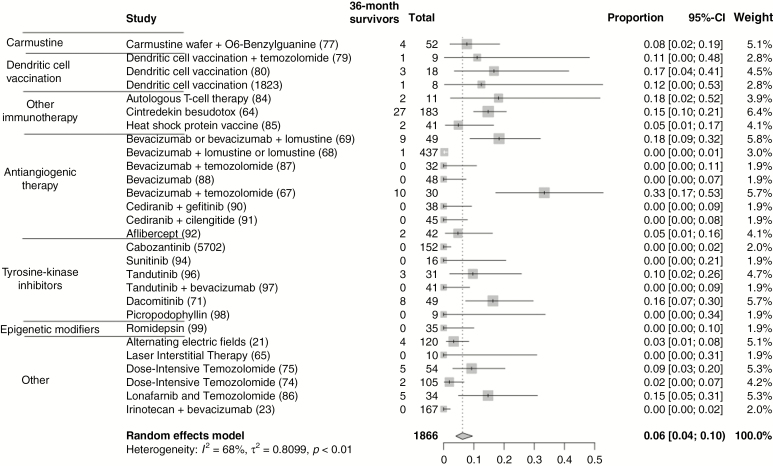
Pooled proportion of survivors in non-virotherapies trials for rGBM at (A) 24 months and (B) 36 months. Studies on non-virotherapy clinical trials reporting 24-month and 36-month overall survival for rGBM are included. Survivors represent the number of patients surviving at 24 or 36 months. Total represents the total number of rGBM patients in a trial. Given the heterogeneity of designs, pooling of proportion of patients was performed via a random effects model.
Fig. 3
Fig. 3
Pooled proportion of survivors in non-virotherapies trials for rGBM at (A) 24 months and (B) 36 months. Studies on non-virotherapy clinical trials reporting 24-month and 36-month overall survival for rGBM are included. Survivors represent the number of patients surviving at 24 or 36 months. Total represents the total number of rGBM patients in a trial. Given the heterogeneity of designs, pooling of proportion of patients was performed via a random effects model.
Fig. 4
Fig. 4
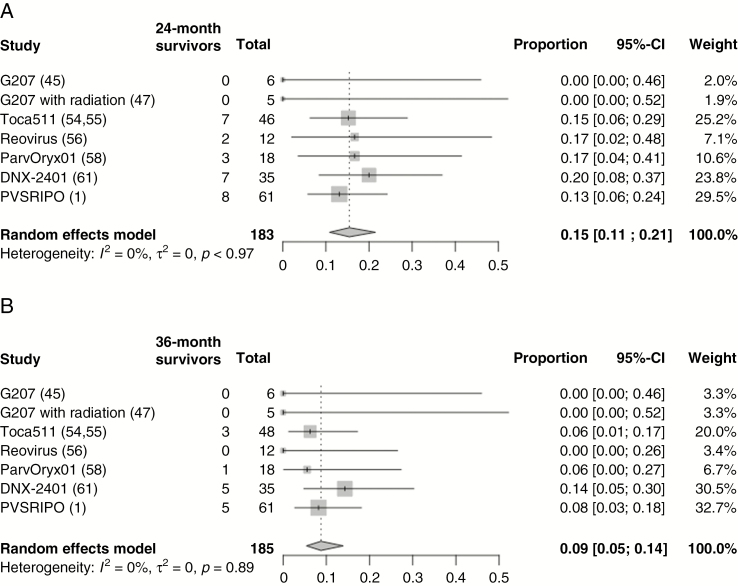
Pooled proportion of survivors in recent virotherapies trials for rGBM at (A) 24 months and (B) 36 months. Studies on virotherapy clinical trials reporting 24-month and 36-month overall survival for rGBM are included. Survivors represent the number of patients surviving at 24 or 36 months. Total represents the total number of rGBM patients in a trial. Given the heterogeneity of designs, pooling of proportion of patients was performed via a random effects model.

References

    1. Desjardins A, Gromeier M, Herndon JE 2nd, et al. Recurrent glioblastoma treated with recombinant poliovirus. N Engl J Med. 2018;379(2):150–161. - PMC - PubMed
    1. Lawler SE, Speranza MC, Cho CF, Chiocca EA. Oncolytic Viruses in Cancer Treatment: A Review. JAMA Oncol. 2017;3(6):841–849. - PubMed
    1. Chiocca EA, Rabkin SD. Oncolytic viruses and their application to cancer immunotherapy. Cancer Immunol Res. 2014;2(4):295–300. - PMC - PubMed
    1. Ribas A, Dummer R, Puzanov I, et al. Oncolytic virotherapy promotes intratumoral T cell infiltration and improves anti-PD-1 immunotherapy. Cell. 2017;170(6):1109–1119.e10. - PMC - PubMed
    1. Stupp R, Mason WP, van den Bent MJ, et al. ; European Organisation for Research and Treatment of Cancer Brain Tumor and Radiotherapy Groups; National Cancer Institute of Canada Clinical Trials Group Radiotherapy plus concomitant and adjuvant temozolomide for glioblastoma. N Engl J Med. 2005;352(10):987–996. - PubMed

Publication types