. 2018 Oct 31;140(43):14455-14463.
doi: 10.1021/jacs.8b09326. Epub 2018 Oct 22.

Photogenerated Radical in Phenylglyoxylic Acid for in Vivo Hyperpolarized 13C MR with Photosensitive Metabolic Substrates

Affiliations

Photogenerated Radical in Phenylglyoxylic Acid for in Vivo Hyperpolarized 13C MR with Photosensitive Metabolic Substrates

Irene Marco-Rius et al. J Am Chem Soc. .

Abstract

Whether for 13C magnetic resonance studies in chemistry, biochemistry, or biomedicine, hyperpolarization methods based on dynamic nuclear polarization (DNP) have become ubiquitous. DNP requires a source of unpaired electrons, which are commonly added to the sample to be hyperpolarized in the form of stable free radicals. Once polarized, the presence of these radicals is unwanted. These radicals can be replaced by nonpersistent radicals created by the photoirradiation of pyruvic acid (PA), which are annihilated upon dissolution or thermalization in the solid state. However, since PA is readily metabolized by most cells, its presence may be undesirable for some metabolic studies. In addition, some 13C substrates are photosensitive and therefore may degrade during the photogeneration of a PA radical, which requires ultraviolet (UV) light. We show here that the photoirradiation of phenylglyoxylic acid (PhGA) using visible light produces a nonpersistent radical that, in principle, can be used to hyperpolarize any molecule. We compare radical yields in samples containing PA and PhGA upon photoirradiation with broadband and narrowband UV-visible light sources. To demonstrate the suitability of PhGA as a radical precursor for DNP, we polarized the gluconeogenic probe 13C-dihydroxyacetone, which is UV-sensitive, using a commercial 3.35 T DNP polarizer and then injected this into a mouse and followed its metabolism in vivo.


Conflict of interest statement

The authors declare the following competing financial interest(s): A. Comment is currently employed by General Electric Medical Systems, Inc.

Figures
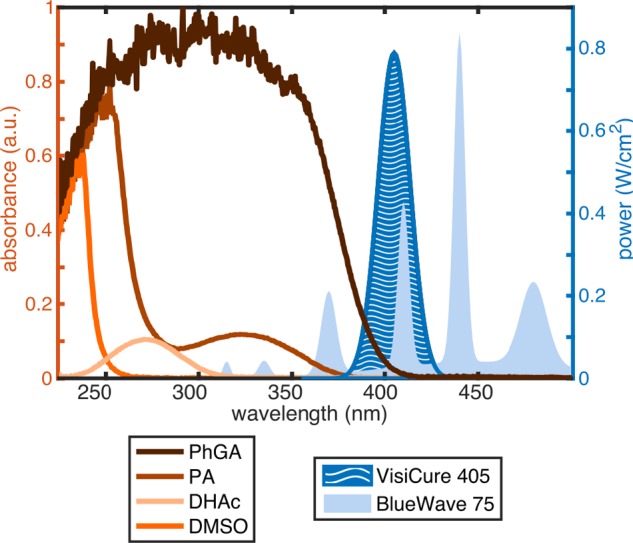
Figure 1
Figure 1
UV–vis absorption spectra (left axis) and light source power distributions (right axis). Power profiles were provided by the manufacturer (Dymax Europe GmbH, Wiesbaden, Germany).
Figure 2
Figure 2
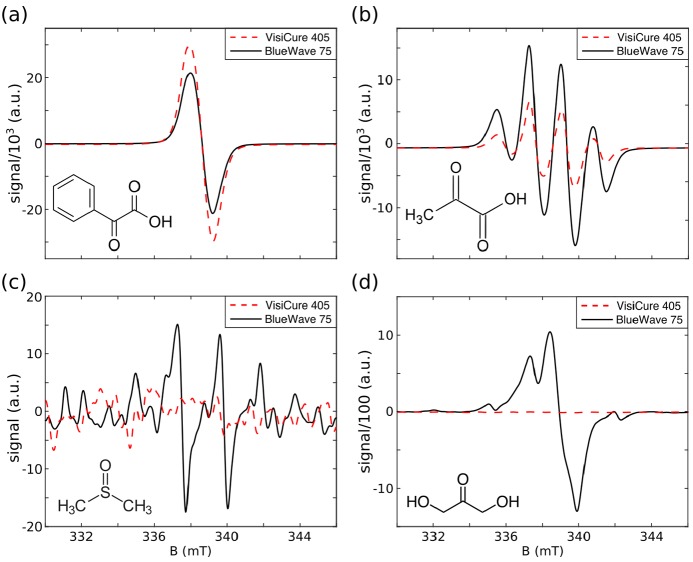
X-band ESR spectra of frozen droplets in LN2, photoirradiated with a broadband (BlueWave 75) or a narrowband (VisiCure 405) light source. (a) PhGA (7.1 M) in 1:1 water/glycerol (v/v). (b) PA (7.0 M) in 1:1 water/glycerol (v/v). (c) DMSO (neat). (d) DHAc (8.0 M) in 2H2O. The spectral structures in panels b and c are caused by the hyperfine coupling to the proton spins of the methyl groups. The units on the y axis are the same in all four plots.
Figure 3
Figure 3
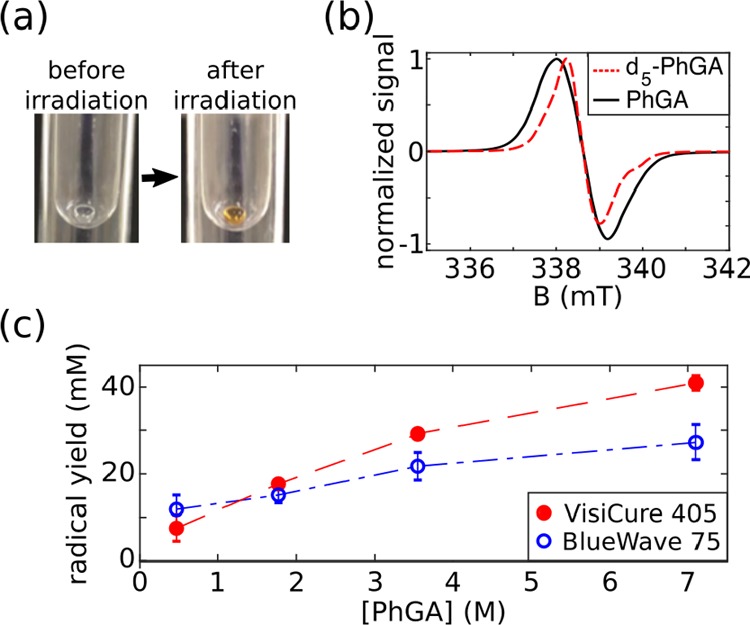
Photoirradiation of PhGA dissolved in 1:1 glycerol/water (v/v). (a) A 4 μL bead of PhGA in LN2 before and after photoirradiation. (b) ESR spectrum of unlabeled PhGA and d5-PhGA. (c) Maximum radical yield vs PhGA concentration using either the broadband (blue open circle) or the narrowband light source (red dots). The radical yield is reported as the mean ± standard deviation across three measurements.
Figure 4
Figure 4
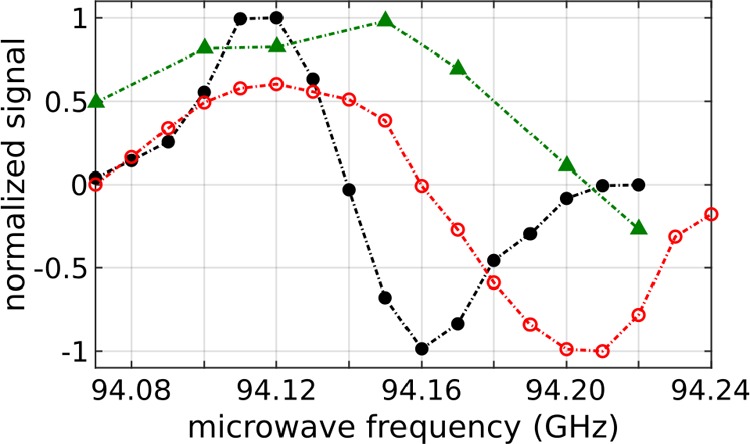
Solid-state microwave spectra at 3.35 T and 1.25 K: (open red circles) photoirradiated [2-13C]DHAc solution (8 M) in H2O doped with 1 M PhGA (18 mM radical); (black dots) [2-13C]DHAc solution (8 M) in H2O/DMSO (v/v) doped with 21 mM OX063; (green triangles) photoirradiated [1-13C]PA solution (7 M) in H2O/glycerol (65 mM radical).
Figure 5
Figure 5
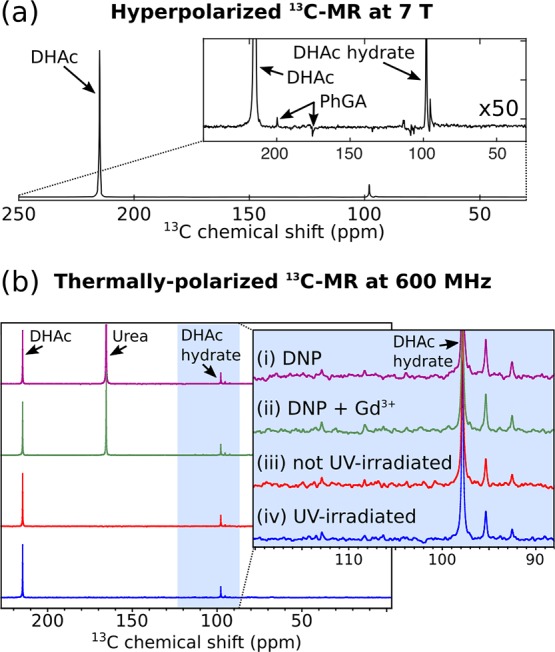
(a) Representative 13C MR spectrum (sum of 180 spectra) of a hyperpolarized solution containing 40 mM [2-13C]DHAc, 5 mM PhGA, and 6 μM Gd3+ in PBS. The MR acquisition started 16 s after the beginning of the dissolution process with a repetition time of 1 s and a nominal flip angle of 9°. (b) 13C MR spectra of thermally polarized solutions at 300 K and 14.1 T. All samples contained [2-13C]DHAc (40 mM-70 mM) and PhGA (4.5–8.0 mM) in PBS with 10% 2H2O. [13C]urea was added to samples i and ii after dissolution as a reference. These samples were made from frozen beads of 8 M [2-13C]DHAc and 1 M PhGA in water. (i) Frozen beads had been irradiated using a narrowband light source (VisiCure 405 nm) for 200 s and dissolution DNP performed on them. (ii) 1.2 mM Gd3+ had been added to the sample prior to photoirradiation and dissolution DNP. (iii) The frozen beads were dissolved in PBS without photoirradiation or DNP. (iv) The frozen beads were irradiated for 200 s and melted in PBS, but they did not undergo dissolution DNP.
Figure 6
Figure 6
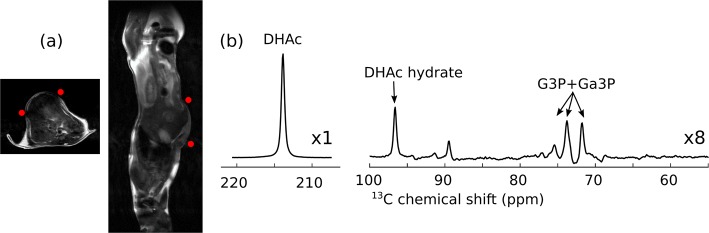
(a) Axial and sagittal T2-weighted images through the mouse with approximate position of the surface coil. (Red dots represent the cross sections of the coil.) (b) 13C MR spectrum acquired in vivo at 7 T following the intravenous injection of 400 μL of a hyperpolarized solution into a mouse. The solution was composed of 40 mM [2-13C]DHAc, 5 mM PhGA, and 6 μM Gd3+ in PBS. The previously reported resonance detected at ∼89 ppm has not been assigned. DHAc region: sum of 40 spectra. Region with the metabolic products of DHAc and DHAc hydrate: sum of the first 70 spectra.

References

    1. Ardenkjaer-Larsen J. H.; Fridlund B.; Gram A.; Hansson G.; Hansson L.; Lerche M. H.; Servin R.; Thaning M.; Golman K. Increase in Signal-to-Noise Ratio of > 10,000 Times in Liquid-State NMR. Proc. Natl. Acad. Sci. U. S. A. 2003, 100 (18), 10158–10163. 10.1073/pnas.1733835100. - DOI - PMC - PubMed
    1. Lee Y.; Heo G. S.; Zeng H.; Wooley K. L.; Hilty C. Detection of Living Anionic Species in Polymerization Reactions Using Hyperpolarized NMR. J. Am. Chem. Soc. 2013, 135 (12), 4636–4639. 10.1021/ja4001008. - DOI - PubMed
    1. Marco-Rius I.; Comment A. In Vivo Hyperpolarized 13C MRS and MRI Applications. In Encyclopedia of Magnetic Resonance; Harris R. K., Wasylishen R. L., Eds.; John Wiley & Sons, Ltd: Chichester, U.K., 2018.
    1. Lumata L.; Ratnakar S. J.; Jindal A.; Merritt M.; Comment A.; Malloy C.; Sherry A. D.; Kovacs Z. BDPA: An Efficient Polarizing Agent for Fast Dissolution Dynamic Nuclear Polarization NMR Spectroscopy. Chem. - Eur. J. 2011, 17 (39), 10825–10827. 10.1002/chem.201102037. - DOI - PMC - PubMed
    1. Nelson S. J.; Kurhanewicz J.; Vigneron D. B.; Larson P. E. Z.; Harzstark A. L.; Ferrone M.; van Criekinge M.; Chang J. W.; Bok R.; Park I.; Reed G.; Carvajal L.; Small E. J.; Munster P.; Weinberg V. K.; Ardenkjaer-Larsen J. H.; Chen A. P.; Hurd R. E.; Odegardstuen L.-I.; Robb F. J.; Tropp J.; Murray J. A. Metabolic Imaging of Patients with Prostate Cancer Using Hyperpolarized [1-13C]Pyruvate. Sci. Transl. Med. 2013, 5 (198), 198ra108. 10.1126/scitranslmed.3006070. - DOI - PMC - PubMed

Publication types