


Role of the 12-lipoxygenase pathway in diabetes pathogenesis and complications
- PMID: 30347209
- PMCID: PMC6397662
- DOI: 10.1016/j.pharmthera.2018.10.010
Role of the 12-lipoxygenase pathway in diabetes pathogenesis and complications
Abstract
12-lipoxygenase (12-LOX) is one of several enzyme isoforms responsible for the metabolism of arachidonic acid and other poly-unsaturated fatty acids to both pro- and anti-inflammatory lipid mediators. Mounting evidence has shown that 12-LOX plays a critical role in the modulation of inflammation at multiple checkpoints during diabetes development. Due to this, interventions to limit pro-inflammatory 12-LOX metabolites either by isoform-specific 12-LOX inhibition, or by providing specific fatty acid substrates via dietary intervention, has the potential to significantly and positively impact health outcomes of patients living with both type 1 and type 2 diabetes. To date, the development of truly specific and efficacious inhibitors has been hampered by homology of LOX family members; however, improvements in high throughput screening have improved the inhibitor landscape. Here, we describe the function and role of human 12-LOX, and mouse 12-LOX and 12/15-LOX, in the development of diabetes and diabetes-related complications, and describe promise in the development of strategies to limit pro-inflammatory metabolites, primarily via new small molecule 12-LOX inhibitors.
Keywords: Inflammation; Lipoxygenase; Lipoxygenase inhibitors; Type 1 diabetes; Type 2 diabetes-related complications.
Copyright © 2018 Elsevier Inc. All rights reserved.
Conflict of interest statement
Conflict of Interest Statement
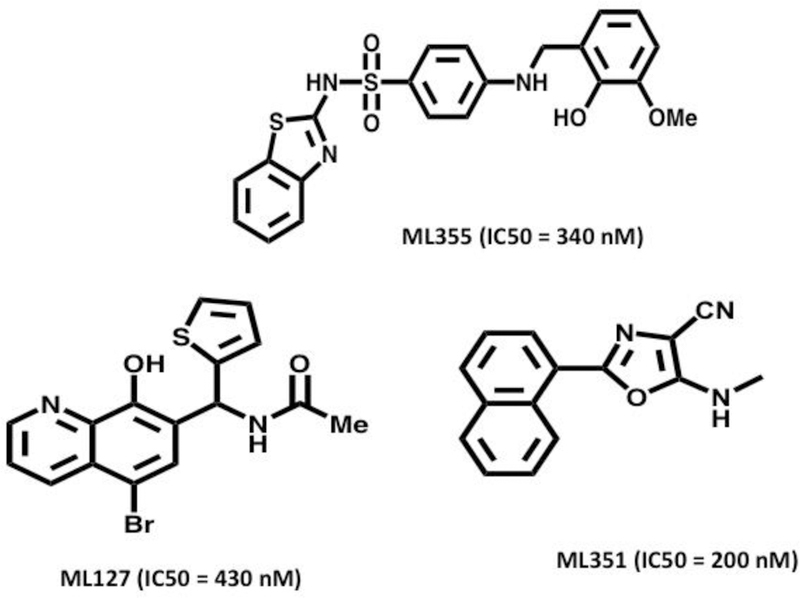
Patents have been filed for ML355 and ML127 by JLN, DTF, TH
Figures
References
-
- Aramaki Y, Yotsumoto S, Watanabe H & Tsuchiya S (2002). NADPH-oxidase may contribute to IL-12 production in macrophages stimulated with CpG phosphorothioate oligodeoxynucleotides. Biological & Pharmaceutical Bulletin, 25, 351–355. - PubMed
-
- Barquissau V, Ghandour RA, Ailhaud G, Klingenspor M, Langin D, Amri EZ et al. (2017). Control of adipogenesis by oxylipins, GPCRs and PPARs. Biochimie, 136, 3–11. - PubMed
