Review
. 2019;11(3):280-288.
doi: 10.1159/000492680. Epub 2018 Oct 22.

Biofilm-Leukocyte Cross-Talk: Impact on Immune Polarization and Immunometabolism

Affiliations
Review

Biofilm-Leukocyte Cross-Talk: Impact on Immune Polarization and Immunometabolism

Kelsey J Yamada et al. J Innate Immun. 2019.

Abstract

Biofilms are bacterial communities contained within an extracellular matrix, which can colonize both native tissues and artificial surfaces. In particular, indwelling medical devices and prosthetic implants are targets for biofilm formation because they facilitate bacterial attachment via host proteins that coat the foreign body. Biofilm infections are particularly challenging to treat, since they are not readily cleared by antibiotics, require invasive procedures to eradicate, and are prone to recurrence. It has been demonstrated that biofilm-derived products can actively suppress proinflammatory immune responses, as evident by the recruitment of myeloid-derived suppressor cells and macrophage (MФ) polarization towards an anti-inflammatory state. Recent studies have shown that alterations in leukocyte metabolism shape their inflammatory phenotype and function. For example, anti-inflammatory MФs are biased towards oxidative phosphorylation whereas proinflammatory MФs favor aerobic glycolysis. This review will compare the immune responses elicited by planktonic and biofilm bacterial infections, with a discussion on the metabolic properties of MФs and neutrophils in response to both bacterial growth conditions.

Keywords: Bacterial biofilm; Immunometabolism; Innate immunity; Macrophage; Myeloid-derived suppressor cell; Neutrophil.


Figures

Fig. 1
Fig. 1
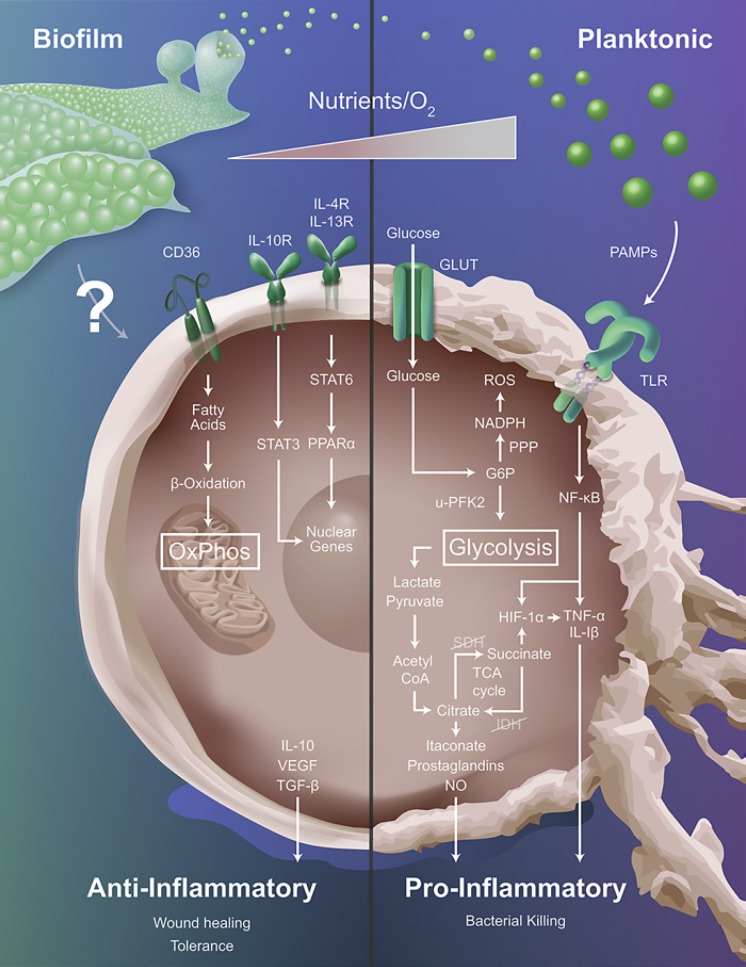
Metabolic profiles influence macrophage inflammatory status. Macrophages respond to planktonic infections via sensing of pathogen-associated molecular patterns (PAMPs) through Toll-like receptor (TLR) engagement. This favors aerobic glycolysis to provide TCA cycle intermediates for anabolic processes required for proinflammatory effector mechanisms. In contrast, biofilm infections polarize macrophages towards an anti-inflammatory state, and the biofilm-derived signals that drive this process are largely unknown (indicated by question mark). Since anti-inflammatory macrophages are typified by oxidative phosphorylation (OxPhos) it is predicted that biofilm infections will bias cells towards this metabolic pathway, and several receptors associated with anti-inflammatory cytokines might be involved (i.e., CD36, IL-10R, IL-4R, and IL-13R). The metabolic gradients present in the tissue microenvironment (i.e., nutrients, oxygen) also influence the pro- versus anti-inflammatory profiles of macrophages that are intimately linked to their metabolic state. G6P, glucose-6-phosphate; GLUT, glucose transporter; HIF-1α, hypoxia inducible factor-1α; IDH, isocitrate dehydrogenase; IL-1β, interleukin-1β; IL-4R, interleukin-4 receptor; IL-10, interleukin-10; IL-10R, interleukin-10 receptor; IL-13R, interleukin-13 receptor; iNOS, inducible nitric oxide synthase; NADPH, nicotinamide adenine dinucleotide phosphate; NF-κB, nuclear factor κB; NO, nitric oxide; PPARα, peroxisome proliferator-activated receptor-α; PPP, pentose phosphate pathway; ROS, reactive oxygen species; SDH, succinate dehydrogenase; STAT3, signal transducer and activator of transcription 3; STAT6, signal transducer and activator of transcription 6; TCA, tricarboxylic acid cycle; TGF-β, transforming growth factor-β; TNF-α, tumor necrosis factor-α; u-PFK2, ubiquitous 6-phosphofructo-2-kinase/fructose bisphosphatase-2; VEGF, vascular endothelial growth factor.

References

    1. Flemming HC, Wingender J, Szewzyk U, Steinberg P, Rice SA, Kjelleberg S. Biofilms: an emergent form of bacterial life. Nat Rev Microbiol. 2016 Aug;14((9)):563–75. - PubMed
    1. Gries CM, Kielian T. Staphylococcal Biofilms and Immune Polarization During Prosthetic Joint Infection. J Am Acad Orthop Surg. 2017 Feb;25(Suppl 1):S20–4. - PMC - PubMed
    1. Mulcahy LR, Isabella VM, Lewis K. Pseudomonas aeruginosa biofilms in disease. Microb Ecol. 2014 Jul;68((1)):1–12. - PMC - PubMed
    1. Stewart PS, Franklin MJ. Physiological heterogeneity in biofilms. Nat Rev Microbiol. 2008 Mar;6((3)):199–210. - PubMed
    1. Archer NK, Mazaitis MJ, Costerton JW, Leid JG, Powers ME, Shirtliff ME. Staphylococcus aureus biofilms: properties, regulation, and roles in human disease. Virulence. 2011 Sep-Oct;2((5)):445–59. - PMC - PubMed

Publication types

Substances