


Global inequities in dietary calcium intake during pregnancy: a systematic review and meta-analysis
- PMID: 30347499
- PMCID: PMC6518872
- DOI: 10.1111/1471-0528.15512
Global inequities in dietary calcium intake during pregnancy: a systematic review and meta-analysis
Abstract
Background: Evidence shows that adequate calcium intake during pregnancy reduces the risk of hypertensive disorders of pregnancy. In most low- and middle-income countries (LMICs) the daily calcium intake is well below recommendations. Mapping calcium intake during pregnancy worldwide and identifying populations with low calcium intake will provide the evidence base for more targeted actions to improve calcium intake.
Objective: To assess dietary calcium intake during pregnancy worldwide.
Search strategy: MEDLINE and EMBASE (from July 2004 to November 2017).
Selection criteria: Cross-sectional, cohort, and intervention studies reporting calcium intake during pregnancy.
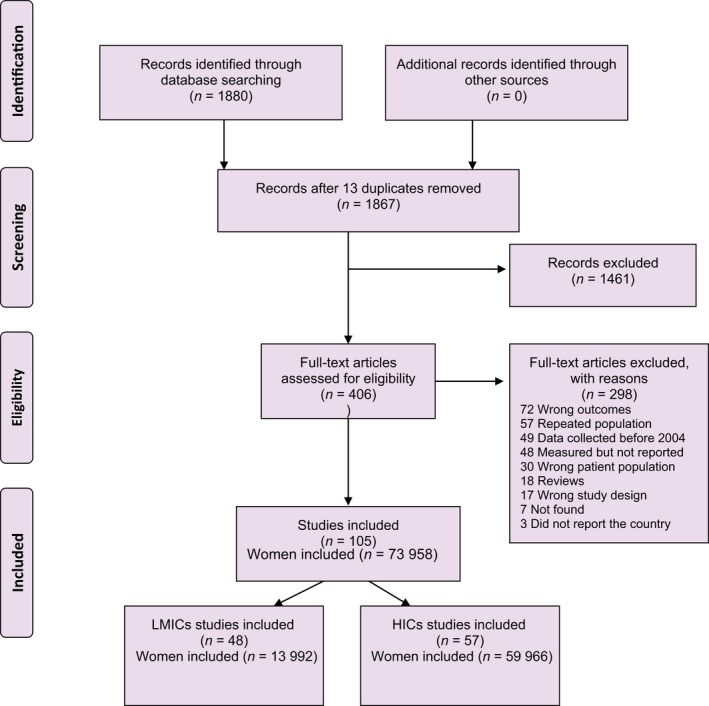
Data collection and analysis: Five reviewers working in pairs independently performed screening, extraction, and quality assessment. We reported summary measures of calcium intake and calculated the weighted arithmetic mean for high-income countries (HICs) and LMICs independently, and for geographic regions, among studies reporting country of recruitment, mean intake, and total number of participants. When available, inadequate intakes were reported.
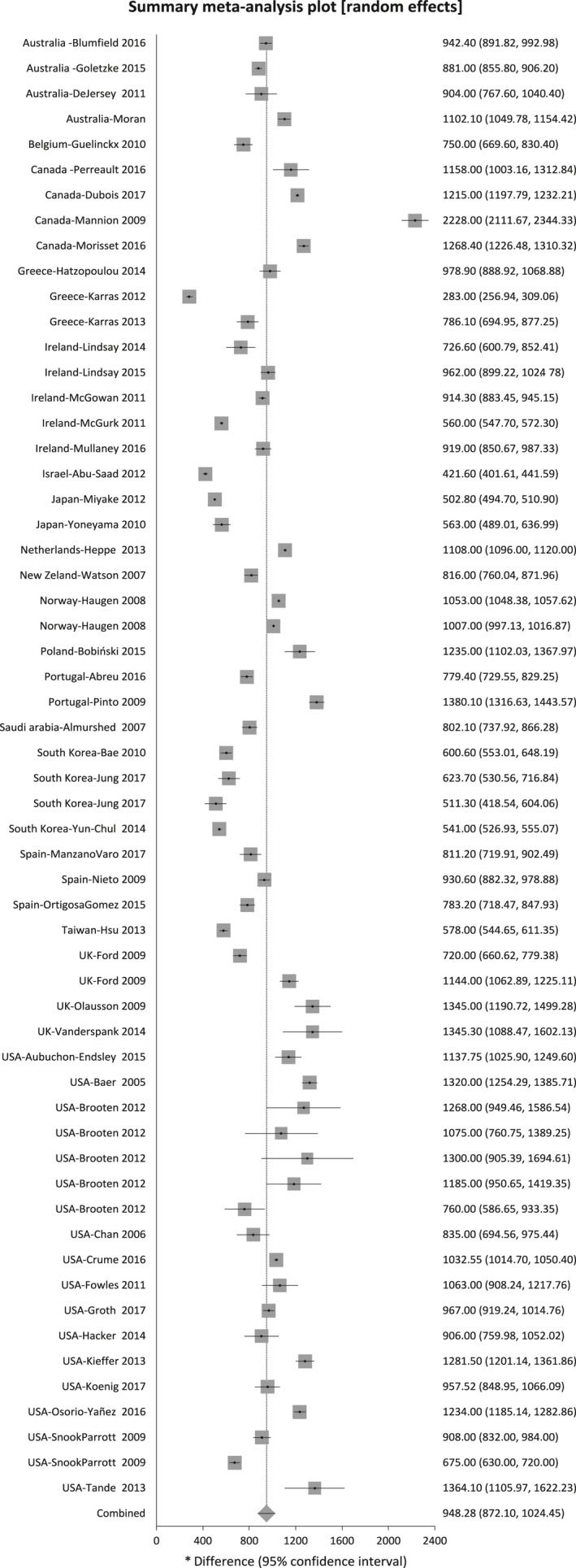
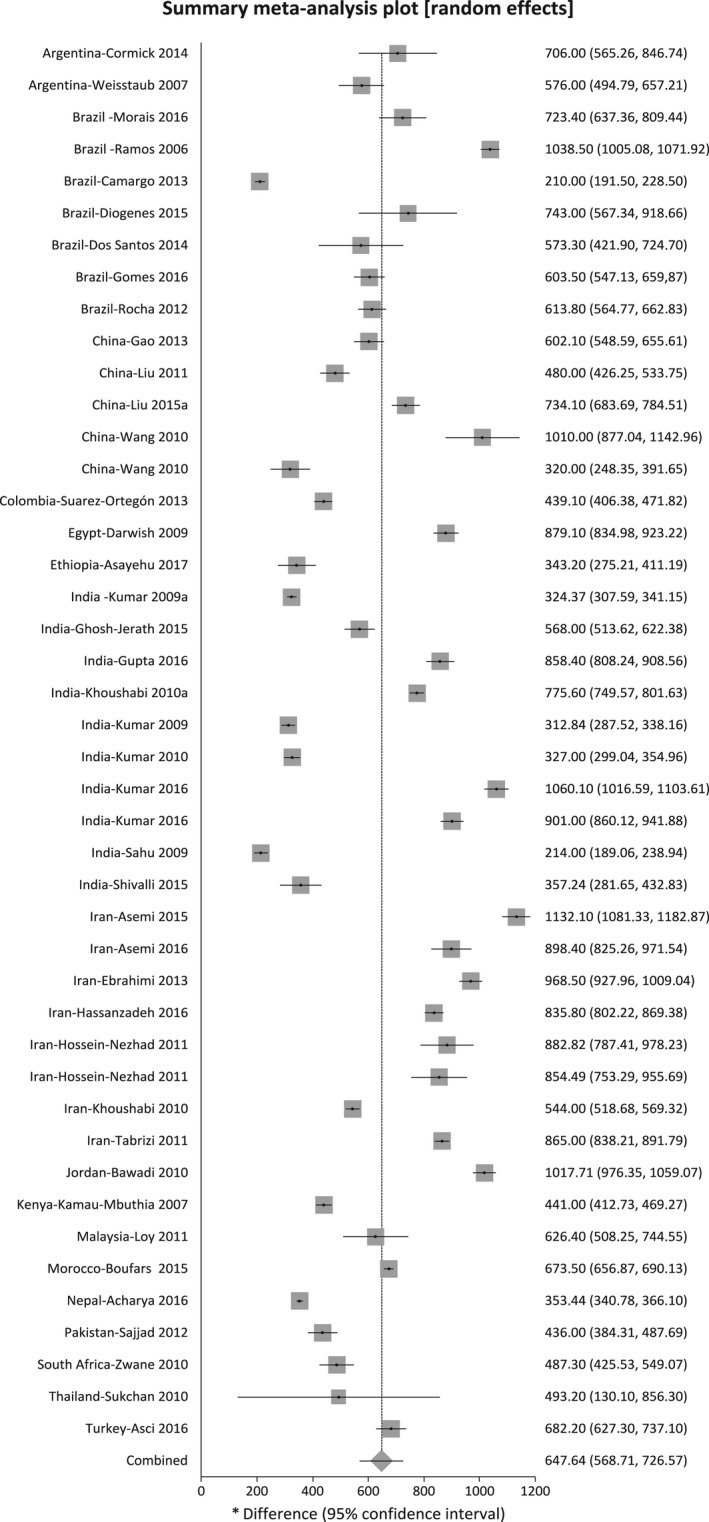
Main results: From 1880 citations 105 works met the inclusion criteria, providing data for 73 958 women in 37 countries. The mean calcium intake was 948.3 mg/day (95% CI 872.1-1024.4 mg/day) for HICs and 647.6 mg/day (95% CI 568.7-726.5 mg/day) for LMICs. Calcium intakes below 800 mg/day were reported in five (29%) countries from HICs and in 14 (82%) countries from LMICs.
Conclusion: These results are consistent with a lack of improvement in calcium dietary intake during pregnancy and confirm the gap between HICs and LMICs, with alarmingly low intakes recorded for pregnant women in LMICs. From the public health perspective, in the absence of specific local data, calcium supplementation of pregnant women in these countries should be universal.
Tweetable abstract: Despite dietary recommendations, women in LMICs face pregnancy with diets low in calcium.
Keywords: Calcium; dietary; high-income countries; hypertension; low- and middle-income countries; pre-eclampsia; pregnancy; systematic review.
© 2018 The Authors. BJOG: An International Journal of Obstetrics and Gynaecology published by John Wiley & Sons Ltd on behalf of Royal College of Obstetricians and Gynaecologists.
Figures
Comment in
-
How to close the calcium gap.BJOG. 2019 Mar;126(4):457. doi: 10.1111/1471-0528.15543. Epub 2018 Nov 29. BJOG. 2019. PMID: 30461173 No abstract available.
-
Re: Global inequities in dietary calcium intake during pregnancy: a systematic review and meta-analysis.BJOG. 2019 Sep;126(10):1290-1291. doi: 10.1111/1471-0528.15834. Epub 2019 Jul 3. BJOG. 2019. PMID: 31270931 No abstract available.
References
-
- Kassebaum NJ, Bertozzi‐Villa A, Coggeshall MS, Shackelford KA, Steiner C, Heuton KR, et al. Global, regional, and national levels and causes of maternal mortality during 1990‐2013: a systematic analysis for the Global Burden of Disease Study 2013. Lancet (London, England) 2014;384:980–1004. - PMC - PubMed
-
- Hofmeyr GJ, Lawrie TA, Atallah AN, Duley L, Torloni MR. Calcium supplementation during pregnancy for preventing hypertensive disorders and related problems. Cochrane Database Syst Rev 2014;(6):CD001059. - PubMed
-
- Heaney RP. Calcium intake and disease prevention. Vol. 50, Arquivos Brasileiros de Endocrinologia & Metabologia. scielo; 2006. p. 685–93. - PubMed
-
- Ross AC, Taylor CL, Yaktine AL. Dietary Reference Intakes for Calcium and Vitamin D. Washington, DC: US National Academies Press; 2010. - PubMed
Publication types
MeSH terms
Substances
Grants and funding
LinkOut - more resources
Full Text Sources
Medical
Molecular Biology Databases
Miscellaneous
