Fluorescence Guided Surgery with 5-Aminolevulinic Acid for Resection of Spinal Cord Ependymomas
- PMID: 30347527
- PMCID: PMC6365784
- DOI: 10.31616/asj.2018.0165
Fluorescence Guided Surgery with 5-Aminolevulinic Acid for Resection of Spinal Cord Ependymomas
Abstract
Study design: A retrospective study.
Purpose: We report our experience with 5-aminolevulinic acid (5-ALA)-assisted resection of spinal cord ependymomas in adults.
Overview of literature: Ependymoma is the most frequent primary spinal cord tumor in adults. Surgery is the treatment of choice in most cases. However, while complete resection is achieved in approximately 80% of cases, clinical improvement is achieved in 15% only. Five-ALA fluorescence-guided surgery seems to be useful for this tumor type.
Methods: We studied 14 patients undergoing 5-ALA fluorescence-guided surgery for spinal cord ependymomas in our service. The modified McCormick classification was used to determine clinical status and the degree of resection was assessed with magnetic resonance imaging.
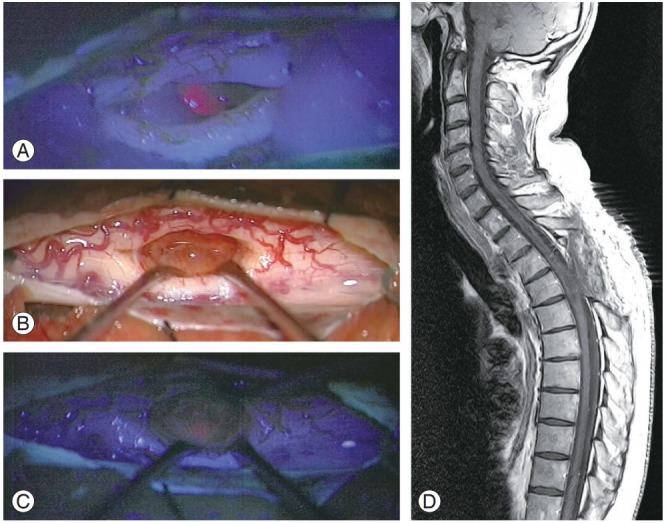
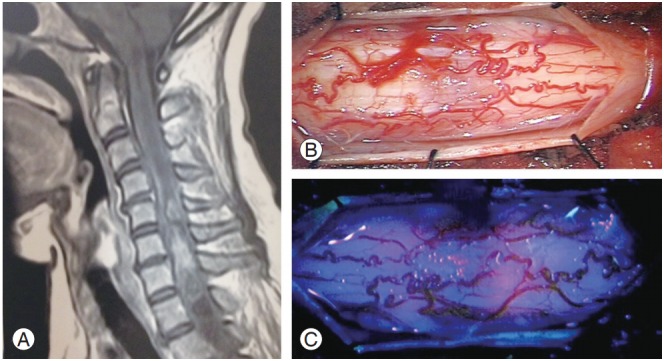
Results: Of the 14 patients, the tumor showed an intense emission of fluorescence in 12 and the fluorescence was weak and nonuniform in two. Complete resection was achieved in 11 cases. According to the McCormick classification, 10 patients improved, two remained the same, and two deteriorated.
Conclusions: Our results confirm that 5-ALA fluorescence-guided resection is useful in spinal cord ependymoma resection. Although the rate of complete resections is similar to that in published series without 5-ALA, clinical results are better when using 5-ALA with a lower percentage of clinical deterioration.
Keywords: Aminolevulinic acid; Ependymoma; Fluorescence guided surgery; Spinal cord.
Conflict of interest statement
No potential conflict of interest relevant to this article was reported.
Figures
References
-
- Louis DN, Ohgaki H, Wiestler OD, Cavenee WK. WHO classification of tumours of the central nervous system. 4th ed. Lyon: International Agency for Research on Cancer Press; 2007.
-
- Miller DC. Surgical pathology of intramedullary spinal cord neoplasms. J Neurooncol. 2000;47:189–94. - PubMed
-
- Samii M, Klekamp J. Surgical results of 100 intramedullary tumors in relation to accompanying syringomyelia. Neurosurgery. 1994;35:865–73. - PubMed
-
- Stummer W, Pichlmeier U, Meinel T, et al. Fluorescence-guided surgery with 5-aminolevulinic acid for resection of malignant glioma: a randomised controlled multicentre phase III trial. Lancet Oncol. 2006;7:392–401. - PubMed
-
- Arai T, Tani S, Isoshima A, et al. Intraoperative photodynamic diagnosis for spinal ependymoma using 5-aminolevulinic acid: technical note. No Shinkei Geka. 2006;34:811–7. - PubMed
LinkOut - more resources
Full Text Sources
Research Materials