


Disparities in Unintentional Occupational Injury Mortality between High-Income Countries and Low- and Middle-Income Countries: 1990⁻2016
- PMID: 30347672
- PMCID: PMC6210857
- DOI: 10.3390/ijerph15102296
Disparities in Unintentional Occupational Injury Mortality between High-Income Countries and Low- and Middle-Income Countries: 1990⁻2016
Abstract
Objective: Using estimates from the Global Burden of Disease (GBD) study, we examined differences in unintentional occupational injury mortality rates from 1990 to 2016 between high-income countries (HICs) and low- and middle-income countries (LMICs).
Methods: Unintentional occupational injury mortality rates were obtained through the GBD online visualization tool. We quantified mortality changes over time for common external causes of injury for ages 15⁻49 years and 50⁻69 years separately in HICs and LMICs using negative binomial regression models.
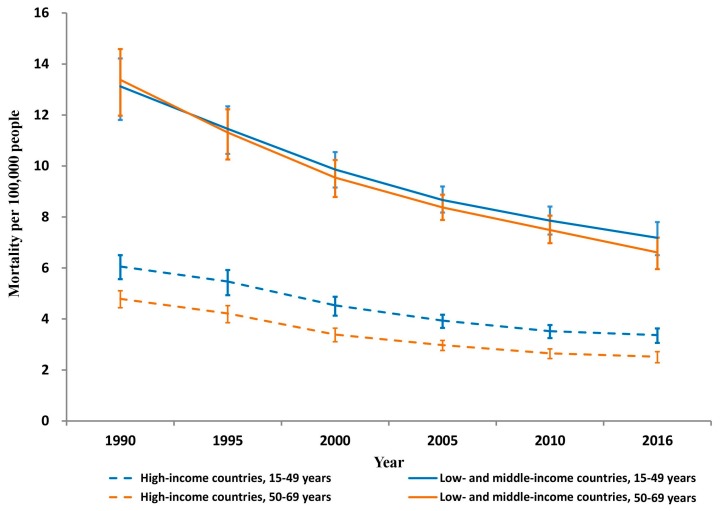
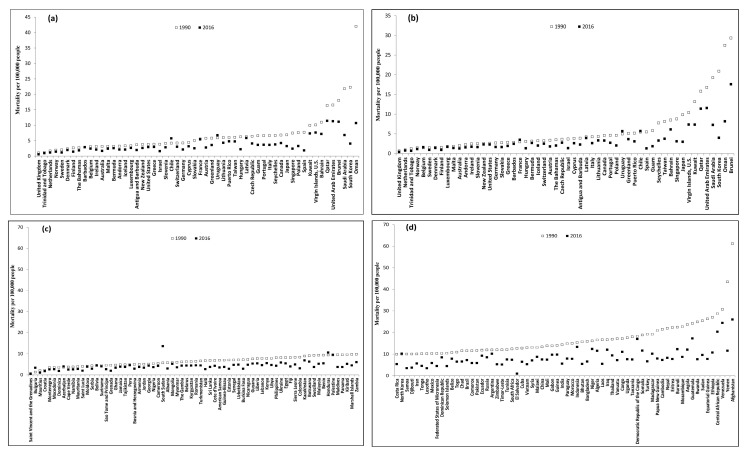
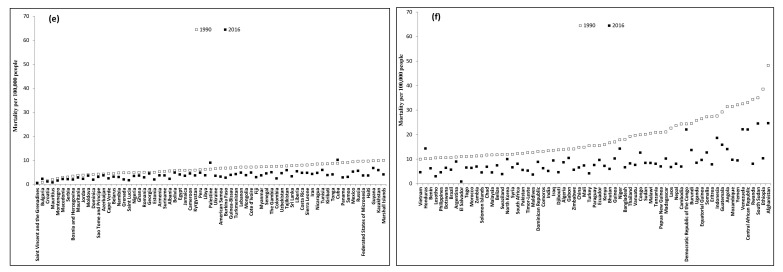
Results: In 2016, there were 24,396 and 303,999 unintentional occupational injury deaths among individuals aged 15 to 69 years in HICs and LMICs, respectively, corresponding to 3.1 and 7.0 per 100,000 people. Between 1990 and 2016, unintentional occupational injury mortality for people aged 15⁻69 years dropped 46% (from 5.7 to 3.1 per 100,000 people) in HICs and 42% in LMICs (from 13.2 to 7.0 per 100,000 people). Sustained and large disparities existed between HICs and LMICs for both sexes and both age groups during 1990⁻2016 (mortality rate ratio: 2.2⁻2.4). All unintentional occupational injury causes of death displayed significant reduction with one exception (ages 15⁻49 years in HICs). Country-specific analysis revealed large variations in unintentional occupational injury mortality and changes in occupational injury mortality between 1990 and 2016.
Conclusions: Despite substantial decreases in mortality between 1990 and 2016 for both HICs and LMICs, a large disparity continues to exist between HICs and LMICs. Multifaceted efforts are needed to reduce the disparity.
Keywords: disparity; occupational injury; unintentional.
Conflict of interest statement
The authors declare no conflict of interest.
Figures

References
-
- United Nations Transforming Our World: The 2030 Agenda for Sustainable Development. [(accessed on 16 October 2018)]; Available online: https://sustainabledevelopment.un.org/post2015/transformingourworld.
-
- International Labour Office (ILO) Independent Evaluation of the Ilo’s Strategy on Occupational Safety and Health: Workers and Enterprises Benefit from Improved Safety and Health Conditions at Work. International Labour Office; Geneva, Switzerland: 2013.
-
- Bureau of Labor Statistics (BLS) Census of Fatal Occupational Injuries Charts, 1992–2016. Washington, DC: USDOL Bureau of Labor Statistics (Bls) [(accessed on 1 March 2018)]; Available online: https://www.bls.gov/iif/oshwc/cfoi/cfch0015.pdf.
-
- Ministry of Employment and Labor Major Statistics. [(accessed on 1 March 2018)]; Available online: http://www.moel.go.kr/english/pas/pasMajor.jsp.
MeSH terms
LinkOut - more resources
Full Text Sources
Medical
